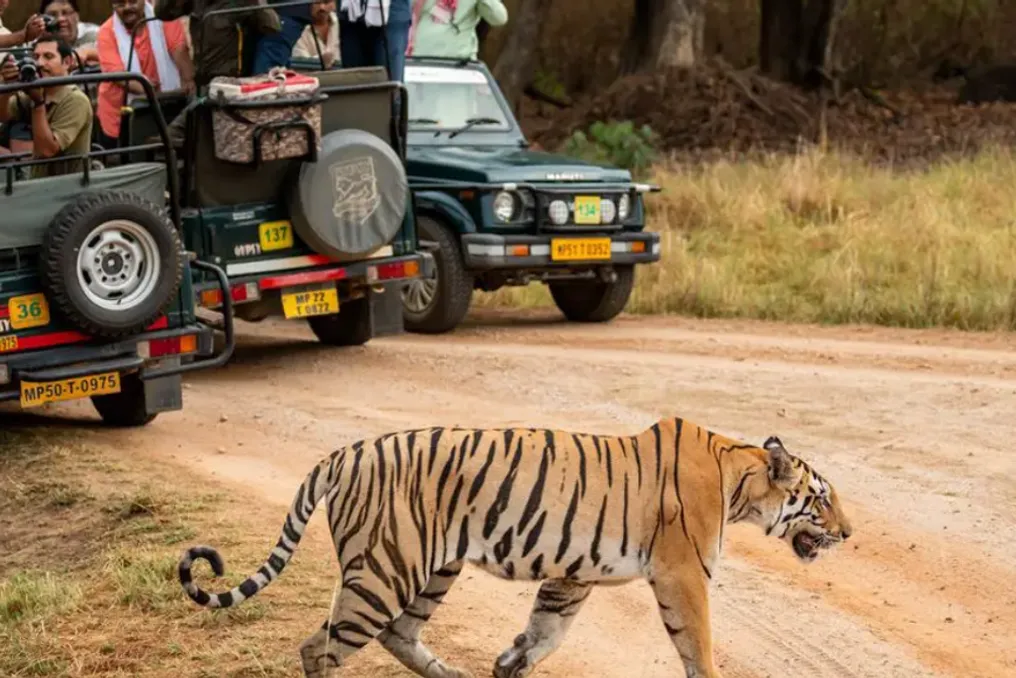
With the approach of winter, national parks, reserves, and protected areas in India are expected to see a new influx of visitors. Many hope to spot a tiger crossing the road or an elephant emerging from the forest. However, safari differs from visiting a zoo because the animals are wild, the landscape is unpredictable, and many rules exist for the safety of tourists and the well-being of the animals.
Below are ten important points to remember before going on a winter safari.
How to prepare for the safari
Since early morning tours can be cold, especially in North and Central India where temperatures rise significantly later in the day, it is recommended to dress in layers, using comfortable trousers, closed shoes, and a hat. Muted colors such as beige, grey, brown, and olive are practical. Bright or reflective clothing, as well as strong perfumes and deodorants, should be avoided.
It is important to bring binoculars, not just a camera. Binoculars allow observation of birds, reptiles, and distant mammals without requiring the driver to get closer. They also encourage visitors to pay attention not only to large mammals but also to movement in the treetops, tracks on the path, or bird reactions to a warning signal.
Silence must be maintained. Shouting, listening to music, or imitating animal sounds can disturb wildlife and interfere with observations by guides and naturalists. The National Tiger Conservation Authority guidelines require tourists to remain silent when animals are near the vehicle to avoid provocation.
Rules for interacting with animals
It is strictly forbidden to ask the driver to chase an animal. If a tiger crosses the road, this is no reason to speed up after it. In December 2025, tourists in the Pilibhit Tiger Reserve exited their safari vehicle after spotting a tiger in the main forest area. In another incident that same day, two safari vehicles allegedly surrounded a tiger near the Siphon Canal bridge. As noted in an India Wildlife News report, there were 'Twenty nomads. One tiger. No room to maneuver.'
In the Patu zone of Corbett Reserve, a situation recently occurred where ecotourism led to self-destruction—a traffic jam of vehicle exhaust fumes formed in the middle of a tiger reserve, where the animal was the least noticeable object in the forest. In January 2026, authorities fined operators of three vehicles 25,000 rupees each and announced that these vehicles would not be registered for future safaris. Furthermore, officials warned that attempting to drive a tiger between vehicles could provoke an attack on tourists.
One of the most important rules is to stay inside the vehicle. In February 2024, two tourists in the Bandipur landscape in Karnataka got out of the car to photograph an elephant. The elephant charged at them, and one man fell while trying to escape. As a result, one tourist was fined 25,000 rupees. This incident serves as a reminder that an animal that appears calm can react within seconds if it feels threatened or crowded. You must remain in the vehicle unless you are in a designated area and have been informed that exiting is safe.
Never feed, bait, or attract wild animals. Do not offer food to an animal or try to attract its attention with whistles, shouts, gestures, or other tricks. Feeding can alter natural behavior and cause wild animals to associate people or vehicles with food. Deliberately attracting an animal also increases the likelihood of close contact.
Photography should not be the priority. Keep your camera flash off and do not ask the driver to constantly change the vehicle's position for the perfect shot. This 'safari jam' situation demonstrates a critical problem in ecotourism: when vehicles pressure the tiger's path, its natural movement is disrupted, forcing the animal into a 'fight or flight' state. Tiger vocalization is a clear sign of territorial stress, and congestion creates physical pressure.
Other rules to observe include: do not block the view of another vehicle, do not create crowds around an animal, and do not encourage other tourists to make noise for a reaction. Photography should never be more important than the animal itself.
Tourists should carry a small reusable bag for their own trash. Snacks can only be consumed in permitted areas and should never be offered to wildlife. It is important to leave the forest in the same condition as you found it: take all your trash with you, do not pluck flowers, plants, feathers, or other natural items, and do not carve names into trees or leave marks on stones. What seems like a harmless souvenir to a visitor can be part of the forest ecosystem.
The main rule is to adjust expectations: the tiger may remain hidden. The main event might be a flock of birds, a warning signal, or fresh tracks on the path.
Recommendations of the National Tiger Conservation Authority
For visitors to tiger reserves, the tourism guidelines of the National Tiger Conservation Authority (NTCA) serve as a useful reference. According to these guidelines, visitors must not walk within the safari zone and must not exit the vehicle unless authorized staff directs them to do so. The guidelines also emphasize the need for regulating tourism and managing visitor pressure in tiger reserves. In 2020, NTCA issued a consultative statement calling for adherence to established tourist capacity; at the time, it also required a minimum distance of 500 meters between safari vehicles in tiger reserves. For tourists, the fundamental principle is to follow reserve rules, listen to the guide, and not view an encounter with wildlife as an invitation to approach.
3.