
Initial public offering of AceVector, the parent company of Snapdeal, to begin on September 25
Read more
YourStory [india, en]
yourstory.com

Initial public offering of AceVector, the parent company of Snapdeal, to begin on September 25

AceVector, the parent company of the e-commerce platform Snapdeal, plans to conduct an Initial Public Offering (IPO) on September 25. This offering will be a combination of a new share issuance and a sale offering as the company aims to raise a total of 420 crore rupees.

In its Red Herring Prospectus (RHP), AceVector stated that it has set the price range for the IPO at 30–32 rupees, with the company valuation estimated at approximately 1,750 crore rupees. The company intends to raise 287 crore rupees through a new share issuance and 133 crore rupees through a sale offering, issuing 4.16 crore shares.

The IPO will open on September 25 and close on September 29, with a likely listing on October 5. Sellers of the shares will include Softbank and Nexus Venture Partners.

The planned fundraising amount in the IPO turned out to be lower than the initial target. Previously, AceVector aimed to raise 300 crore rupees from a new share issuance and 6.38 crore shares from a sale offering.

According to the prospectus, the funds from the IPO will be directed towards marketing, business promotion, covering technology infrastructure costs, and leveraging opportunities for inorganic growth.

AceVector reported revenue of 510.38 crore rupees for the fiscal year 2026 compared to 395.02 crore rupees in 2025, demonstrating a 29% growth. Meanwhile, the company's net loss for the 2026 fiscal year reached 46 crore rupees, which is a decrease of 64% compared to the 2025 fiscal year.

Snapdeal operates in the value e-commerce segment, focusing more on second-tier and more remote regions. In addition to Snapdeal, other business areas of AceVector include the SaaS company Unicommerce and the consumer brands Stellaro Brands.

AceVector joins a number of Indian companies going public. Although the IPO market experienced a lull in the first half of this year, it began to pick up momentum in the second half, with many Indian startups either raising funds or undergoing the process of going public.
Similar stories

LIC and Norway's ADIA fund become anchors in the placement of NSE shares worth 6,746 crore rupees
Read more
business-standard.com

LIC and Norway's ADIA fund become anchors in the placement of NSE shares worth 6,746 crore rupees

Life Insurance Corporation of India (LIC), as well as Norway's Government Pension Fund Global, the Monetary Authority of Singapore, Abu Dhabi Investment Authority (ADIA), and Societe Generale were among the key participants that ensured the anchor placement of the National Stock Exchange of India (NSE) initial public offering.

The exchange approved the distribution of shares among 189 anchor investors on Wednesday. According to the disclosure, the board of directors allocated 377,937,399 equity shares to anchor investors at a price of 1,785 rupees per share, totaling 6,746.18 crore rupees.

LIC, being the largest shareholder of NSE, became the largest anchor investor, acquiring 2.24 million shares worth 400.3 crore rupees. This was followed by Societe Generale's offshore derivatives division with 1.77 million shares amounting to 316 crore rupees, and the Norway's Government Pension Fund with 1.4 million shares valued at 250 crore rupees.

Offshore investors accounted for 43 percent of the total anchor placement volume, investing 2,883 crore rupees. Additionally, the Monetary Authority of Singapore and ADIA's Monsoon fund acquired shares worth 200 crore rupees, while Fidelity Funds’ India Focus Fund invested 178.24 crore rupees.

Among the total anchor allocation, 29 domestic mutual funds—which applied through 98 schemes, including SBI, ICICI Prudential, HDFC, Nippon India, Kotak, and Axis funds—received 1.40 crore shares, constituting almost 37 percent of the anchor portfolio, and are valued at 2,494.99 crore rupees. Insurance companies and pension funds, such as SBI Life and HDFC Life, along with various NPS Trust schemes, acquired an additional 60.61 lakh shares worth 1,081.84 crore rupees.

Sources added that demand for shares within the anchor placement reached approximately 1.2 trillion rupees, nearly 20 times the size of the anchor portfolio itself. The NSE IPO, with a total volume of 22,560 crore rupees and including only the offer sale, is scheduled to begin subscription for the general public on Thursday, with listing expected next week. Shares are trading at a premium of about 9 percent in the grey market.

Positron AI raises $875 million to scale AI inference hardware
Read more
ventureburn.com

Positron AI raises $875 million to scale AI inference hardware

Positron AI has successfully raised $875 million in a Series C funding round, valuing the company at $5 billion. The company's core business involves developing hardware that makes the artificial intelligence inference process more energy-efficient and cost-effective.

The funding was secured in two stages: first, a Series C round of $375 million was closed, followed by a Series C-1 round of up to $500 million. The main round was led by NEA, Atreides Management, and Valor Equity Partners, with co-leads from Andra Capital and SemiAnalysis Capital participating. The second tranche was led by Jim Clark, founder of Silicon Graphics and Netscape, with participation from several institutional and strategic investors.

The capital raised will allow Positron to significantly expand its growing business in inference and add several experienced technology investors to its board of directors. Forest Basket from NEA and Gavin Baker from Atreides Management will join the board. Thomas Germoluk and Dylan Patel will also become directors.

As AI workloads increasingly shift towards inference, infrastructure is necessary for the continuous operation of models by every AI assistant, agent, and helper. Positron focuses on solving memory and power issues arising from this growth. The company's systems are designed with an emphasis on bandwidth and memory capacity, rather than raw computational power.

The company's next-generation systems utilize standard LPDDR5X memory, which reduces dependence on constrained high-performance memory supply chains. Positron claims its systems can achieve over 90% of available memory bandwidth.

Furthermore, the company focuses on high performance in tokens per dollar and tokens per watt metrics. Positron's architecture supports both air-cooled and liquid-cooled data centers, giving customers flexibility in deploying systems across various rack densities.

Positron already has clients using the first version of the Atlas system. Over 50 Atlas racks have been deployed in Oracle Cloud Infrastructure, where Parasail uses this power for its own inference services. Jump Trading and i3d.net are also production clients of Atlas.

The new funding will be directed towards developing the next generation of silicon chips. The Asimov chip is scheduled for fabrication using TSMC's N3P process by the end of 2026; TSMC describes N3P as an improved 3nm process. Production of Asimov is slated for the second half of 2027. Each Asimov chip will support between 288 GB and 2304 GB of memory, meeting the demands of increasingly complex AI inference workloads.

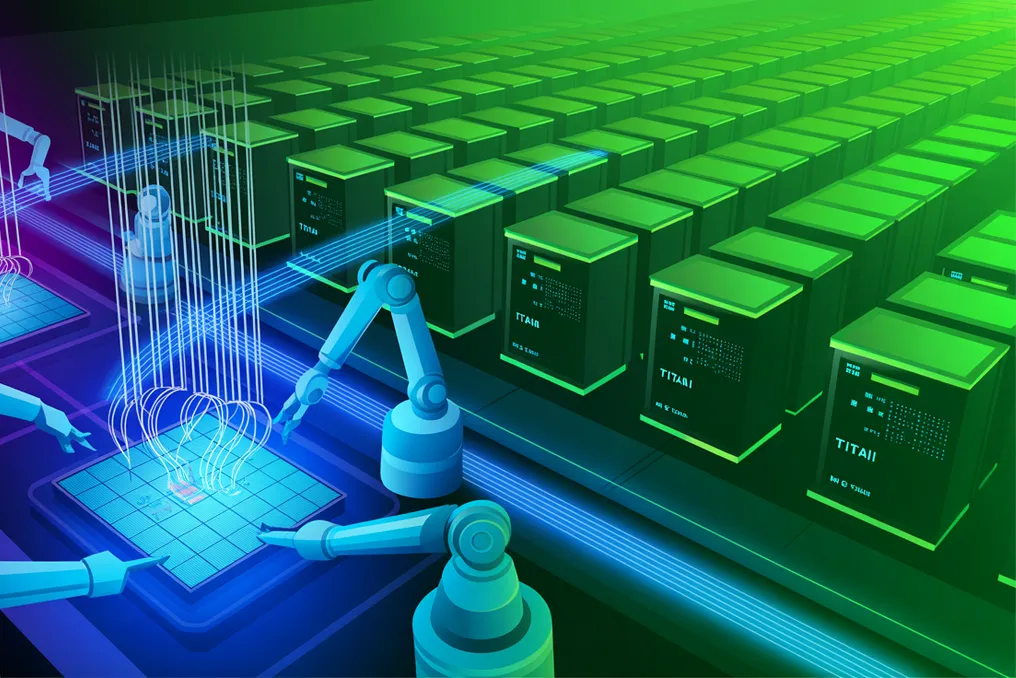
The Titan system will integrate four to eight Asimov chips into a single system and is designed to support models exceeding 16 trillion parameters. Titan will also target context windows exceeding 10 million tokens and can scale to thousands of nodes for larger deployments. Positron also plans to build a data center engineering facility with a capacity of over 2 MW and an emulation platform to support development, testing, and manufacturing readiness.

Positron intends to use the funds to secure LPDDR5X supply commitments, as well as to increase manufacturing capacity and system integration. Go-to-market operations will expand in parallel with production, helping the company meet the growing demand for inference infrastructure.

CEO Mitesh Agrawal noted that the Atlas deployments provided valuable customer insights that influenced the design of Asimov and Titan. The company is currently in a demanding execution phase, requiring it to complete silicon development while simultaneously scaling production and customer adoption.

Positron's strategy is focused on the economic efficiency of AI model operation. Its memory-centric architecture aims to reduce both energy consumption and infrastructure costs. The $5 billion valuation reflects investor confidence in the inference market.

Wave of IPOs expected in Indian stock market this week, attracting funds from 12 companies
Read more
www.aajtak.in

Wave of IPOs expected in Indian stock market this week, attracting funds from 12 companies

The Indian stock market is preparing for a significant surge in Initial Public Offerings (IPOs) this week. Between September 7 and 11, 12 companies are set to enter the market, planning to raise approximately 7,180 crore rupees from investors.

These IPOs are taking place at a time when major IPOs, such as NSE, are also anticipated later this month.

The total volume of these 12 IPOs amounts to approximately 7,179.84 crore rupees. Some companies will raise capital by issuing new shares, while others will allow existing investors to sell their stakes. Of the total issuance, about 2,814.10 crore rupees will be raised through fresh issues, and 4,365.74 crore rupees will come through an Offer For Sale (OFS).

The largest IPO this week is Rentomojo with a volume of 1,255.57 crore rupees, while the smallest will be Manika Plastic's offering at 125.50 crore rupees.

The companies entering the market this week represent various sectors. The IPO of Pranav Constructions will be available from September 7 to 9. Following that, the IPOs of Glas Wolf Systems, Prasol Chemicals, and Kanohar Electricals will open to investors from September 8 to 10.

From September 9 to 11, investors can participate in the IPOs of Karmatar Engineering, LCC Projects, Steamhouse, Manipal Payment and Identity Solutions, Asset Reconstruction, and Rentomojo. Additionally, Vigaland Developers' IPO will be open from September 10 to 15, and Manika Plastic's from September 11 to 16.

It is important to note that the Asset Reconstruction IPO is entirely based on OFS, meaning the company is not issuing new shares as part of this offering.

To participate in these IPOs, retail investors will need to invest an average of 14,500 to 15,000 rupees per lot. Karmatar Engineering's IPO requires the highest amount, around 14,986 rupees per lot, while a lot in Kanohar Electricals can be purchased for approximately 14,536 rupees.

The simultaneous appearance of so many IPOs provides investors with numerous options; however, due to limited capital, choosing between different offerings may prove difficult.

Despite the total IPO volume of 7,180 crore rupees this week, market attention is also focused on two potential mega-IPOs. According to reports, the proposed NSE IPO could be around 30,000 crore rupees and might appear in the week starting September 21. Furthermore, Jio Platforms has received SEBI approval, and its IPO could reach a volume of approximately 37,700 crore rupees.

If this size is maintained, it could surpass the Hyundai Motor India IPO of 27,859 crore rupees and become the largest IPO in the country. Thus, high activity is expected in the primary market over the next few months.

Good IPOs are often oversubscribed several times, after which allocation is done via lottery. In such a situation, applying for 1 lot from different demo accounts linked to family members (parents, spouses, siblings) using their separate PAN cards significantly increases the probability of receiving an allocation.

Popular