Hindu Mysticism: The Mystery of 84 Lakh Lives and the Connection Between Karma and Reincarnation
Read more
Aaj Tak
www.aajtak.in

Hindu Mysticism: The Mystery of 84 Lakh Lives and the Connection Between Karma and Reincarnation

Do people come back to life after death? If so, in what form will the next birth occur? Is this determined solely by fate, or do our actions shape the path of the next journey? Ancient Hindu scriptures offer profound answers to these questions.

The Padma Purana mentions 84 lakh types of beings, while the Garuda Purana links the movement of a living being after death to its karma. Furthermore, in the context of certain great sins, reincarnations that might surprise an ordinary person are described.

Today, many claims regarding the 84 lakh species are circulating on the internet and social media. Some say that every soul must be born into all 84 lakh species. Others assert that a specific animal species is designated for every sin. But do our primary sacred texts truly state this? Or have some folk beliefs merged with the sacred scriptures over time?

This article examines where the 84 lakh species are mentioned, whether every soul must pass through all these species, how the movement of a living being after death is determined, how karma affects the next birth, and whether a person can be liberated from this cycle of birth and death.

Where are the 84 lakh species mentioned?

The Padma Purana contains a famous verse:

Jalaja nava lakshani sthavara lakshavishatiḥ.
Kramayo rudrasankhyakāḥ pakṣiṇāṁ daśa laksham.
Triṃśallakṣāṇi paśavaścatur lakṣāṇi mānuṣāḥ।।

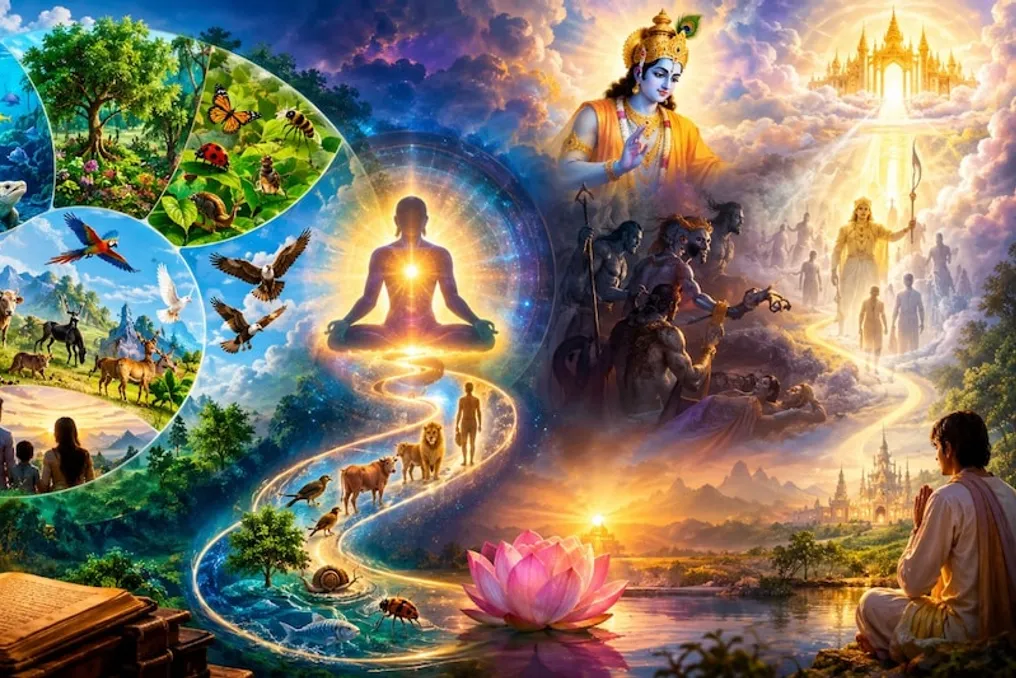
According to this verse, various types of living beings are classified: 9 lakh aquatic creatures, 20 lakh immobile ones (plants and other stationary flora), 11 lakh worms and insects, 10 lakh birds, 30 lakh animals, and 4 lakh humans. The total comes to 84 lakh.

However, it is important to understand that the purpose of this verse is not merely to name the number of beings. It also demonstrates the breadth and diversity of the living world existing in the universe. Various forms of creation are described—from the depths of the water to plants, from microscopic organisms to birds, animals, and finally, humans.

Must every soul go through all 84 lakh species?

This is where the biggest misconception about the 84 lakh species arises. Although the Padma Purana verse presents a classification of species, it does not explicitly state that every soul must be born into all 84 lakh species sequentially.

Therefore, the assertion that every soul must first become an aquatic creature, then a plant, then an insect, and then go through all bird and animal species before becoming human, does not directly follow from this verse.

On what basis does the next birth occur?

In the Shrimad Bhagavatam, Lord Krishna explains the connection between the soul and the body, stating that just as a person sheds old clothes and puts on new ones, the soul leaves the old body and acquires a new one. This means the body changes, but the soul is not considered as transient as the mortal body.

Is the next birth determined by only one action (karma)?

Here, another important point needs to be understood. The next birth is not determined by just one action; such a simple rule does not reflect the entire essence of the teachings of the sacred texts. Important aspects in this discussion also include the accumulation of karma, life tendencies, sanskaras (impressions), and consciousness.

In the eighth chapter of the Shrimad Bhagavatam, Lord Krishna emphasizes the importance of memories and disposition in the final moments of life. Based on this, it is believed that the influence of the state and consciousness a person develops throughout life can be felt even at the last moment. Thus, the topic of reincarnation is related not only to counting one good or bad deed but also to the extensive path of the being's karma.

Does committing great sins lead to a special form of birth?

The Garuda Purana describes the fruits of karma in detail. It mentions severe consequences and various states for some serious sins. In religious tradition, killing a brother, stealing gold, and inappropriate relations with a teacher's wife are considered serious great sins. In the context of their consequences, various states such as hell, suffering, and rebirth are described.

But caution is also necessary here. The simple rule that a specific animal or bird species is assigned to every sin cannot accurately represent the entire teaching of the Garuda Purana. In many cases, suffering or hell resulting from the first act is described first, and then rebirth is mentioned. Therefore, it cannot be considered a direct conclusion from the sacred texts that 'upon committing such and such a sin, one necessarily becomes such and such an animal' in every case.

Why is human birth considered so important?

Now the question arises: if a being can be born in various forms, why is human birth considered so significant? One of the main reasons is the capacity for reason (viveka).

Basic instincts, such as eating, sleeping, fear, and reproduction, are observed in humans and other creatures. However, the ability of a human to contemplate righteousness and unrighteousness, choose their actions, and change the direction of their life is considered particularly important.

Humans are capable of acquiring knowledge, practicing asceticism, engaging in charity and service, as well as devotion, trying to control inner greed, anger, and egoism.
Similar stories

Radha Ashtami 2026: Celebration Date, Auspicious Time, and Worship Ritual
Read more
www.aajtak.in

Radha Ashtami 2026: Celebration Date, Auspicious Time, and Worship Ritual

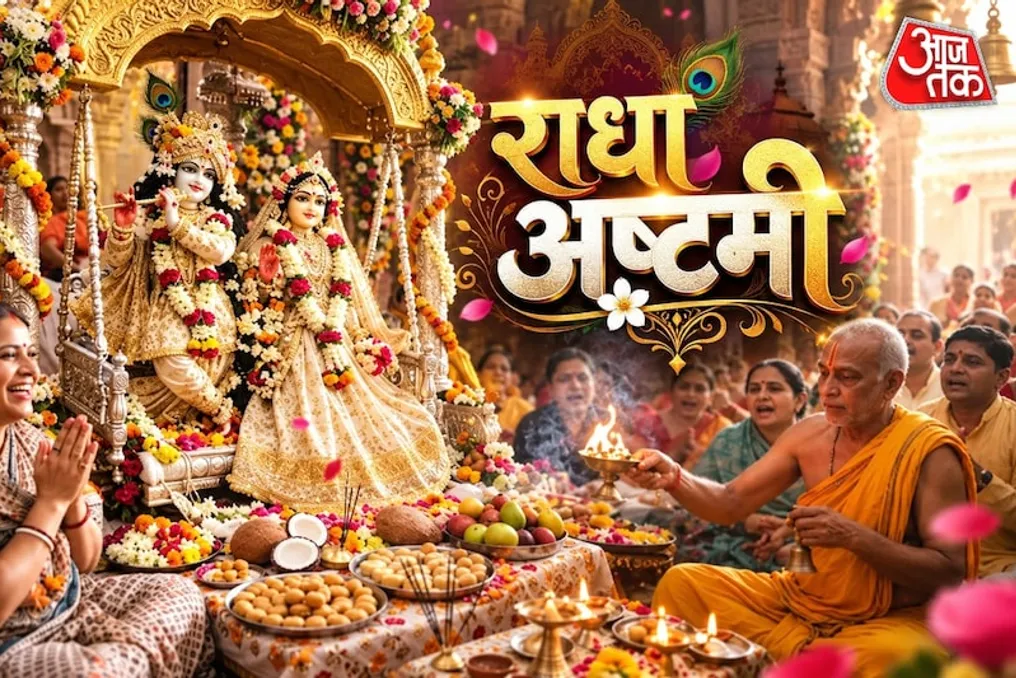
The festival of Radha Ashtami in 2026 is celebrated today, September 19, 2026. This day is dedicated to celebrating the appearance of Radha Rani. Radha Ashtami falls on Ashtami Tithi in the Bhadrapada month, during the Shukla lunar half. This festival is also known as Radhika Ashtami or Radha Jayanti, and on this day, worship is performed for Radha and Krishna. Special enthusiasm during this celebration is observed in Barsana, Mathura, and Vrindavan.

According to the Panchang, the Ashtami Tithi of Bhadrapada Shukla began on September 18 at 13:02. This date will conclude on September 19 at 15:28. Since the Ashtami Tithi is present on September 19 during sunrise, Radha Ashtami this year is celebrated on September 19, Saturday, based on the sunrise date.

For the worship of Radha Rani on Radha Ashtami, the midday time is particularly significant. According to the Panchang, the auspicious time for worship today, September 19, will be from 11:01 AM to 1:28 PM. Due to differences in sunrise and sunset times in various cities, there may be slight variations in the ritual timing.

On Radha Ashtami, one should take a morning shower and wear clean clothes. After that, the place for worship must be thoroughly cleaned. A red or yellow woven material should be spread on the platform. Then, images or statues of Radha Rani and Lord Krishna are installed. The worship begins with lighting a lamp. Radha Rani should be adorned with flowers, fruits, sweets, and other items for worship. If possible, the ritual of Abhisheka for Radha Rani with Panchamrita should be performed. After this, she is presented with beautiful clothes, ornaments, and flowers. During the worship, mantras of Radha Rani and Krishna should be recited. The ritual concludes with Aarti.

Tradition states that on Radha Ashtami, items for sixteen adornments should be offered to Radha Rani. According to religious beliefs, this helps preserve love and sweetness in married life. Incense can also be offered to Radha-Krishna during the worship. Along with this, roses, jasmine, or other fresh flowers should be placed. In religious views, these items are considered auspicious for worshipping Radha and Krishna.

A large number of devotees observe a fast on Radha Ashtami. The rules for breaking the fast vary depending on the region and traditions. According to the Panchang, the fast can be broken after 6:08 AM on September 20. Nevertheless, devotees observing a fast should break it according to the Panchang of their region and family traditions.

Radha Ashtami is celebrated as the birthday of Radha Rani. In the Vaishnava tradition, Radha Rani holds a special place as the greatest devotee of Krishna and His divine power. This is why the worship of Radha and Krishna on this day is considered especially significant. In Barsana, Vrindavan, and other areas of Braj, temples are decorated. Special worships, abhishekas, aartis, and singing of bhajans are conducted. Pilgrims arrive at the temples to see and worship Radha Rani.

Flowers, fruits, and sweets are offered to Radha Rani. In some local traditions of Braj, vegetarian dishes made from arbi are also included in the offerings to Radha Rani. Furthermore, the offerings include sweets made from milk, yogurt, khoya, and ghee. Greater importance is given to sincerity and devotion in the offering, rather than the quantity of dishes. On this day of Radha Ashtami, devotees pray to Radha Rani and Krishna, wishing for happiness, peace, and love.

Five Signs of Kali Yuga Described in the Mahabharata Epic
Read more
www.aajtak.in

Five Signs of Kali Yuga Described in the Mahabharata Epic

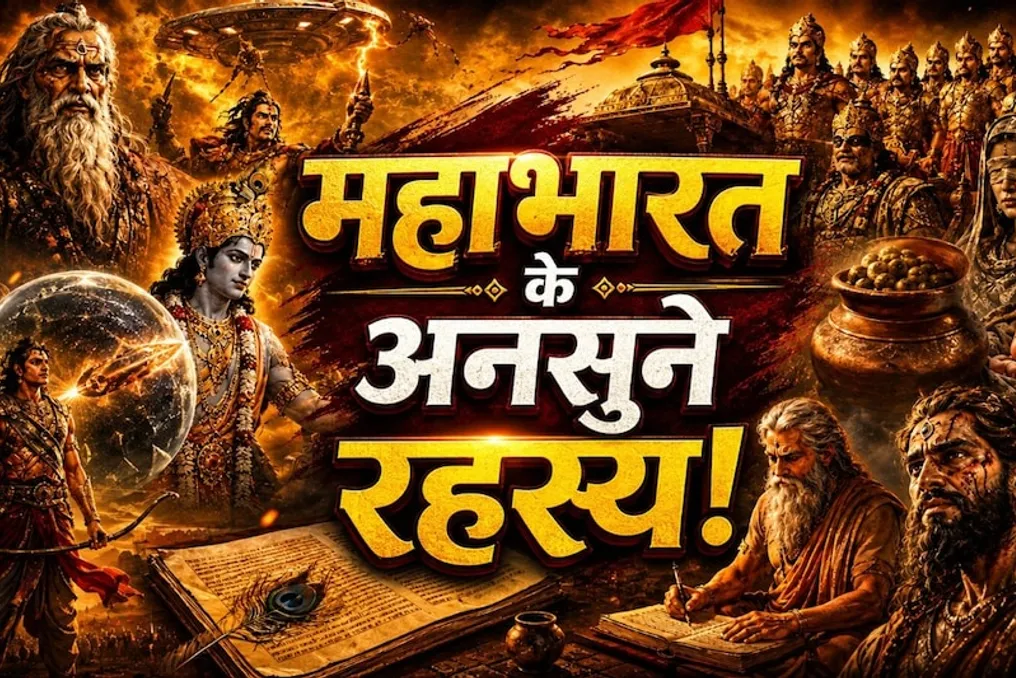
There is a narrative associated with the time of the Mahabharata, in which the Pandavas witnessed a series of unusual events and turned to Lord Krishna to understand their meaning. It is said that Krishna explained these events as omens of the coming Kali Yuga. These five phenomena indicate changes in human behavior, parental attitudes towards children, propensity for ostentation, and the state of religion in Kali Yuga. It is important to understand that these episodes should be viewed as religious traditions and beliefs.

Yudhishthira saw a snake with two mouths

According to the story, Yudhishthira asked Lord Krishna about a strange incident. He recounted seeing a snake with two mouths. Krishna linked this to Kali Yuga, stating that in the future, the number of people whose external appearance will contradict their inner substance will increase. Their words and actions will be completely different. Thus, a person's character will be determined not by their speech, but by their deeds.

Arjuna saw a bird with Vedas written on its wings

Furthermore, Arjuna observed another unusual image. According to tradition, he saw a bird whose wings were covered with inscriptions of the Vedas, yet this bird fed on meat. When Arjuna asked about the meaning of this, Krishna also connected it to Kali Yuga. He explained that in the coming times, some people will talk extensively about knowledge and religion, but their behavior will be directly opposite to their words; that is, outwardly observing religion while essentially violating it.

Bhima saw a cow injuring her calf

After this, Bhima witnessed a scene where a cow was gently licking its calf. However, this excessive affection led to the calf being injured and bleeding. When Bhima asked Krishna about the meaning of this, he replied that in Kali Yuga, excessive parental attachment to children can become harmful to them. Parents will try to protect children from all difficulties, ignoring all their mistakes and not giving them a chance to struggle. Such blind love sometimes hinders a child's development instead of strengthening it.

Sahadeva saw a dry well

Sahadeva also noticed a strange phenomenon: among many wells filled with water, he saw one that was completely dry. Explaining this, Krishna said that in Kali Yuga, people will spend large sums of money on ostentation but may refuse to help the needy. People will spend large amounts for their reputation and appearance, but they will lack interest in helping a hungry or poor person. That is, resources and opportunities will exist, but compassion for the needy will gradually decrease.

Nakula saw a falling giant rock

Finally, Nakula saw a huge rock rapidly falling down, destroying everything in its path. However, it stopped in a small area. When Nakula asked about the meaning of this, Krishna smiled and linked it to Kali Yuga. According to the tradition, the decline of a person in Kali Yuga will be just as fast, but even amidst this darkness, there will remain a small support for him.

What will save a person in Kali Yuga?

According to religious beliefs, the name of God is considered the greatest salvation for a person in Kali Yuga. The traditions state that when a person begins to slip into decline due to their actions and attachments, remembering God will give them the strength to return to the right path. The name of Rama, the name of Hari, or remembering Radha-Krishna are considered a simple path to liberation and spiritual peace in Kali Yuga. This is why in the Sanatana tradition, remembrance and devotion to God hold special significance for Kali Yuga.

Popular