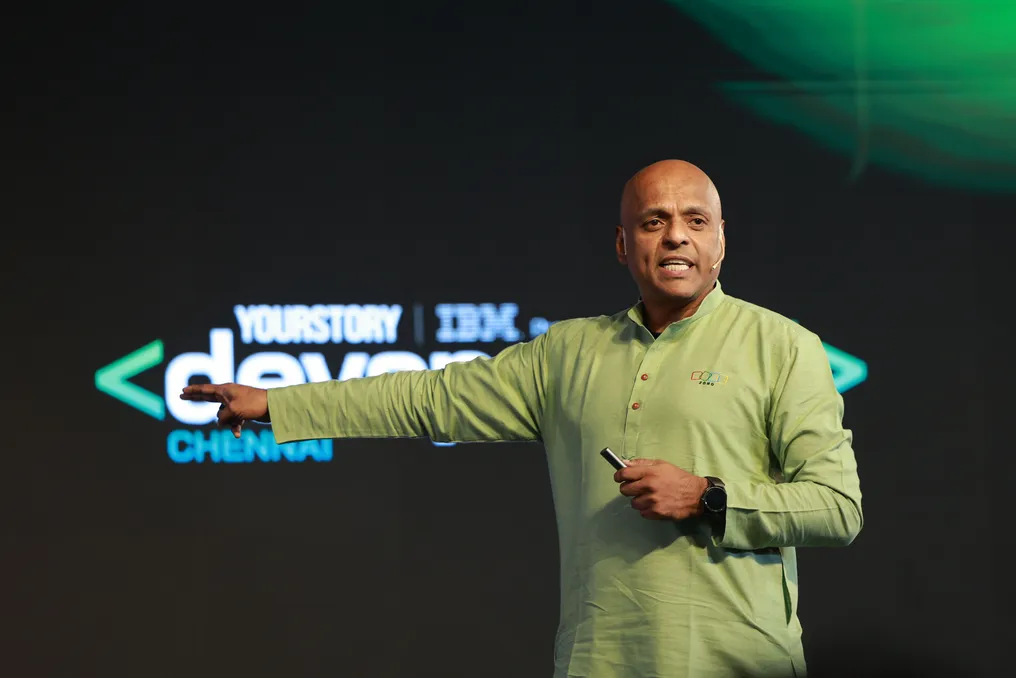
During his opening address at the DevSparks Chennai conference, Rajendran Dandapani, Director of Zoho Corporation, addressed a concern among developers: if artificial intelligence is increasingly performing tasks, what should be the role of a developer?
Under the title 'The Developer is Dead. The Developer Lives,' Dandapani presented his viewpoint. Despite the alarming headline, his argument was not about the disappearance of specialists but about the transformation of the nature of their work. He quoted Steve Jobs, who in turn adapted a statement by Mark Twain, saying: 'Reports of our death are greatly exaggerated.'
He noted that the anxiety surrounding AI-assisted development is not entirely new. In 1957, when John Backus introduced FORTRAN and the compiler, programmers feared that machines would create inefficient code, and people unfamiliar with basic hardware could write software.
Dandapani emphasized that similar concerns are being voiced today. Developers argue that AI-generated code can be suboptimal, consume expensive tokens, and allow people without traditional programming skills to create software, which is sometimes called 'vibecoding.'
However, according to Dandapani, technological efficiency does not always mean a reduction in workload. Sometimes it makes previously expensive activities cheap enough for significantly more people to engage in them. He referred to the Jevons Paradox, which describes how increased efficiency can lead to increased resource consumption; for example, more efficient steam engines did not eliminate the need for coal. Similarly, simplifying software creation can broaden the pool of individuals and organizations involved in it.
'We are not seeing a reduction in the number of developers. We are seeing an abundance, a Cambrian explosion. Now almost everyone wants to build an application,' he stated. Dandapani believes that the more important question is what will happen when writing code ceases to be the main bottleneck.
He described this as another stage in the evolution of the developer's role. Since AI can generate software, developers can transition from being primary code authors to editors, directors, and evaluators of what machines create. 'If you can build anything today, you don't need to worry about how to build it, but what to build. That is the question,' he said.
This places high value on what AI does not automatically provide: taste. Dandapani used the concept of a 'taste gap' to describe the distance between what a person creates and what they know to be good. Traditionally, developers develop technical skills and judgment in parallel, learning over years to distinguish quality software from low-quality software. AI can disrupt this process by producing impressive results before the user has time to develop the judgment to properly evaluate them.
'The problem with AI is that it has given us grandeur, but not taste,' concluded Dandapani. His recommendation was to use the time saved by AI differently. If a developer can complete a task 10 times faster, the extra time should be spent not just generating 10 times more code, but on understanding, evaluating, and improving what the AI created.
He advised: 'If AI completes your work 10 times faster, spend nine-tenths of the time on understanding, evaluating, editing, recognizing, and discovering.' There is another effect of this shift that companies will have to face. If AI takes on most of the work traditionally assigned to junior developers, organizations might hire fewer entry-level engineers. However, this could also weaken the pipeline that shapes tomorrow's experienced developers.
Dandapani stressed the importance of learning through client interaction, corporate culture, and the specific problems an organization is trying to solve, noting: 'A senior is someone who fought like a junior.' He assured the audience that the developer may not disappear, but rather advance up the stack. Less time will be spent transforming instructions into code, and more on determining what is worth building, guiding AI systems, and deciding whether to release their results.