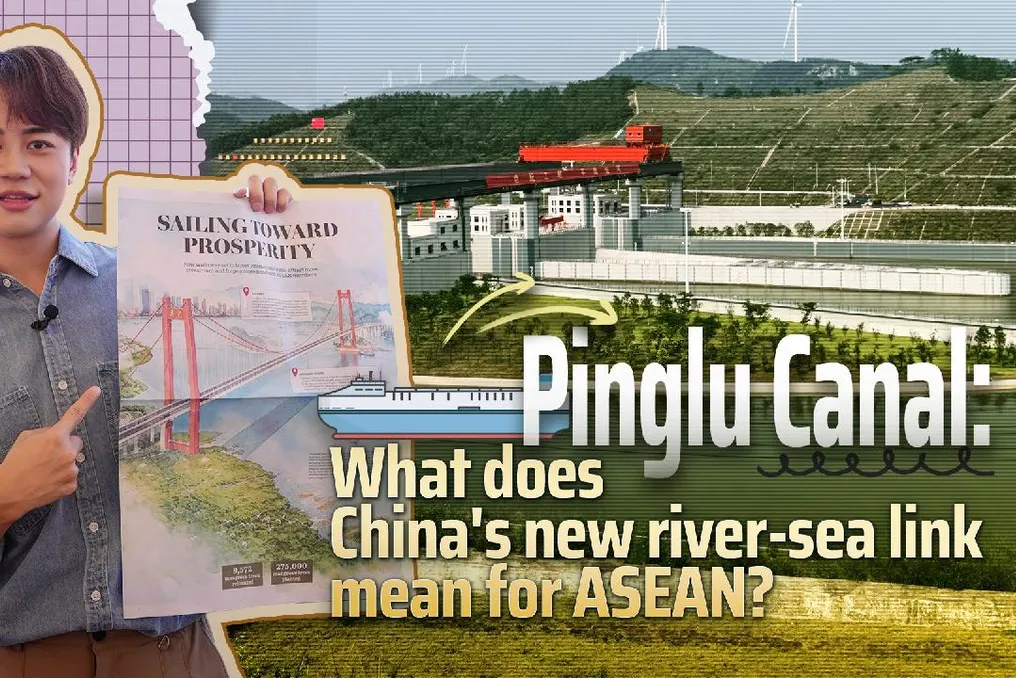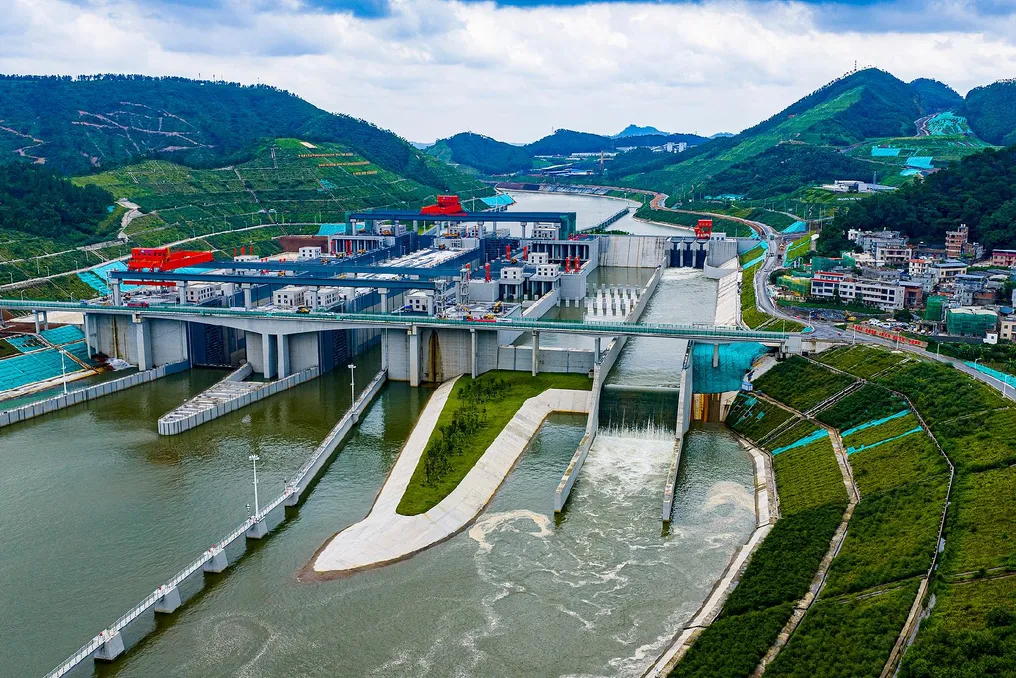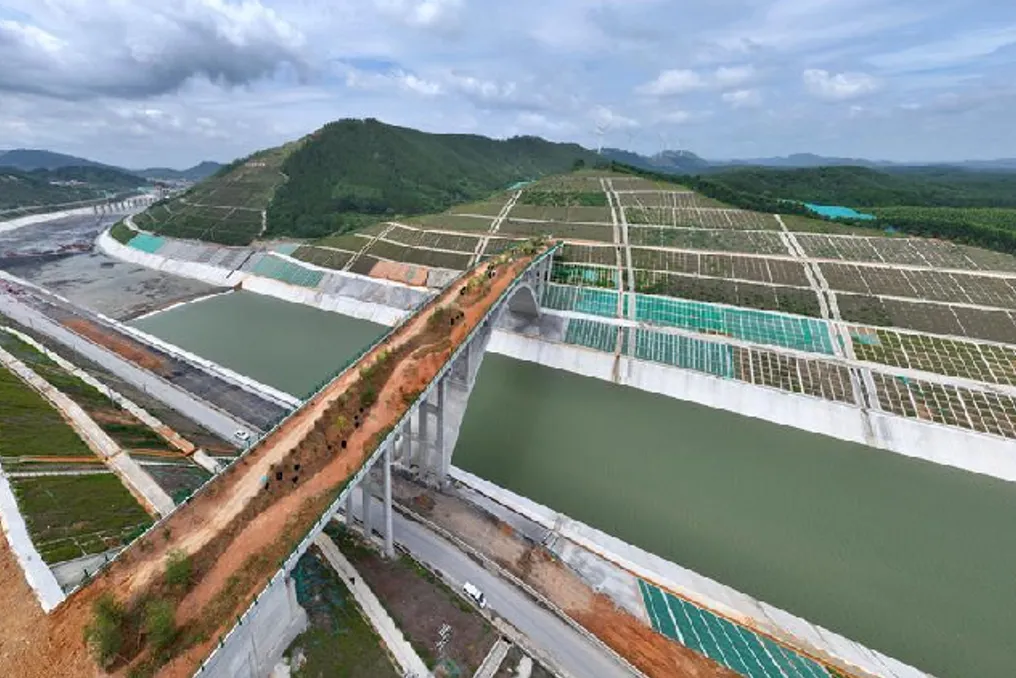
A new waterway has opened in the Guangxi Zhuang Autonomous Region in southern China, providing faster access to the sea for the southwestern part of the country.
The Pinlu Canal, which is 134.2 kilometers long, officially began operation on September 16th after four years of construction. It connects the mouth of the Pintan River in Hengzhou, Nanning, with the Bibao Bay. The project was designed to accommodate vessels up to 5,000 tons and required total investment of 72.7 billion yuan (equivalent to approximately $10.8 billion).
For the Guangxi region, this canal marks a historic breakthrough. Despite its coastal location, the region long suffered from a lack of a direct inland waterway connecting its river network to the sea. The new route directly links Nanning with Bibao Bay, reducing the sea transport distance by more than 560 kilometers and offering a more efficient, potentially less costly way to transport goods from Guangxi and the entire southwestern region to global markets.
Expert Xu Fan, a professor at the School of International Trade and Economics of the University of International Business and Economics, analyzed the national significance of the Pinlu Canal and its potential impact within China's broader development strategy.
Significance of the Pinlu Canal for China's Overall Development Strategy
China is both a major maritime power and a significant force in inland water transportation. The annual volume of cargo transported via inland waterways in the country consistently ranks first globally, exceeding US figures by more than eight times and European Union figures by approximately ten times. The Yangtze and Pearl River systems are two of the world's largest inland water networks by transport volume.
To further utilize inland shipping, China has developed a national high-grade water network plan known as the 'four verticals, four horizontals, and two networks' scheme. The four horizontal waterways include the Yangtze, Pearl, Huai, and Heilongjiang Rivers. The four vertical corridors are the Beijing-Hengzhou, Yangtze-Huai, Zhejiang-Jiangxi-Guangdong, and Han-Xiang-Gui canal routes. The two networks are the high-grade waterways in the Yangtze and Pearl River deltas.
The Pinlu Canal serves as an important element in completing this national water network within the Han-Xiang-Gui corridor. For a long time, central and western regions of China largely relied on the 'export goods move east' model, with most cargo being delivered to the sea via the Yangtze and Pearl River deltas. As these regions developed economically, bottlenecks emerged in both river systems, hindering the movement of goods to foreign markets. Such problems include congestion at ship locks on the Yangtze in the Sanggou Gorge and at ship locks on the Pearl River in Guangzhou.
The opening of the Pinlu Canal will reduce the load on the Pearl River, creating another major waterway connecting inland areas with the sea.
Canal's Potential for China's Inland Western Regions
For the inland western regions, the Pinlu Canal will not only shorten internal routes to the sea by more than 560 kilometers but will also help develop more seaport-accessible inland ports in the long term, enhancing the economic benefits of other developing waterway projects.
For instance, the canal provides a southern sea outlet for the long-planned Han-Xiang-Gui inland waterway corridor, significantly accelerating progress in the construction of the Xiang-Gui Canal, which is the key upper section of this corridor. Upon completion, the Xiang-Gui Canal will greatly facilitate the southward movement of goods from Hunan in Central China to the sea.
The Pinlu Canal is also expected to improve sea access for inland provinces such as Yunnan and Guizhou, located in southwest China. With the completion of auxiliary waterway development projects, including the modernization of the Yujiang and Hunshui rivers, these provinces will be better connected to the canal and gain greater capacity for water transport to the sea.
Thus, the canal will help transform Southwest China from a hinterland region into a zone of the country's outward expansion frontier, supporting China's efforts to build a more comprehensive and open economic landscape. Although some types of processing trade are shifting from coastal regions to central and western ones due to industrial modernization in coastal zones, high domestic transportation costs for both inbound and outbound goods limited these regions' ability to integrate deeper into global value chains. The opening of the Pinlu Canal, along with the future expansion of the waterway network in central and western China, will help make inland western provinces more oriented towards external markets and create new opportunities for industrial development.
How the Pinlu Canal May Change China's Connection with ASEAN, Trade, and Industrial Supply Chain Cooperation
In the initial phase of operation, the Pinlu Canal is expected to primarily transport raw materials. As related waterways expand and open, the share of containerized transport, especially industrial goods and intermediate products, may gradually increase.
Guangxi can form an industrial network along three key corridors—the Pearl River, the Pinlu Canal, and its coastal and border areas, strengthening connections between inland production centers, seaports, and neighboring ASEAN markets. This could also deepen industrial integration between Guangxi and ASEAN.
Regions such as Yunnan, Guizhou, Sichuan, Chongqing, and Hunan will also actively use the Pinlu Canal to strengthen cooperation with ASEAN. Furthermore, the canal may enhance the role of Hainan Free Trade Port in linking domestic and international markets.