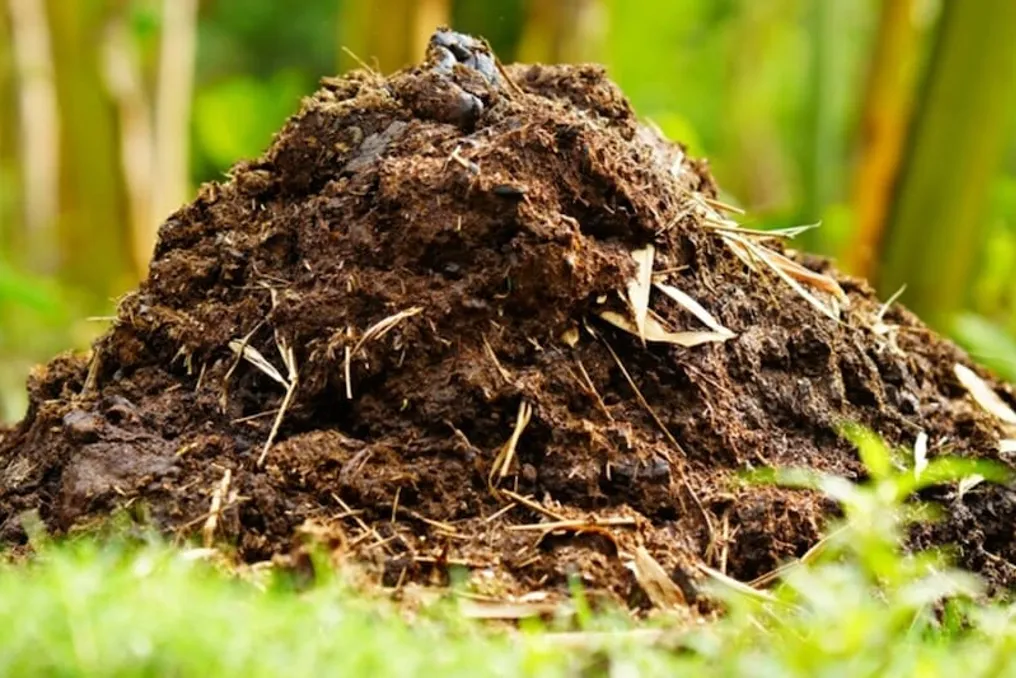
If you are involved in cow breeding, you should not rely solely on milk income. Manure, which is often viewed as waste, can become a second source of income for livestock farmers. Vermicompost (earthworm manure) can be made from manure, which can then be sold to farmers, nurseries, and those who grow plants.
In large-scale production, using 200 units (solid or soft tanks), one can expect to produce about 30 tons of vermicompost monthly. At a price of 5 rupees per kilogram, the revenue can be around 1.50 lakh rupees, and at a price of 10 rupees per kilogram—up to 3 lakh rupees. It is important to note that this is only a preliminary estimate and does not include costs and other expenses.
Income from manure along with milk
Dairy farming is widespread in India, and people across the country sell milk obtained from cows. However, monthly expenses for feed, medicine, and animal care are quite significant. Therefore, utilizing other products derived from dairy farm activities can help increase income instead of depending solely on milk sales.
Manure is produced daily. In some places, it is used to make fuel briquettes, while others simply spread it on the field or nearby. But this same manure can be properly prepared and turned into vermicompost. Due to the demand for organic farming and plant fertilizers, local markets can be sought out.
Do not give fresh manure directly to worms
Do not place fresh manure directly into the vermicompost bin. Fresh manure has a high temperature, which can harm the worms. First, the manure should be collected in a clean and open area. Add water as needed and leave it for about 7 days. During this time, the manure can be mixed 1-2 times, which helps reduce its temperature. Only after preparing the manure should it be used in the vermicompost bin.
How to make a vermicompost bin
Choose a location that does not receive direct strong sunlight or rain. The bin can be prepared by laying a thick plastic sheet on the ground. For example, a bin of approximately 9 by 4 meters can be created, although the size can be changed depending on available space. Distribute the prepared manure evenly in the bin and add the worms. Dry straw chaff or burlap can be placed on top. To maintain moisture in the bin, lightly spray it with water periodically. It is important to ensure that water does not stagnate in the bin, as too much water is harmful to the worms.
Compost is ready in 2 months
The worms gradually transform manure and other organic matter into fine compost. During this process, the most attention should be paid to moisture. If the manure dries out too much, worm activity may decrease. On the other hand, constant accumulation of water can spoil the compost. The bin should be kept in the shade during hot weather and watered as needed. Water should be used more cautiously in winter. Usually, the vermicompost is ready in about 2 months. The finished fertilizer has a dark color and a granular texture.
Worms are useful not only for compost
After the compost is ready, watering can be stopped for a few days. Then, by gathering the compost to one side, the worms can move to the other side. They can be separated and used in new bins. The finished compost can be sifted, allowed to dry slightly in the shade, and then packed in bags weighing 5, 10, and 25 kilograms depending on the needs.
Start with 20 bins, then scale up
If you start with 20 bins, you can expect to produce about 17 quintals of vermicompost in about 3 months. This can bring about 10 thousand rupees at the initial level. As experience is gained and the number of customers increases, the number of bins can be increased. With 200 bins, a production of about 30 tons of vermicompost is expected monthly. If the fertilizer is sold at 5 rupees per kilogram, selling 30 tons, or 30,000 kilograms, will amount to about 1.50 lakh rupees. At a price of 10 rupees per kilogram, the same sale can reach 3 lakh rupees. It is important to understand that the figures of 1.50 lakh or 3 lakh rupees are sales volume, not net profit. Expenses such as labor, packaging, water, space, worms, sorting, and transportation must be deducted from these. If the livestock farmer already has their own manure and space, this can help reduce costs.
Where to find buyers for fertilizers?
You do not necessarily have to look far to sell vermicompost. Potential buyers can include local farmers, nurseries, people engaged in organic farming, and customers who grow plants at home. Instead of selling large volumes wholesale, selling in small retail packages can sometimes yield a better price. However, the price can vary depending on local demand, fertilizer quality, packaging, and the market.
Manure can be used to make not only compost, but also briquettes
Manure can be used not only to make vermicompost; it can also be used to produce briquettes and other useful products. Thus, if the manure obtained from dairy farming is used properly, it ceases to be just waste and becomes an additional source of income. Although milk may be the main source of income in the dairy business, creating and selling fertilizers from manure allows opening another path to earning, especially in cases where...