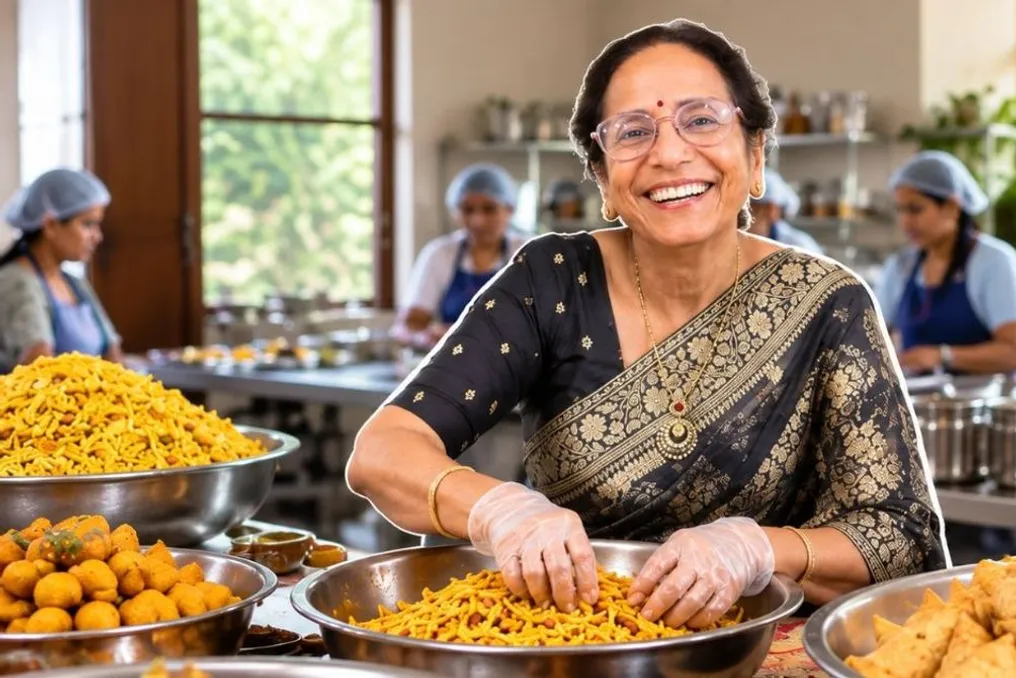
In the Agarwal family kitchen, several pairs of hands can be seen preparing a batch of basan barfi. Each portion includes the required amount of besan (gram flour), cane sugar, and most importantly, ghee and nuts. Tasting this barfi prepared by the team, one felt an explosion of flavor. The besan was well roasted, each piece was soft, with the rare crunch of nuts and the richness imparted by the ghee.
The basis of this barfi is Sunita Agarwal's recipe. At 62 years old, Sunita dedicated most of her life to cooking for her family as a homemaker who loved making sweets and snacks. She recalls: 'Since childhood, I have always loved making sweets and snacks.'
For years, she cooked them for her children. Sometimes she bought sweets from outside, but often felt that the quality did not meet what she wanted for her family. Therefore, she started making them herself. As her children grew up and she had more free time, Sunita continued doing what she enjoyed: meeting friends and family and sharing food with them. People around her always reacted positively to what she made by hand. Slowly, the thought began to form in her mind: 'Why not turn this into a business?'
In 2022, Sunita founded K&G as a home kitchen, starting with four items: basan barfi (sweet made from gram flour), gond barfi (sweet made from edible gum), masala channa dal (spicy roasted chickpeas), and matrix (crunchy savory crackers). By 2024, the enterprise expanded to over 30 varieties in the categories of snacks and sweets and officially began operating on a commercial kitchen, constantly increasing its assortment and adhering to food safety standards.
Initially, the business was focused only on Guwahati. The family spent the next year serving customers there and gaining confidence through positive reviews. Around this time, Sunita's son, Rajwardhan, joined her. He left his job and tried to figure out what to do next when Sunita suggested developing the venture. Rajwardhan recalls: 'I quit my job, and we tried to figure things out. Then my mother said, 'Let's make it bigger.' '
As part of his research, Rajwardhan traveled across North and West India to learn more about traditional sweets and understand the manufacturing process. He also traveled to hire halwais (traditional sweet makers) who could join the K&G kitchen. This journey allowed him to study the ecosystem of traditional sweet production across the country in depth and see more clearly how his mother's approach differed. He notes: 'My mother was different from many of them. My mother makes it by hand, with pure ghee, without artificial flavors.'
This became an important part of how the family wanted to shape K&G: keeping traditional recipes at the forefront while experimenting with fusion products for modern tastes. Thanks to this approach, the business continued to grow beyond its initial customer base in Guwahati. In 2026, after a year of serving customers in the city and receiving positive feedback, K&G expanded its presence through a website and Amazon. The family also plans to enter the express delivery sector.
However, for Sunita, managing a food business comes down to getting every small detail right. She says: 'I am naturally very organized. I plan ahead.' As soon as an order comes in, she sets deadlines, prepares raw materials, and begins planning the work. The kitchen team includes halwais from Rajasthan and Haryana. There are eight people in total: four work in operations and marketing, and four are in the kitchen.
Sunita remains closely involved in what leaves the kitchen. Before anything is packaged, she personally checks the sweets for quality. 'Our goal is to ensure customer satisfaction,' she states. She thanks her team for helping bring this intention to life: 'My team is amazing. They meticulously follow my instructions, which makes the final product worthwhile.' She also uses her many years of experience while the team develops new products. Once, the team was researching a new product, and Sunita felt it might fail, so she shared her concerns with the halwais. After considering her remarks, the product improved, and the young halwais began praising her experience—a moment that brought Sunita special pride. For someone who spent most of her life as a homemaker, having her knowledge of food recognized by young professionals was special.
Currently, K&G has almost 3000 customers and receives about four to five orders a day. The business currently generates about 2–2.5 lakh rupees per month, and the family hopes to increase this amount to 6–7 lakh in the future. Its customer base has also begun to expand beyond individual orders: K&G collaborates with enterprises and brands under the B2B corporate gifting model. As the business grows, Sunita began thinking about how she could create earning opportunities for other women. Having created something of her own later in life, she wanted to ease the path for women to earn without giving up their domestic responsibilities. 'I always believed that women need a platform for financial independence, and I wanted to give them that platform,' she says. So far, she has connected two women to this initiative. The model allows them to work from home: Sunita provides the product, and they handle sales and receive a share of the revenue. The women receive training on customer communication and how to secure initial orders. There are no goals or fixed time commitments. This initiative currently includes women from Shillong and Assam, and they receive 23 percent of their sales.
For Sunita, the idea is simple: provide women with the tools, training, and confidence to earn on their own terms. One of the women who joined the initiative is Prem Agarwal from Shillong, Meghalaya. Prem lives with her husband and son. Her husband is ill, and she is both the family provider and caregiver. For Prem, this arrangement allows her to focus on finding clients while K&G handles the rest. 'I work from home. I just need to find orders for them, and then they take care of everything,' she says. She earns about 6000–7000 rupees per month through this initiative, although she says her income usually exceeds 7000 rupees. Prem also values the support she receives from the K&G team. They train her on the products so she can confidently communicate with customers and gain their trust. 'They train me as if I were part of the family. It helps me build relationships.'
For Sunita, this is exactly what she hoped to create with this initiative: a way for women to earn while working according to their circumstances. The story of Kitchen and Gupshup is also a family effort from the beginning. Sunita says her husband was the first to support her. Her children were happy to learn that their mother was starting a business. 'The atmosphere was very supportive,' she says. What started with four items made in a home kitchen has turned into a business with a team, thousands of customers, and a growing network of women sellers. And at the center of it all is still Sunita—planning every order, checking every sweet before it leaves the kitchen, and trusting the recipes she perfected over the years, now as the owner of something she can call her own.
} , 3.