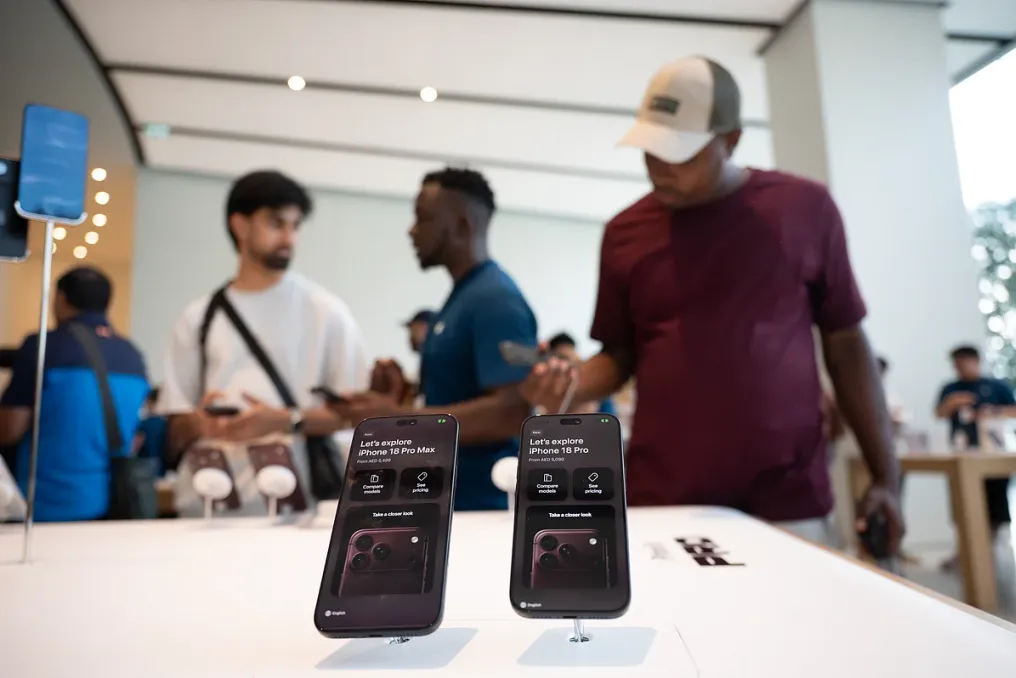
The iPhone 17, which was launched in the UAE market a year ago for 3399 dirhams, is now selling for 3799 dirhams despite no changes to the device itself. This price hike is part of a broader trend that initially affected PCs before spreading to mobile phones. The iPhone 17 is no exception; newer models like the iPhone 18 Pro and Pro Max are more expensive than last year's counterparts. Furthermore, Samsung has increased the price of the Galaxy Z Fold8 Ultra compared to its predecessor, the Galaxy Z Fold7, and Google has raised the cost of its entire Pixel 11 lineup.
Typically, phones become more affordable over time due to discounts on older models, but this pattern has been broken this year. The reason lies in the sharp rise in memory prices, forcing manufacturers to pass these costs onto consumers.
What is happening with phone prices?
Apple's price increases were unusual because they affected devices already on sale. When the new iPhone 18 Pro was announced on September 9th, the company raised the prices of the iPhone 16, iPhone 17, iPhone Air, and iPhone 17e by $100 in the US. In the UAE, the price of the iPhone 17, iPhone Air, and iPhone 17e increased by 400 dirhams. None of these four models have been redesigned or relaunched, making the price increase particularly noticeable since prices usually drop during this time of year.
In other regions, changes involved specifications along with the price. Google increased the cost of the Pixel 11 Pro by $100 while reducing the base memory from 16GB to 12GB, citing a severe shortage of RAM caused by suppliers. It is reported that Samsung is considering raising the price of the Galaxy S26 in Korea starting October 1st, although no official decision has been made.
Counterpoint Research notes that this year, prices for phones already on the market have risen by approximately 15% globally, and by 18% in the Middle East and Africa region. New models are appearing on the market, on average, 25% more expensive than their predecessors. Over half of tracked phones have seen a price increase, which the company says has not been observed before. The situation is particularly difficult for the budget and mid-range segments, where the share of memory in the device's cost is higher.
What is causing this rise?
The primary cause is memory. The cost of DRAM and NAND has risen by over 300% year-over-year, and IDC indicates that manufacturers have exhausted their ability to absorb these costs. A year ago, memory and storage in the iPhone Pro accounted for about one-tenth of the device's cost for Apple; in the current quarter, this share reached approximately one-third, and TrendForce predicts it will exceed 40% by mid-2027.
RAM prices are rising because chips are being redirected to other areas. Memory manufacturers have shifted production capacity to High Bandwidth Memory (HBM)—a stacked DRAM used alongside AI accelerators in data centers, where it generates much higher profits than in phones. Since HBM requires more silicon per useful bit, moving capacity to this sector doubles the reduction in the supply of standard RAM, while demand for memory has reached an all-time high. Tim Cook, then CEO of Apple, called this a 'centennial flood' in an interview with the Wall Street Journal in June.
Not everyone agrees that the price increase is solely due to supply and demand. In June, consumers and small businesses sued Samsung, SK Hynix, and Micron, which collectively control about 90% of the DRAM market, alleging that these companies used the AI boom as a cover to create a shortage of standard memory. Manufacturers deny collusion, and courts dismissed a similar lawsuit in 2022.
How long will this last?
No relief is in sight, and the shortage is likely to last longer than the lifespan of your phone. SK Hynix, one of the three major memory producers, expects 2027 to be worse than 2026 and states that demand will outpace production after 2030. Intel CEO Pat Gelsinger previously set a benchmark this year: the situation will not improve until 2028.
Theoretically, increasing production capacity could solve the problem, but this is not easy. A new memory fabrication plant costs over $15 billion (55 billion dirhams) and requires at least 18 months to become operational. Micron's factory in Singapore starts in 2027, Samsung's expansion in Pyongyang in 2028, and SK Hynix's facility in Indiana in late 2028. This is a change in pace compared to the insufficient investments in 2024 and 2025, but the effect is not expected anytime soon.
It is unlikely that phone prices will fall again, and this test has already been conducted. Memory prices plummeted in 2022 and 2023, but phone prices did not follow suit: the average global retail price continued to rise two years later. When component costs fall, savings rarely reach the end consumer.
The lowest price segment takes the biggest hit. FDM CCS Insight reports that some entry-level phone models have already increased by more than 50% compared to this time last year. IDC now describes the sub-$100 segment, around 370 dirhams, which shipped 173 million phones in 2025, as being in existential crisis, and Gartner predicts that buyers in this segment will leave the market five times faster than premium buyers. Cheap phones may not return.
Therefore, if your current phone is still working, now is not the best time to replace it, and next year looks even worse. If it has broken down, you should purchase the necessary level of storage, not what you might need in the future. This is the part of the bill you can still control.