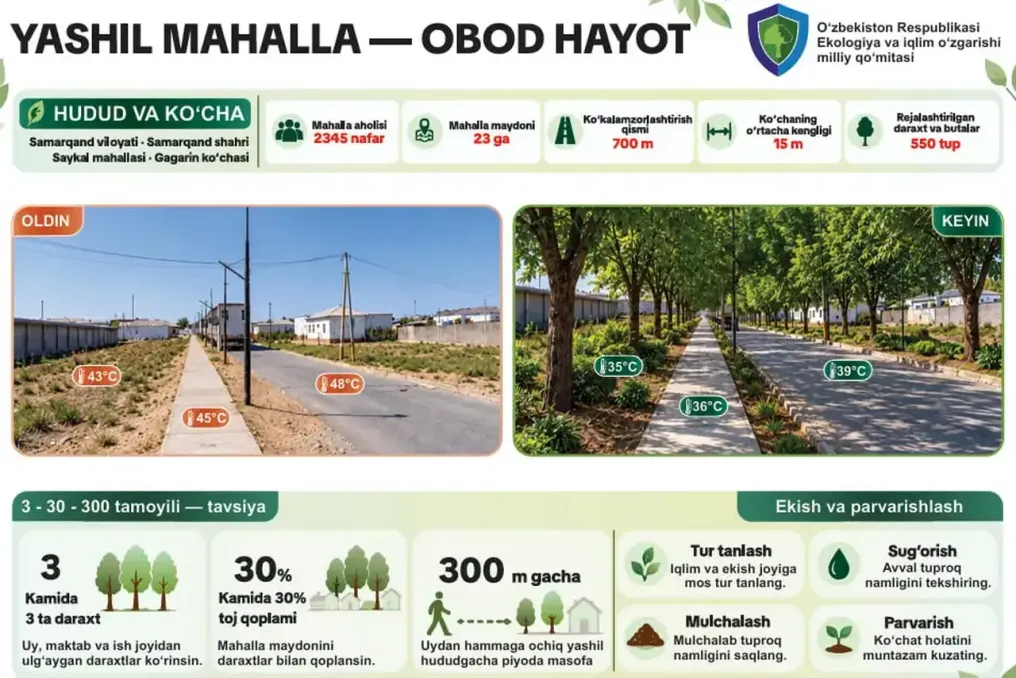
Green zones and comfortable walking spaces are expanding in mahallas across Uzbekistan as part of the national project 'Yashil Maqon'. One such example is the implementation of this initiative in the Saikal mahalla of Samarkand city, where sidewalks are gradually being transformed into shaded pedestrian streets.
This project involves planting 550 trees and shrubs, as well as landscaping an area spanning about 700 meters. This measure is expected to improve the microclimate for residents, especially during hot periods. As a result of the landscape design, the ground temperature in this area is projected to decrease from 43°C to 35°C, and the asphalt temperature should drop from 48°C to 39°C.
The creation of shaded pedestrian routes is part of broader efforts to develop green infrastructure in settlements across the country. In accordance with the State Program for implementing the Uzbekistan–2030 Strategy in the Year of Environmental Protection and Green Economy, a network of similar streets is planned along the main sidewalks used by residents.
According to specialists, increasing greenery and forming shaded pedestrian paths can reduce air pollution by 5–10% and lower the air temperature along sidewalks by 3–5°C. Furthermore, such spaces can promote increased physical activity and create more favorable conditions for walks among the population.
Attention is growing regarding the 3-30-300 principle in landscape design, which is used in modern urban ecological planning. According to this principle, every person should be able to see at least three large trees from their home. The presence of greenery in the immediate visual environment is considered a factor that helps reduce stress and improve the quality of the urban environment.
The second indicator requires that at least 30% of the mahalla or district be covered with trees. This level of greening helps ensure shade, improve air quality, and mitigate the urban heat island effect. The third benchmark mandates access to a green zone, meaning that every residential building must be located no further than 300 meters from the nearest park, public garden, or other green area. This corresponds to approximately a five-minute walk and creates conditions for regular sports, physical activity, and social interaction among residents.
The national project 'Yashil Maqon' has been implemented in Uzbekistan since 2021 under the initiative of the President of Uzbekistan. As part of this project, at least 200 million fruit and ornamental trees and shrubs are planted every spring and autumn. Currently, the project extends beyond simple tree planting; mahalla territories are being improved, new green zones are being created, and pedestrian routes are being developed to improve the microclimate in densely populated areas.
The example of the Saikal mahalla in Samarkand demonstrates how a large-scale environmental initiative is gradually transforming into concrete projects that directly affect the daily lives of citizens. The development of green infrastructure, the creation of shaded streets, and the expansion of landscaped areas are viewed as important tools for increasing the resilience of cities to heat and other consequences of climate change, as well as for forming a healthier and more comfortable urban environment.