A Brazilian citizen documented a rare phenomenon—the collision of an asteroid with Jupiter, the gas giant. Asteroids are remnants of the formation of the Solar System, which occurred about 4.6 billion years ago. Many of them continue to orbit the Sun, primarily in the so-called Asteroid Belt located between Mars and Jupiter.
However, these orbits are not entirely stable and can change under the influence of planetary gravity, especially the strong influence of the gas giant. Due to its colossal mass, Jupiter exerts a powerful gravitational pull on surrounding objects, functioning as an extensive cosmic shield. This scenario leads to the planet regularly being struck by space rocks, although the vast majority of these events remain unnoticed by telescopes.
In certain cases, larger stones enter Jupiter's atmosphere, causing a brief flash of light. This brilliance lasts only a few seconds but possesses enough energy to be registered by instruments on Earth, overcoming distances of hundreds of millions of kilometers.
Event Recording
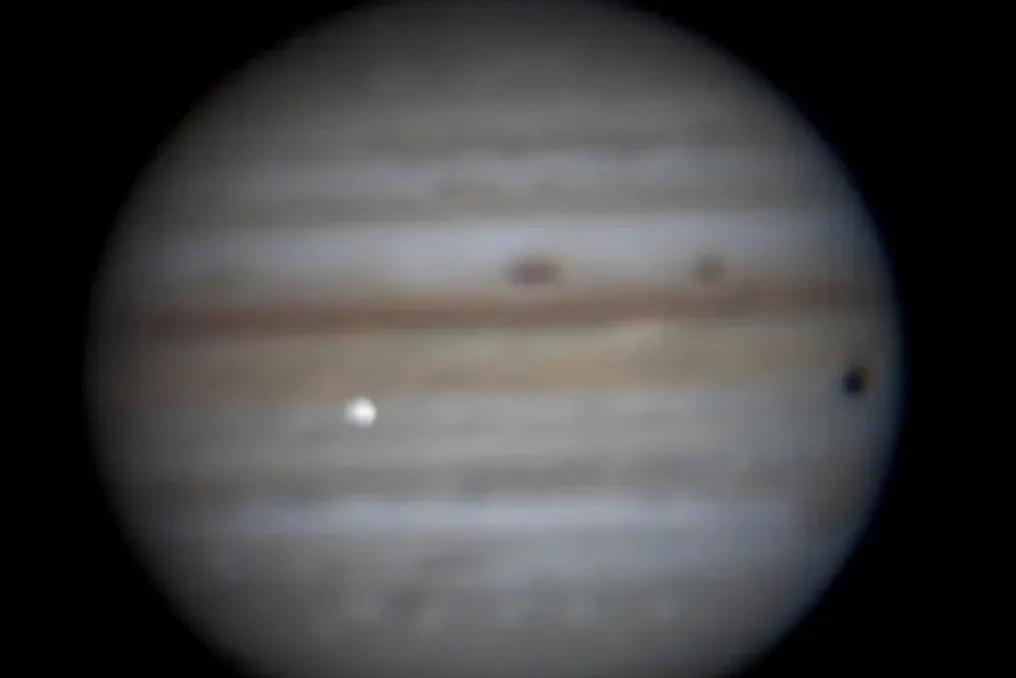
One such event occurred on September 13, 2021, and was recorded by an amateur astronomer from Brazil who was observing Jupiter and noticed a rapid flare caused by the impact. This recording helped document another rare episode that can be observed directly.
The person responsible for this achievement is José Luís Pereira, a retired civil engineer living in São Caetano do Sul (SP). In an interview with the program Olhar Espacial, he spoke about his experience. He noted how great it is to contribute to the field of astronomy, especially planetary astronomy, by collecting data that can be used by professionals.
The observer's interest in astronomy arose in childhood, and the decision to focus on planets was influenced by the urban environment, as excessive lighting hinders the observation of fainter celestial bodies. Pereira explained that due to the high level of light pollution in a large city, it was very difficult to find nebulae and galaxies, so he focused on the planetary region.
To deepen his analyses, Pereira began using software created by the Frenchman Marc Delcroix, designed to search for impacts on Jupiter. This program automatically analyzes hours of continuous recordings sent by volunteers from around the world, identifying any suspicious changes in the planet's luminosity.
Observation Details
The historical recording took place during a night of bad weather. The amateur astronomer struggled with high cloud cover in the sky when he noticed a glowing point. He recalls: 'In the first video, while I was focusing the telescope, I saw a white spot on the planet, but I thought it was related to the settings.' Confirmation came the next morning when the program analyzed the night files and indicated a high probability of an impact. He used the program to separate the video into images, after which he saw a clear sequence from the beginning of the flash to its diminishing and disappearance, concluding: 'Yes, it really was an impact.'
Excited by the discovery, he contacted the program creator to verify the file. The analysis showed the scale of the event: the object had a diameter of 5 to 20 meters and was moving at a speed of 60 kilometers per second, creating an explosion approximately 5,000 kilometers in extent. Pereira explained: 'This flare was estimated to be 5,000 km in diameter. Therefore, the light it created was visible here on Earth.'
Significance of Data Contribution
Recording such events requires immense dedication and thousands of hours of continuous observation through cameras. The astronomer stated that before this impact, he had accumulated 6.5 days of continuous observations, emphasizing that community involvement allows for the collection of significant amounts of data unavailable to professional researchers alone.
Obtaining clear images requires overcoming the turbulence of the Earth's atmosphere, which distorts light and makes the planet appear shaky. Pereira compares this to the feeling of 'observing through water, inside a pool.' To cope with this instability and achieve magnification of more than a thousand times, the engineer improved the mechanics of his telescope and built a small private observatory to protect the equipment from the wind.
According to Pereira, assembling equipment of this level is a gradual process carried out in stages by replacing cameras, mirrors, and computerized mounts. After creating the structure, he expanded his horizons in recent years: he acquired a specialized solar telescope and now also dedicates time to recording solar flares and filaments. Pereira's discovery demonstrates the value of amateur collaboration in mapping small bodies of the Solar System. Continuous recordings help scientists calculate the frequency of such episodes, expanding the understanding of impact risks threatening other worlds and our own planet.