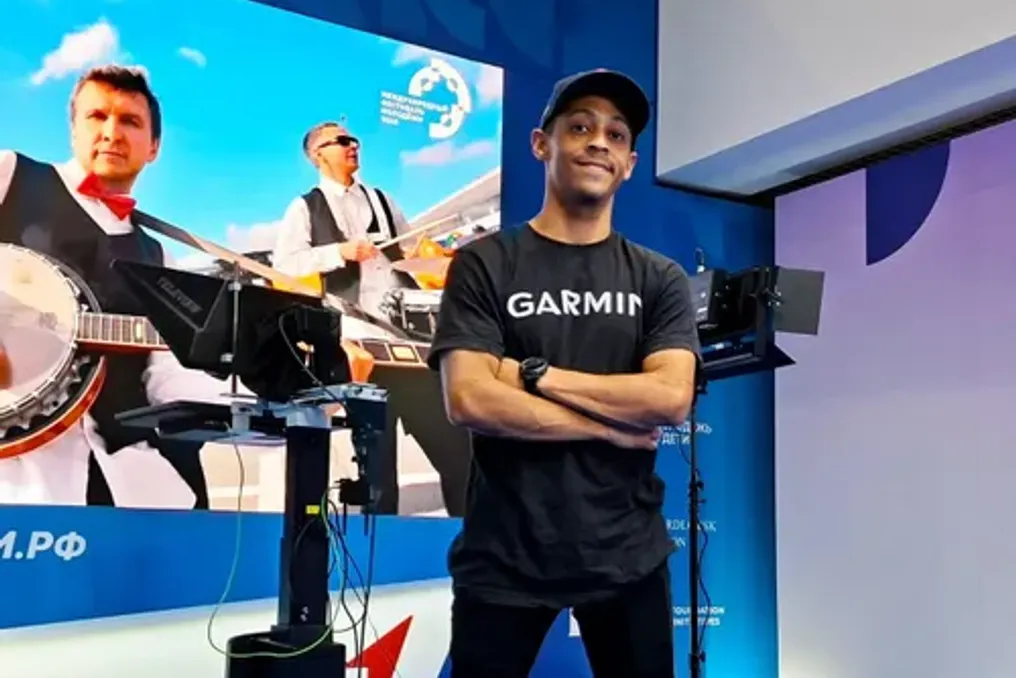
South African professional skateboarder Jean-Marc Johannes concluded his participation in the International Youth Festival in Yekaterinburg, Russia, with an updated vision, an expanded network of global innovators, and a firm resolve to stop acting cautiously.
Johannes understands the feeling when looking at a skateboarding trick and deciding that it is unattainable. He has spent enough time on attempts, falls, and retries to recognize this hesitation in other people.
Nevertheless, standing before participants at his first international masterclass in Russia, Johannes himself faced doubts. He admitted: 'I have never done anything like this internationally in my life.'
At the International Youth Festival in Yekaterinburg, he taught people how to approach what scares them. Furthermore, conversations outside the skatepark made him reflect on how often he allowed fear to hold him back from his own ideas.
Starting from the middle of the ramp
Johannes structured the masterclass by breaking down familiar tricks. Teaching proper foot placement was part of the exercise, but its main goal was to help participants understand why a trick they already knew could suddenly seem impossible in a new setting.
'I took one trick and broke down what makes it work,' Johannes explained. As an example, he analyzed the ollie technique and then asked participants to imagine performing the same movement over a car.
On the ramp, he gradually worked with the skaters. They started in the middle and moved towards the top, while Johannes asked them what changed as they progressed. 'I constantly asked what was different, and they answered: 'Actually, nothing',' Johannes recalled. He noted that participants expected the trick to be much harder if starting from the top, although the core technique remained identical.
He understood their hesitation. In the past, he dismissed tricks as impossible before the hard process of learning proved him wrong. 'I would tell myself: 'Okay, I can't do this trick. It's impossible',' Johannes said. 'And then, over time, painfully, I realized it was possible.'
Johannes shared knowledge about networking, overcoming fear, and finding inspiration outside the skatepark.
Arriving with his own doubts
The International Youth Festival required Johannes to adapt to a different type of international travel. Used to traveling solely for competitions with a schedule strictly tied to skateboarding, he now met innovators from fields such as science, medicine, engineering, business, and technology.
'I felt ready, but I was also a little scared,' Johannes admitted. 'It was a mix of everything: excitement, fear, and surprise.'
The event, part of the Next Generation Program, brought together various fields to exchange knowledge and discuss the future of youth innovation. It was estimated that about 7,000 people attended the festival, and Johannes felt he absorbed more than he expected.
'I felt like I absorbed knowledge equivalent to ten years just by talking to people from different sectors,' he said. These conversations went far beyond sports and touched upon topics he usually did not encounter during competition tours.
He was impressed not only by the projects but also by the conviction of the creators. During a conversation with a delegate from the energy sector, he was struck by their absolute confidence. 'They are so confident in themselves and believe in themselves so strongly that nothing else matters,' Johannes observed.
In Russia, Johannes saw a sharp contrast between the unwavering confidence of the invited delegates and how he himself often treated his ambitions. He had big ideas, but he easily found reasons to postpone them. 'Often you get an idea that is so big that it scares you,' he said. 'It scares you, and you automatically apply a filter that prevents you from moving forward.'
This experience prompted him to reconsider plans he had postponed for years. He realized that he himself was filtering his potential, worrying about obstacles instead of giving himself a chance to start.
Seeing how global youth were taking control of their dreams and dedicating themselves to working out of deep belief in its impact, his worldview completely changed. 'Even if it's grand, even if it's crazy, I am going to do it,' Johannes told IOL.
While Johannes absorbed others' work, he also shared his story, talking about his journey, the state of skateboarding in South Africa, and his vision for the sport.
A special moment for Johannes was the opening ceremony. He vividly recalled the electric reaction of the crowd to the performance of the African delegation. 'Africa completely blew up the hall,' Johannes said. 'When the drums started playing, my mouth dropped open from the energy.'
Bringing benefits home
Johannes does not want his experience to end as mere personal motivation. He is already developing strategies on how to apply this knowledge in South Africa to create better opportunities for local skateboarders and increase their visibility.
He carefully noted how other sports were organized, how platforms were created, and how projects were promoted outside his field. 'There are ways to adapt what we do so that we are seen more,' Johannes said. 'There is so much that I cannot wait to implement on my end.'
He intends to contribute beyond his personal time on the board. 'If I can help them in any way, even just with advice, that is what I want to do,' Johannes added.
Finale of the KARDO World Series
After the International Youth Festival in Yekaterinburg, on September 17, Johannes headed directly to Vladivostok for the finale of the KARDO World Series, which took place from September 16 to 20.
Due to lack of time, Johannes had about a day and a half for training: he flew from Yekaterinburg to Vladivostok and immediately began grueling training on the test track used by athletes from BMX, scooter, and other disciplines.
'That couldn't give you real, comfortable skateboarding practice,' he told IOL after the Series Finale.
} , 3. {