Water scarcity affects almost all industries in the American West. Although cloud seeding has long been discussed as a potential solution, its effectiveness has never been measured in a quantifiable way.
To address this issue, Rainmaker has raised $100 million to bring rain through cloud seeding. These funds will be used to expand the weather research team and reduce the cost of producing freshwater from cloud seeding.
The funding round was supported by NOA VC, Upfront Ventures, DCVC, Lowercarbon Capital, and Dream Ventures. These firms have previously invested in companies involved in climate infrastructure and hard technologies.
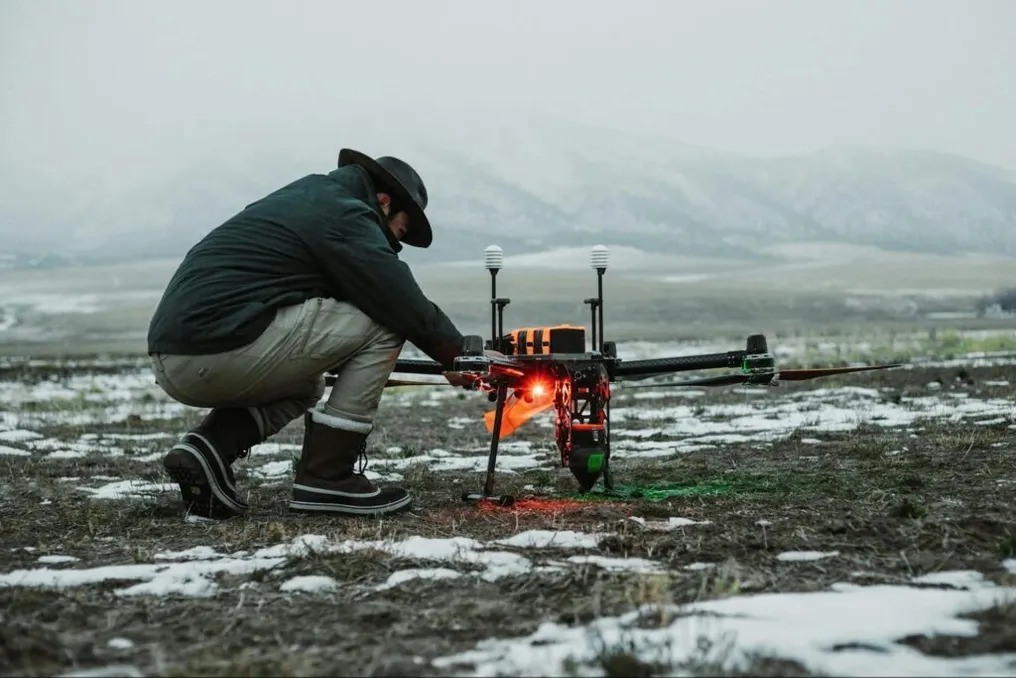
Rainmaker does not use expensive traditional piloted aircraft limited by weather conditions. Instead, the company deploys weather-resistant drones directly into winter storm clouds. The drone releases a small amount of silver iodide inside the cloud, which serves as a nucleus for ice crystal formation.
The innovation lies not only in the drone itself but also in the subsequent actions. Rainmaker uses its own radar to accurately determine the volume of additional rain or snow created by each flight. This kind of proof has always been missing in cloud seeding practice.
Earlier this year, the company became the first private firm to confirm the results of its cloud seeding using real data. Over a four-month period, the company registered 82 unambiguous seeding signatures. These are specific radar patterns that directly link precipitation to the seeding flight, rather than natural weather variability.
Collectively, these 82 signatures provided over 145 million verified gallons of fresh water, equivalent to nearly one year's water consumption for 1800 American households. The company demonstrated the ability not only to create precipitation but also to count it with a high degree of certainty.
In August, the team noted a significant increase in efficiency. Near Homer, Alaska, Rainmaker produced 19 million gallons in about three hours during a single operation, showing an improvement in technology regarding the volume of water per flight.
For regulators and local communities, result confirmation ensures transparency. Instead of general claims about seeding efficacy, Rainmaker can provide radar data for each flight and the amount of additional precipitation it generated.
For investors, validation reduces business model risks. Instead of selling a service that might prove ineffective, Rainmaker can sell measured gallons of new freshwater, similar to the assessment methods for desalination plants or water treatment facilities.
This shift from unmeasurable to measurable is what enabled the $100 million funding round. It moves weather modification from the field of atmospheric science into the realm of infrastructure.
The capital infusion will be directed towards achieving three main goals. First, expanding the research structure. Rainmaker positions itself as an atmospheric research organization, not just a water supply company.
Second, scaling operations across the American West. The direct focus is on cloud seeding to alleviate drought in western states where reservoirs and snowpack are critical.
Third, developing a technology stack to reduce costs. While desalination in California often costs over $1000 per acre-foot plus high energy consumption, cloud seeding has historically been estimated at $10–$50 per acre-foot when successful. Rainmaker aims to prove this cost at scale using verified data.