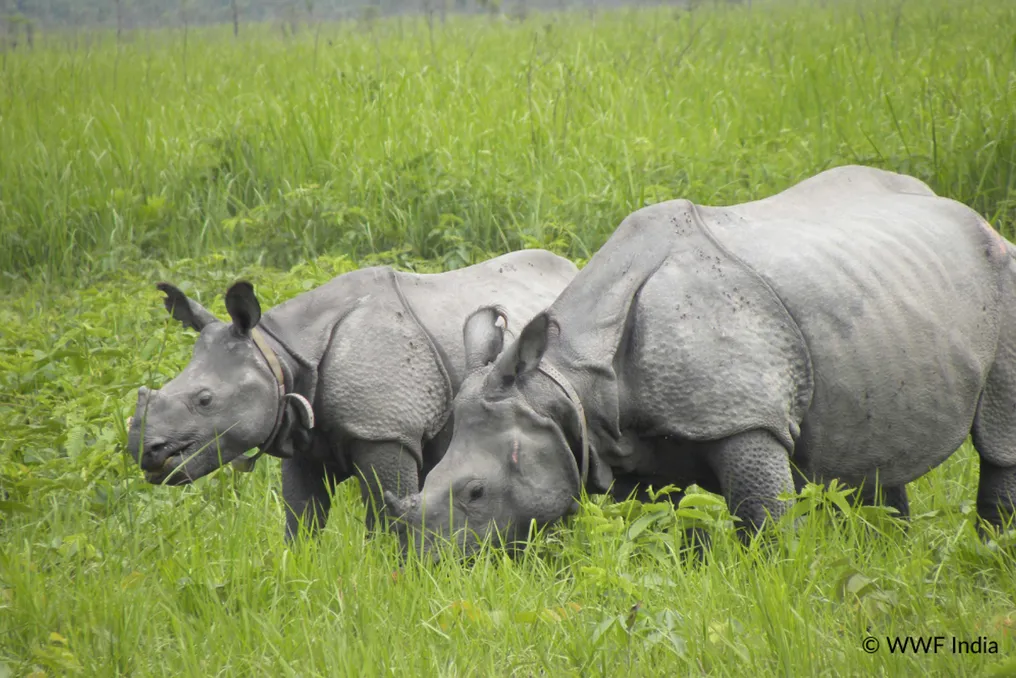
In the Manas Tiger National Park and Reserve (India), the population of the Greater One-horned Rhinoceros (Rhinoceros unicornis), which was previously absent from this ecosystem, has been successfully restored. After a population collapse in the late 1980s and 1990s due to civil unrest and intensive poaching, there were no rhinos left in Manas by the mid-2000s.
According to reports, there are currently about 40 rhinos inhabiting Manas, and they are reproducing successfully. A decade-long study tracking 42 reintroduced rhinos showed that the animals adapted to the landscape and began giving birth. A total of 35 calves were recorded in Manas between September 2012 and December 2021.
However, the success of the population recovery is overshadowed by the fact that the grassland vegetation, upon which the rhinos depend, is shrinking. In 1990, meadows constituted 53.61% of the Manas Tiger Reserve's territory, whereas by 2019, this figure had dropped to 30.24%, representing a decrease of 23.37 percentage points or a relative loss of 43.59% of grassland cover compared to 1990.
Restored Population
The disappearance of rhinos from Manas did not occur due to slow natural decline. The International Rhino Foundation notes that the species was eradicated from the park during the civil disturbances of the late 1990s. It was previously estimated that the population numbered over 80 individuals in the early 1990s, but none remained by the middle of the following decade.
The recovery began through the Indian Rhino Vision 2020 program, developed by the Assam Forest Department in collaboration with WWF-India, the International Rhino Foundation, and other partners. The program aimed to expand the Assam rhino population beyond its main habitat in Kaziranga and create additional viable populations, with Manas becoming the first major target.
Rhinos were moved from Kaziranga National Park and Pobitor Reserve. The program documented both wild animal translocations and the release of rescued and rehabilitated individuals. Among them, nineteen calves were born from transferred females, nine from rehabilitated rhinos, and five from first-generation females born in Manas. The latter figure is significant because the rhinos born in Manas are now contributing to the population increase themselves, which is a clear sign of the reintroduced population's adaptation to the new environment for conservation biologists.
Grass Under Their Feet
Manas's alluvial grasslands are an integral part of the landscape, supporting rhinos as well as pygmy hogs, hares, Bengal florican, wild buffalo, and other grassland-dependent species. However, a significant portion of this habitat is undergoing changes.
Data from the Assam government, presented in 2026, demonstrates the scale of these changes: grassland coverage decreased from 53.61% in 1990 to 30.24% in 2019. Officials attribute this decline to a combination of invasive plants, natural succession, changes in fire and flood regimes, overgrazing, declining herbivore populations, and disruption of conservation activities during civil unrest.
Thus, over four decades, a paradoxical shift has occurred: the return of large herbivores happens at a time when the open biotopes that support them are becoming harder to maintain. While some of these changes are natural, as meadows without disturbance can gradually be replaced by shrubs and trees, Manas also faces the problem of invasive plants.
The species Chromolaena odorata, among other invasive species, has spread into the grassland areas. The reserve management assessment also identified Leea crispa as a problem and recorded the invasion as a management weakness, noting that approximately 36.78 sq km across four areas of the initial core and first buffer zones have been affected by the invasion. Consequently, the ecological issue is more complex than simply 'more grass equals more rhinos'; the presence of the right grass in the right places and maintaining the openness of these areas is crucial.
How Can the Meadow Problem Be Solved?
Daraindhar Bora, a retired forest official and conservationist, recalls Manas before it became a model of conservation success. He served as an assistant forester and former deputy director of the Manas Tiger Project. When he arrived, the park was recovering from years of conflict, depleted protection, and environmental damage.
Bora remembers that the meadows were good then, but later the Bodo movement intensified in the late 1990s, leading to a very poor law and order situation and staff shortages in the forest. The consequences of this were evident in the landscape itself. He saw the spread of invasive species, such as Shimul and Siam weed, on degrading meadows, and tourism almost disappeared.
However, one encounter allowed him to view the landscape differently. Hearing the call of a deer, he saw the animals, and for him, this was proof that Manas was not lost. But he realized that bringing back animals would require more than just forest staff. He understood that local communities needed to be involved and understand the landscape.
As a representative of the Bodo community himself, Bora found that this facilitated communication with the locals. His approach focused on community participation, as he believed the meadow problem could never be solved without it. This logic also influenced the restoration of Manas: community organizations became part of conservation efforts, and local residents were increasingly involved in protection and tourism work. Bora does not reject tourism, viewing it as part of the economic and environmental equation, but insists on the need for control to prevent the uncontrolled nature that threatens wildlife, poaching, and meadows.
There Is a Plan
Manas is not starting the meadow restoration from scratch. In November 2021, an Action Plan for Meadow Management was approved after the park administration and conservation organizations began joint work on meadow restoration in 2017. The main measures of the plan are included in the park's operational plans, including the Tiger Conservation Plan. The plan involves mapping invasive alien plants, especially Chromolaena odorata; removing invasive species; restoring degraded meadows; involving communities and exchanging restoration methods in the wider sub-Himalayan grassland landscape. The idea is to make meadow restoration part of routine protected area management, not a temporary project.
In June 2026, Assam opened the first specialized grass nursery in the Bansbari Manas range. About 16 local grass species collected from different habitats in Manas since November 2025 are being grown there to provide planting material for restoring degraded meadows. Nevertheless, the restoration must compete with another factor—changes in land use.
The Land Use Issue
Furthermore, The Better India examined documents and records concerning land use, tourism infrastructure, and landscape management in Manas. Currently, a case regarding alleged encroachment on the Manas Tiger National Park and Reserve, including the Kokilabari seed farm, is pending in the Gauhati High Court. In August 2026, the court issued notices in a class-action suit regarding alleged unauthorized land grabs in areas including Panbari and Betbari. The plaintiff, environmental activist Rohit Choudhury, also raised the issue of the seed farm, where, he claims, a large area of land continues to be cultivated under the management of the Bodoland Territorial Council Agriculture Department.
The court ordered authorities to ensure no further encroachment on the tiger reserve until the next hearing, scheduled for October 7, 2026. It is important to note that these are allegations before the court, not a final judicial ruling. For a landscape losing grassland vegetation, such issues strike at the heart of why Manas is managed. How should the future of a parcel of land within a protected landscape that is still used for cultivation be determined?
The Tourism Dilemma
Rohit Choudhury, an ecologist who previously raised legal and regulatory issues related to Manas, points to another pressure point—tourism infrastructure within sensitive habitats. In an interview with The Better India, he noted violations of the National Tiger Conservation Authority (NTCA) Normative Standards from 2012 and the Tiger Project Guidelines. He is concerned about an eight-story tourist structure in Motanguri. According to documents obtained via RTI and provided by Choudhury, the project was approved for approximately 5.6 crore rupees, of which 4.3 crore was allocated, and construction began in 2017.
Choudhury refers to a letter dated April 5, 2022, from the field director of Manas Tiger Reserve to senior officials. In the document he provided, it stated that the structure was built inside the tiger's core/critical habitat and did not comply with the provisions of the Wildlife (Protection) Act, NTCA guidelines, and previous Supreme Court directives. The letter also indicated that the facility had not yet started operating, and its intended use would exacerbate the non-compliance.
The NTCA principles of 2012 stipulated a phased withdrawal of lodging tourism in tiger reserve cores, while the 2018 Supreme Court directives distinguished between forest guesthouses used by officials for conservation and management tasks and facilities used for tourism and overnight stays. Choudhury argues that these principles should guide decisions in Manas. The issue is particularly complex in Manas because tourism can also support nature conservation and local livelihoods. Therefore, the answer cannot simply be 'no tourism'; it must address questions of where, to what extent, and at what ecological cost?
The Next Test
Manas has already demonstrated that nature conservation can reverse local extinction. The rhinoceros disappeared, and then it returned. Now the question is whether the park can sustain the habitat between forests, rivers, and settlements? Can invasive plants be controlled before they displace native meadows? Can tourism remain within ecological limits?
Bora's recommendation is to restore grass, involve people, and control tourism. Scientific data points in the same direction: the rhinoceros can return to Manas.