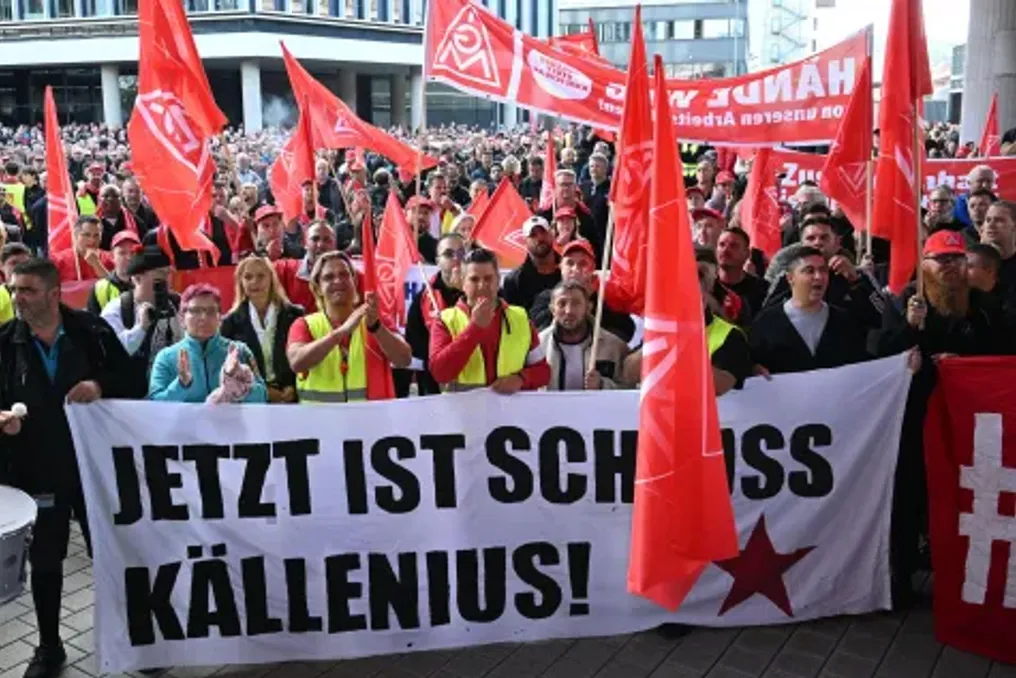
Workers in Germany's automotive industry held nationwide demonstrations on Monday, demanding that the government and management take measures to protect factories and jobs in an industry facing serious difficulties.
The German automotive industry is under severe pressure from growing competition from China, weak domestic purchasing power, and US tariffs. Volkswagen plans to cut 100,000 jobs by the end of the decade, which represents the largest structural reorganization in the history of the global automotive industry. Furthermore, Mercedes-Benz and BMW are also conducting staff reductions.
According to the union IG Metall, nearly 180,000 people participated in the protests across more than 280 sites throughout Germany. Jannik Hitzemann, a 31-year-old assembly line worker at the VW plant in Hanover, one of four potentially closing plants in Germany, told AFP that he is participating in the protests to put pressure on management to find alternative uses for the facility. He emphasized that losing his job would be devastating for him.
Speaking at the iconic VW plant in Wolfsburg, the world's largest by floor area, Christianne Benner, leader of IG Metall and a member of the VW supervisory board, stated that 'the situation has truly gotten out of control.' She noted that companies such as VW, BMW, Audi, Bosch, Mercedes, and Porsche, previously associated with high-quality cars, are now being led by management 'at full speed into a brick wall.'
Industry support is needed
Many attribute the industry's problems to management for starting the transition to electric vehicles too late and for slow investment in software. Others point to the Chinese government's support for its domestic automakers, which many in Europe believe has unfairly led to overproduction in the global automotive industry.
German Finance Minister Lars Klingbeil stated last week that he would insist that the European Union provide additional protection for continental car manufacturers against Chinese competitors, noting that one cannot be 'naive.' On Monday, Benner called on the government to lower energy costs, provide financial aid to suppliers needing to modernize factories, and promote domestic production adhering to 'Made in EU' rules.
She added that 'colleagues in these turbulent times should be able to count on protection of general welfare and industrial policy.'
Painful truths
Also speaking in Wolfsburg, Daniela Cavallo, head of the VW workers' council, presented some 'painful' truths to her colleagues. She stated that Europe's automotive industry will be transformed, and many long-established automakers will leave the market, while others will be forced to merge. She added that the battle over burden sharing has already begun, and the question is not what they will be asked to do as employees, but how they can collectively distribute the sacrifices fairly among themselves.
Wolfgang Schröder, a political scientist from the University of Kassel who studies labor relations, told AFP that the protests reflect deep concern about the future of the automotive industry. He noted that nationwide actions that are not related to wage negotiations or specific disputes with companies, but concern an entire sector and its problems, are a rather new phenomenon, expressing a 'real fear for the industry's future.'