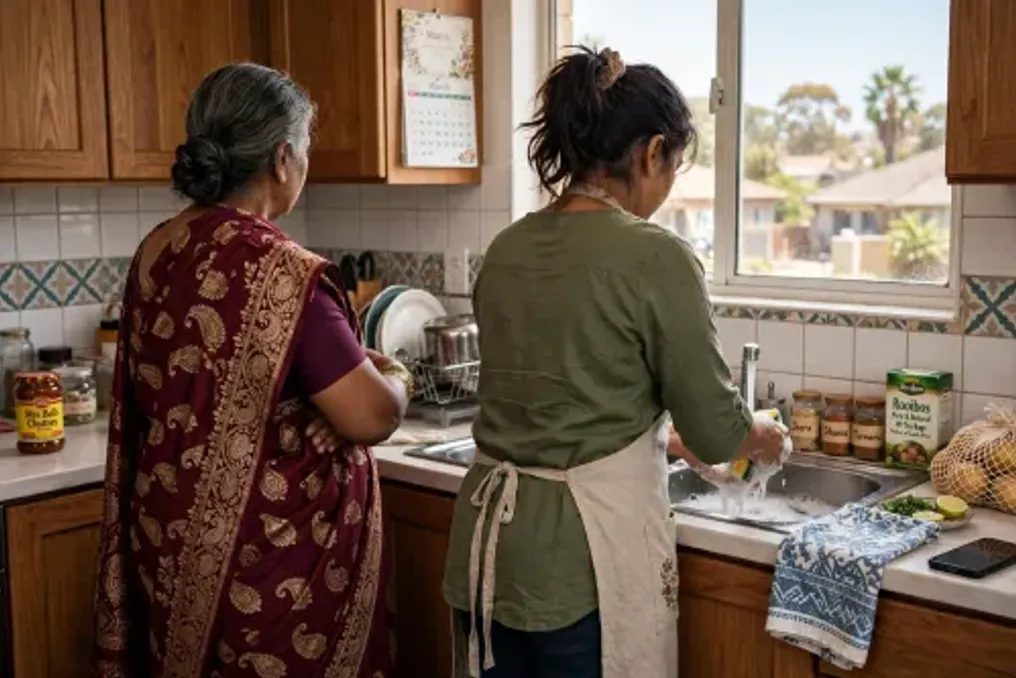
The article's author argues that household duties should not define a woman's character. As an example, cases are cited where mothers-in-law praise their daughters-in-law for managing 'domestic affairs,' which is a deeply ingrained problem in the Indian community: conditioning women to believe that their worth is measured by their efficiency in running a household.
A more alarming aspect is that often the women themselves perpetuate this culture. From an early age, girls are taught that competence in domestic life is not just a useful skill but a measure of their character. A girl who cooks is considered 'well-mannered'; one who maintains a flawless home is seen as a 'good wife'; and a daughter-in-law who anticipates everyone's needs is called a 'blessing.' However, a woman who states she does not want to spend her life on such tasks is sometimes labeled as selfish, lazy, arrogant, or incapable of caring for her family.
The author highlights the absurdity of a situation where what should be a shared human responsibility turns into a test of female virtue, forcing women to compete with each other for approval. Mothers-in-law judge their daughters-in-law, daughters-in-law compare themselves to other daughters-in-law, and women compete by comparing kitchens, children, clothing, careers, marriages, and culinary skills.
In this exhausting 'Olympics of Domestic Perfection,' no one asks the most important question: Are they happy? Do they have dreams? Do they know who they are outside the roles of wife, daughter, daughter-in-law, or mother? Society has become remarkably comfortable accepting a woman's ability to dissolve into service; the more she sacrifices, the more virtuous she becomes, and the more she is praised, despite her exhaustion.
However, perhaps we should stop romanticizing exhaustion. The phrase 'she does everything' should not be a compliment; it should prompt us to consider why other people do nothing. A woman should not receive a medal for being able to cook dinner while working a full-time job, raising children, caring for elderly relatives, and maintaining perfect order in the house. She should be given the freedom to say, 'I don't feel like cooking today,' and the world should keep turning.
It is also necessary to abandon the notion that domestic perfection is a sacred legacy that must be passed down from generation to generation. A grandmother surviving without a dishwasher, a mother cooking for ten people—that is wonderful, but it does not mean the daughter must repeat this performance to prove her worth. Progress implies that the next generation can live differently. If technology can ease life, it should be used; if the husband can cook, he should cook; if the children are old enough to clean, they should clean; and if the family can afford help, they should hire someone.
If a woman prefers to spend a Saturday morning writing a novel, drawing, studying, exercising, sleeping, traveling, or simply doing nothing, so be it. Her life does not become less meaningful because of a footprint on the kitchen floor. Perhaps we should ask why women are judged much harsher for an untidy home than men. A man returning from work might receive praise for his fatigue, whereas a woman might be criticized because dinner isn't ready. A man who cannot cook is often considered amusing, while a woman who cannot cook is sometimes viewed as inadequate. This is not tradition; it is a double standard, and we must dare to call it what it is.
The author does not want her daughters to grow up with the belief that the highest achievement is becoming a woman capable of doing everything for everyone else. She wants them to know that their life belongs to them. She wants them to receive an education without hearing that diplomas are useless because 'what's the point when you'll still be washing dishes.'
Of course, if they enjoy cooking, let them cook. But let it be because they love cooking, not because they fear being judged as bad women if they don't. Daughters need to be taught how to cook, but also how to earn money. They need to be taught how to maintain a home, but also how to build a career. They need to be taught how to care for others, but also how to care for themselves. They need to be taught how to serve food, but also that they do not exist to serve everyone. And most importantly—they need to be taught that housework is not unpaid labor for a woman. Because until men understand that domestic responsibility lies with everyone, women will continue to compete with each other over who can bear the heaviest burden.
The author does not want the next generation of Indian women to compete over who can sacrifice more. She wants them to compete over who can dream bigger. Who can walk into a room without guessing if someone has judged the state of their kitchen. The kitchen sink is not a measure of a woman's character. A flawless home is not proof of a good marriage. Perfectly cooked food is not evidence of good motherhood. And exhaustion is not a personality trait. The woman here is not to win the 'Domestic Goddess' Championship. She is here to live, think, create, discover, and become. And perhaps the most radical thing to teach daughters is this: you do not have to earn your worth by making yourself useful to everyone else. Your life can be more than the people you serve. An entire world awaits you behind the kitchen sink. Go and live in it.