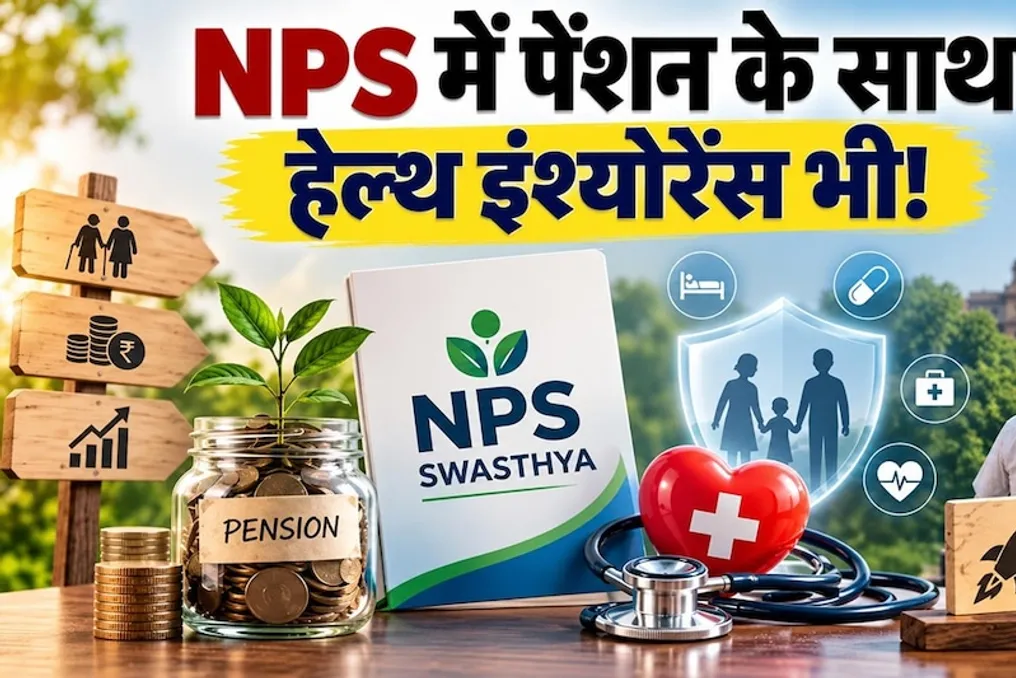
If a retirement savings scheme can also provide assistance for emergency medical expenses, it can be a significant support for people. With this idea in mind, the government is working to make the National Pension System (NPS) more attractive.
NPS now includes an option for health insurance and treatment expenses along with retirement savings. Under this facility, subscribers can use a portion of their savings for specified healthcare expenses. However, this amount will not come directly to the subscriber but will be provided directly to the hospital or the concerned healthcare institution.
The Pension Fund Regulatory and Development Authority (PFRDA) issued the operational guidelines for 'NPS Swasthya' on September 18, 2026, which became effective immediately upon issuance. The objective of these guidelines is to give people the option of making separate savings for retirement through NPS, as well as access to health insurance and healthcare. NPS Swasthya will be divided into two parts: NPS Swasthya Investment Account and a separate Super Top-Up health insurance policy. This means that while investments for retirement will continue on one hand, health insurance coverage will also be available on the other.
Any person eligible to join NPS can enroll in NPS Swasthya, provided they take the relevant insurance policy. Initially, the customer will have to deposit a certain amount, which includes the first year's health insurance premium, ₹200 for the annual maintenance fee of Health Benefit Alliance (HBA), applicable tax, and a minimum of ₹1,000 for investment in the NPS Swasthya account. The minimum amount for subsequent contributions has been set at ₹10.
The most important feature of NPS Swasthya is partial withdrawal for healthcare expenses. Subscribers can withdraw up to 25 percent of their total contribution for eligible healthcare expenses. It is important to understand that this amount will not come directly to the subscriber's bank account. In cases of healthcare expenses, the payment will be made directly to the concerned hospital, healthcare provider, or other institution. That is, if there are expenses related to treatment that are eligible under this facility, the payment will be made to the service providing institution through NPS Swasthya.
There is no fixed limit on the number of partial withdrawals. However, each withdrawal must be for an eligible healthcare expense, and in total, the subscriber can withdraw only up to 25 percent of their contribution. The money deposited in the NPS Swasthya account will be invested according to the investment pattern prescribed for the central government scheme.
This standard health insurance policy offers the option of Family Floater, which covers the subscriber along with their spouse and two dependent children. Parents will not be included in this Family Floater. The entry age for the policy is kept between 18 and 70 years, and the policy renewal can continue up to 85 years, although this depends on the premium, policy terms, and applicable rules.
The standard policy provides various Sum Insured options for Family Floater, including ₹1 lakh, ₹5 lakh, ₹10 lakh, and ₹30 lakh. Along with these, the annual aggregate deductible is set at ₹10,000, ₹50,000, ₹1 lakh, and ₹3 lakh respectively. In case of general hospitalization, the right to a single private room will be available, while ICU charges will be based on actual expenses. However, the final benefit depends on the sum insured and the final terms of the policy.
To put it simply: If a person is eligible to join NPS and opts for NPS Swasthya, they will initially have to pay the insurance premium, ₹200 annual maintenance fee, applicable tax, and a minimum investment of ₹1,000. After this, a minimum contribution of ₹10 can be made to the NPS Swasthya account. The deposited amount will be invested according to the prescribed investment arrangement. If healthcare expenses are required in the future, up to 25 percent of the total contribution can be used, but this amount will be paid directly to the hospital or the concerned healthcare institution.
PFRDA issued the operational guidelines for NPS Swasthya on September 18, 2026, and they are effective immediately. Registered intermediaries, HBA, and other concerned parties with PFRDA must follow these guidelines. This implies that the enrollment and processing of NPS Swasthya will now proceed under these operational rules. In short, the framework of NPS Swasthya attempts to connect NPS not just to retirement savings but also to health insurance and healthcare needs.