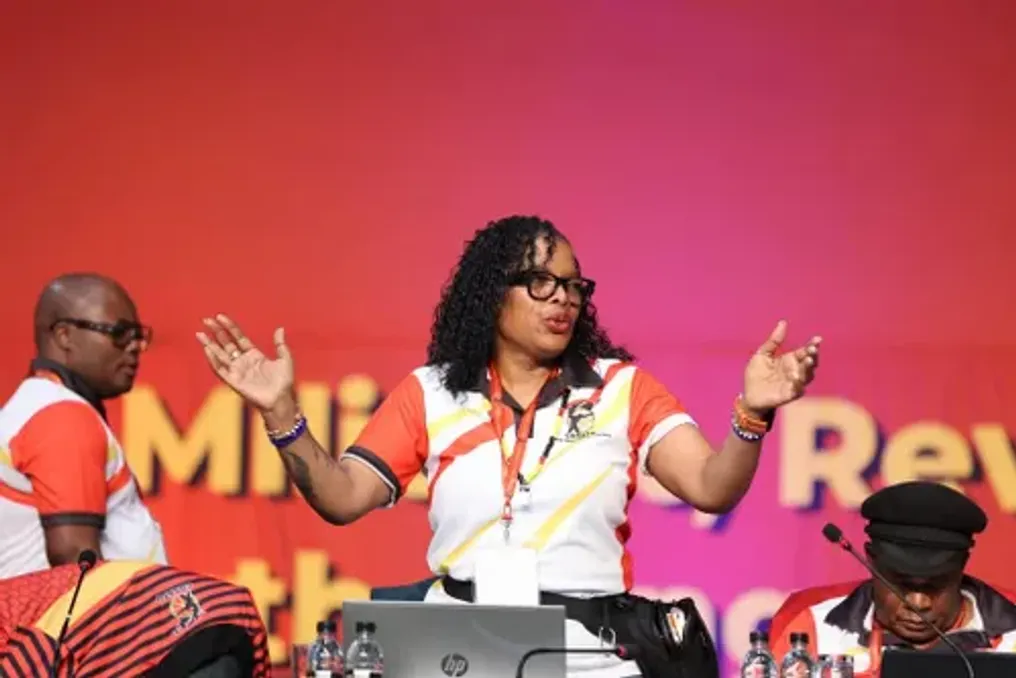
Cosatu President Zingiswa Losi addressed the federation's 15th National Congress, which was suspended after delegates failed to achieve the necessary quorum amid disagreements over leadership.
South Africa's largest trade union federation, Cosatu, stated that it had no choice but to postpone the congress, as holding it in its current form could not only weaken the organization but also lead to its division.
For the first time in 40 years, the SA Congress abandoned the four-day national meeting by the second day, primarily due to disputes over quorum. The event is now scheduled for October 12 to 15.
Matthew Parks, Cosatu's party coordinator, noted that this was a 'painful moment' and a 'moment of embarrassment,' adding that no one would want to see such a headline in the press. He emphasized that while damage was done, it could have been much greater, and that a degree of humility from all participants was required to decide not to proceed but to take a step back.
Parks explained that despite the imperfect headlines, they were better than a headline about a split, which would take years to overcome. According to him, this current crisis could be fixed within 30 days with a successful congress.
Furthermore, by postponing the conference, the federation's leadership considered events related to the expulsion of the South African Metallers National Union and its former General Secretary, Zwelinisima Vavi, from which the organization was still recovering.
'I think that's why there was a quick consensus during discussions about the possible postponement that this was the best option. It is much easier to endure embarrassing headlines for a week than to resume work in a way that unites Cosatu, instead of forcing a congress that would leave Cosatu divided for the next four years,' said Parks.
The Cosatu Congress, which gathers just over 1800 delegates representing 16 affiliated organizations, was set to begin on Monday and run until Thursday at the Gallagher Conference Centre in Midrand. It took place just eight weeks before the local elections on November 4 and could have served as a platform for workers to discuss socio-economic issues such as electricity costs, unemployment, economic stimulation, combating inflation, and other political, international, and organizational matters besides electing officials.
However, this week, these discussions took a backseat as delegates argued over authority for two days. Questions also arose regarding the right of federation deputy president Mike Singange to nominate and be elected, as his affiliated organization suspended his activities a few days before the meeting. Singange had been nominated by some affiliated organizations for the post of Cosatu president.
The third contentious issue concerned the number of delegates allocated to the retail affiliated organization SA Commercial, Catering and Allied Workers Union. Technically, the federation's constitution states that if a quorum is absent three hours into the scheduled meeting time, the session must be postponed and held within one month.
Parks reported that 'these were three general technical issues that dragged the congress into heated debates about whether we could continue.' He added that 'the political issue was that the Cosatu leadership and affiliated organizations are responsible for ensuring that the Cosatu congress leaves the federation stronger and more united. If the congress leaves Cosatu divided and therefore weakened, that is unfair.'
Therefore, the federation's leadership and all affiliated organizations decided that ultimately the tension was too high, there were significant disagreements on important authority issues, and it was better to postpone the congress, as provided for by the constitution, than to allow the congress to collapse when people simply walk out and the congress falls apart.
Parks confirmed that the Cosatu national office notified affiliated organizations of the date of the next congress on Thursday. This means that Cosatu, which reportedly spent about 32 million rand on the event held this week, will have to raise funds for the rerun. Parks noted that 'there is a huge price to pay. Cosatu spent about 12 million on the venue, catering, printing, and sound system, among other things, and affiliated organizations spent about 20 million on flights and accommodation for their delegates,' and added that the federation depends on workers' membership fees for its operations.
He concluded that 'it will be a difficult task to raise additional funds, and time is constrained because you have elections in two months, but the leadership had to maintain the unity of the federation, and that is a more important goal than rushing the event and consequently weakening the federation.'
Parks also insisted that the postponement of the meeting was necessary to allow affiliated organizations and Cosatu's leadership to resolve substantial procedural issues and ensure that when the congress resumes, Cosatu will be stronger.
The Cosatu Central Executive Committee is expected to hold a series of meetings to resolve the problems that led to the postponement. Furthermore, Cosatu is expected to determine its position regarding SACP's participation in the November elections separately from the ANC.
_