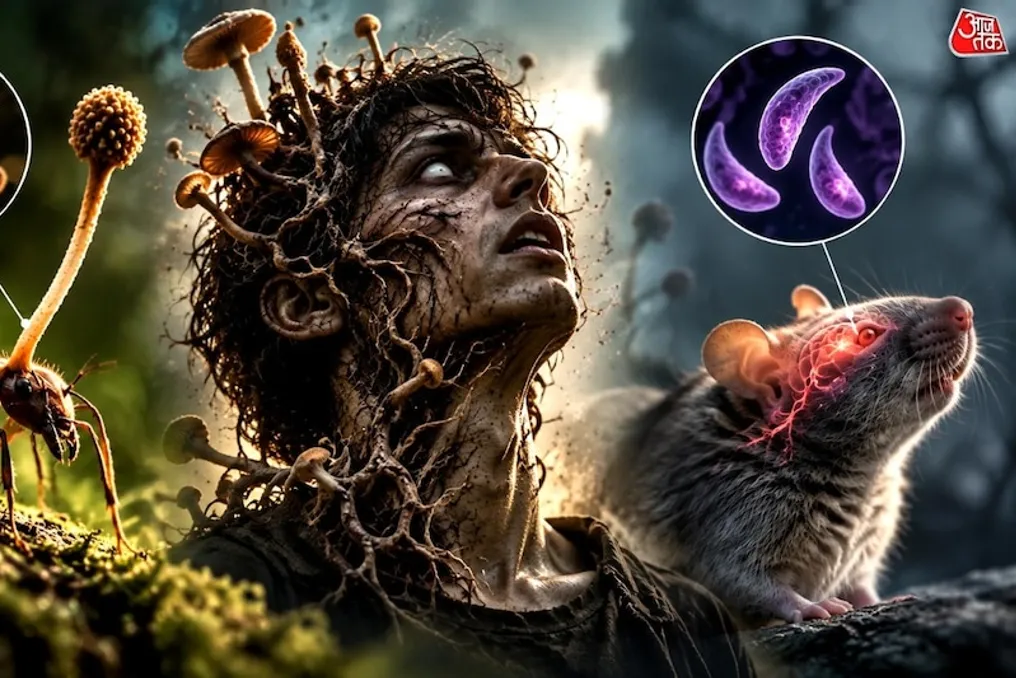
Imagine an invisible agent entering your body, altering your behavior, and directing it against you. This resembles zombie horror plots, but in nature, there are organisms that can control the behavior of other living beings for their own benefit.
Scientists have long studied these parasites and fungi. Although they do not resemble movie zombies, their impact is astonishing. For example, a fungus called Ophiocordyceps infects ants in forests. The infected ant stops following its usual route, begins climbing plants, and wraps its mandibles around a leaf or stem. After the ant dies, the fungus exits its body, releasing spores that become new prey for ants.
The scientific community continues to investigate how this fungus is able to influence the brain and behavior of the ant so precisely. This is considered one of nature's strangest mysteries.
It is not just fungi; a parasite called Toxoplasma gondii can alter animal behavior. This parasite affects rats, reducing their natural fear of cats. Cats become the primary victims of this parasite. When an infected rat is eaten by a cat, the parasite completes its life cycle. It can also infect humans, forming cysts in tissues, even the brain, for extended periods. However, there is currently no scientific evidence that this parasite turns people into zombies, and its effect on human behavior remains a subject of research.
Rabies is another real disease that attacks the nervous system. Infected animals and humans may exhibit confusion, anxiety, hallucinations, and unusual behavior. Unlike movie zombies, these symptoms are caused by a serious infection damaging the brain, and without treatment, this disease is fatal. The rabies virus is mainly transmitted through the bite of an infected animal, but it can be prevented by vaccination.
Scientific data indicates that the zombies depicted in films are not the result of any known organism's activity. The fungi controlling ants are specific to certain insect species. There is no evidence that the Cordyceps fungus can naturally turn a human into a zombie. Toxoplasma is also usually not transmitted directly from one person to another. These organisms depend on their specific hosts and do not demonstrate the level of control over humans seen in insects.
Nevertheless, the real story is more exciting than fiction. Evolution has given rise to organisms capable of influencing the behavior of other living beings. Sometimes this influence seems so incredible that it is hard to believe. They do not require any supernatural power; millions of years of process have given them superior biological mechanisms. Scientists are trying to find new drugs and methods of biological control by studying these systems. Movie zombies cause fear, but real parasites reveal the depths of science. Ophiocordyceps, Toxoplasma, and rabies show that behavioral control is possible in nature, but at present, there is no scientific probability of a zombie attack on humans. Research is ongoing, and we may learn more about these mysteries in the future.