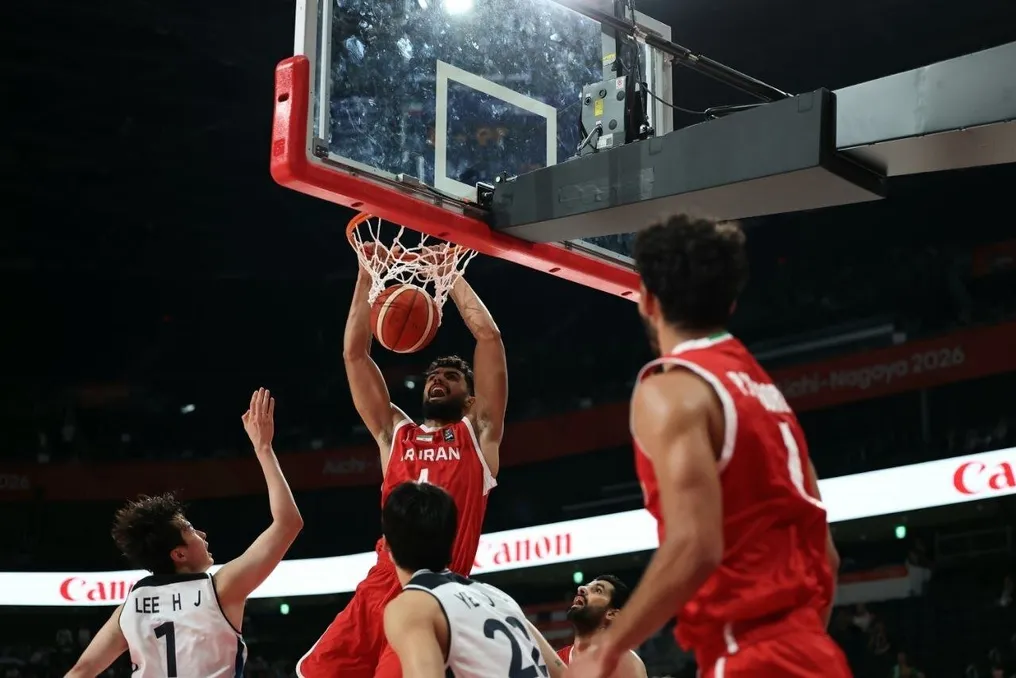
The Iranian men's basketball team left Nagoya with a bronze medal, which served as a reminder of the group's potential when their confidence, shooting accuracy, and defensive intensity work in harmony.
The victory over China with a score of 79-70 secured Iran's first medal at the Asian Games since 2018, as well as the delegation's first award at the Aichi-Nagoya competitions.
This result was particularly significant due to how it was achieved. After a heavy loss in the semi-finals to South Korea with a score of 77-51, Iran could have allowed disappointment to define the final match of its campaign. Instead, the team managed to recover after trailing by 17-12 in the first quarter, improved its perimeter shooting, and dominated the third quarter with a score of 26-15. Matin Aghajanour played for Iran, scoring 21 points, while Arsalan Kazemi once again demonstrated physical strength and ball-handling skills. China, for its part, struggled to counter Iran from beyond the three-point line and committed 16 turnovers.
This contrast may reflect a broader picture of this Iranian team. Its potential is clearly higher than recent inconsistency suggests. In Nagoya, Iran lost its opening match against Qatar with a score of 59-53, then defeated Taipei, Jordan, and Bahrain before suffering a heavy defeat to Korea in the semi-finals. The bronze medal match showed that the problem is not necessarily a lack of talent, but the team's ability to replicate its best level from game to game.
This issue will become even more relevant in the coming months. Iran's next major challenge is the FIBA Basketball World Cup 2027 Asian qualifying rounds; the fifth qualifying stage is scheduled from November 23 to December 1.
Iran is in Group E along with Australia, New Zealand, the Philippines, Jordan, and Syria; results from the previous round carry over. The top three teams from each second group, as well as the best fourth team along with host Qatar, will qualify for the World Cup.
For coach Sotiris Manolopoulos, the bronze medal in Nagoya is both an achievement and a warning. The medal can strengthen belief in the developing generation, but it should not hide the weaknesses exposed against Korea and during some Asian Games matches. Iran needs greater offensive stability, more reliable long-range shooting, and better performance under pressure.
A positive point is that the core of this team has already demonstrated the ability to compete. The next step is to turn sporadic performances, like the win against China, into a standard, not an exception. The bronze medal returned Iran to the podium. The World Cup qualifiers will show whether this team is ready to build something bigger.