
Despite declaring a national catastrophe, women continue to suffer from gender-based violence
Read more
IOL
iol.co.za

Despite declaring a national catastrophe, women continue to suffer from gender-based violence

After President Cyril Ramaphosa declared gender-based violence and femicide a national catastrophe on November 20, 2025, the event was perceived as a historic moment. This declaration, confirmed by state agencies in 2026, allowed the Disaster Management Act to be used as a basis for a coordinated national response. For many activists, human rights defenders, and legal experts, this represented a long-awaited recognition of the scale of violence afflicting the country.

However, the recognition itself is only the beginning. The true test lies in implementation, and it is here that the state fails women. To understand the significance of this declaration, one must examine the provisions of the Disaster Management Act. When an issue is classified as a national catastrophe, the state is legally obliged to mobilize resources, establish coordination structures, and take urgent measures to prevent further harm. This is not merely a symbolic gesture.

What the declaration actually requires

The declaration creates legitimate expectations among citizens that the government will act with the same urgency as during a flood, pandemic, or fire. Citizens have the right to expect visible strengthening of measures, rapid deployment of resources, and accountability mechanisms. Any deviation from this undermines the very purpose of the Act. Nevertheless, despite the existence of this framework, real life remains unchanged. A pattern of killings had long been observed in Kempton Park before the tragic death of Elizabeth Moselakgomo. The question arises: why were three or four bodies required before escalation occurred? Why are there nine female bodies in Ekurhuleni this week, with the latest found by the roadside in Kwathembe, Thembis, and another near Boxburg?

These cases are not isolated incidents; they represent a disturbing continuity of violence against women, and the state's slow reaction is unjustifiable. The gap between policy and lived experience is vast. We have legal recognition, we have a framework, we have a declaration, but we lack effectiveness, resources, or urgency. The Disaster Management Act is intended to prevent this complacency. It demands coordination between police, health, social development, and justice, as well as monitoring, reporting, and intervention. Yet, women continue to be victims, being killed while authorities appear paralyzed.

Why inaction can be illegal, not just unacceptable

As a lawyer, I cannot ignore the principle of legitimate expectations. When the government declares a national catastrophe, it gives citizens a legally binding promise. Women and children in South Africa have the right to expect protection, swift action, and systemic change. Failure to meet these obligations is not only a moral betrayal but also a legal one. According to the Promotion of Administrative Justice Act, untimely and unsatisfactory inaction can be challenged in court. The declaration of a catastrophe is not a political gesture but an administrative act that triggers statutory duties. When these duties are ignored, the public has the right to question whether the inaction is illegal. Courts have long recognized that administrative actions include the failure to make decisions when such a duty exists. In this context, the duty is clear, the expectation is lawful, and the delay is unjustified.

More than the story of one woman

Elizabeth Moselakgomo's story is not just about one woman. It speaks of a nation that has acknowledged the scale of gender-based violence but continues to fail in its duty. It concerns mothers, daughters, and sisters whose lives are cut short while the state apparatus hesitates. It is a call to condemn violent crimes and demand accountability from a government that has already declared this crisis a catastrophe. The time for symbolic gestures is over. The law demands more. People demand more. And Elizabeth's memory, along with eight other women in Ekurhuleni and countless others, deserves more.

Nkololazi Nomvulo is a legal director at a South African corporation and an attorney admitted to the High Court. She actively writes and speaks on issues of systemic accountability, gender justice, and the urgent need for reform.

Similar stories

Despite declaring GBVF a national catastrophe, murders of women continue in South Africa
Read more
iol.co.za

Despite declaring GBVF a national catastrophe, murders of women continue in South Africa

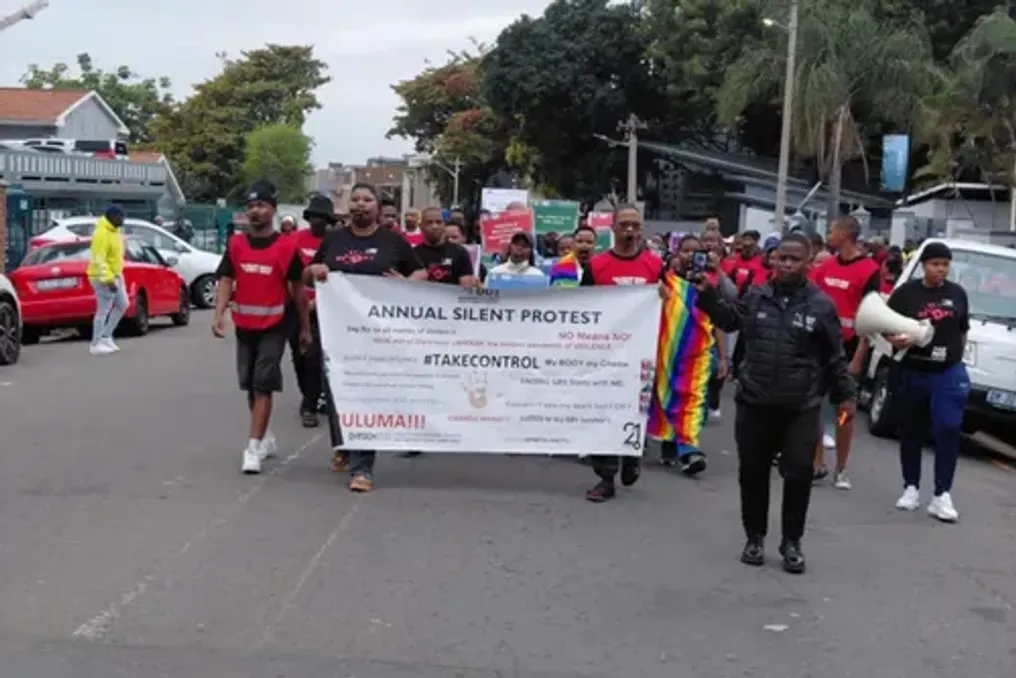
In South Africa, students and staff from DUT marched silently through Durban to honor the memory of victims of gender-based violence and femicide, and to call for an end to violence, fear, and silence.

In the eThekwini area, the body of a sixth woman was found in approximately two months. Police are investigating possible links between these cases but warn that it is too early to speak of a serial killer's guilt.

Nevertheless, this should not distract from the broader crisis. South Africa does not lack reports of GBVF; it lacks consequences, protection, and urgency.

The case of 38-year-old Elizabeth 'Ntontso' Moselakgomo intensified public anger. Moselakgomo, a mother, went missing after going for a run. Her family later identified her body at the Germiston morgue. The police deployed specialized resources to investigate her death alongside other murders.

The circumstances of the deaths are still being determined, and it would be irresponsible to claim that the women were killed by the same person before investigators establish that. However, six bodies in a concentrated geographical area demand an exceptional response.

Police have already involved multidisciplinary investigators and forensic specialists. One suspect is in custody in connection with the first body found in July. Investigators are now working to identify connections between these cases. Therefore, the public needs more than just assurances that investigations are underway; it needs results.

Because for the women living in eThekwini, the question is not whether the authorities will eventually explain what happened, but whether the state can prevent the next woman from becoming another case.

Murders in eThekwini occur against the backdrop of a national crisis. SAPS registered the murder of 569 women between April and June 2026, as well as 9201 rape cases. Over 60% of the rape cases sampled occurred in residential premises, challenging the notion that violence against women is a danger lurking somewhere outside the home.

The scale of this is precisely what led the government to classify GBVF as a national catastrophe in November 2025. This classification was intended to allow the government to coordinate its response, direct resources to the crisis, and strengthen accountability. The government also established a National GBVF Council to coordinate the national response.

However, almost a year after the declaration of the catastrophe, frontline organizations continue to report serious resource issues. The South African National Shelter Movement states that about 90% of shelters supported by them are struggling with funding and other forms of support. These facilities may be necessary for women trying to escape abusive homes, receive counseling, legal aid, or protect their children.

This reveals a fundamental contradiction. If GBVF is a national catastrophe, the infrastructure protecting its victims cannot be treated as a secondary issue.

South Africa is not alone in the fight against femicide. In Cameroon, reports indicate that over 120 women have been killed by intimate partners since the beginning of the year. In response, the government launched a three-month national campaign targeting femicide, domestic violence, gender inequality, and male dominance, focusing on prevention, reporting crimes, and prosecution.

Cameroon's campaign itself does not solve the problem. Campaigns only make sense when backed by functioning institutions. But the comparison raises an important question for South Africa: what does emergency action look like when a crisis has already been officially recognized?

It should mean swift police investigations. It should mean adequately funded shelters. It should mean prosecutors effectively handling cases. It should mean the enforcement of protection orders. It should mean early intervention when patterns of abuse emerge. And it should mean confronting the attitudes among men who normalize control, the right to dominate, and violence against women.

The most dangerous response right now will be another cycle of outrage followed by another declaration. The state has already acknowledged the problem. President Cyril Ramaphosa declared GBVF a national catastrophe, and the government established a status National Council and promised increased policing, survivor support, and prevention programs.

The question is no longer whether the government understands the crisis. The question is whether the system delivers results. This means publishing measurable targets for investigations, prosecutions, convictions, protection orders, shelter capacity, and police responsiveness. It means identifying where resources are lacking and addressing those gaps instead of creating another layer of bureaucracy. And it means that men must become part of the solution, not just receive instructions to condemn violence after another woman dies.

The women found in eThekwini cannot be reduced to statistics. Nor can the 569 murdered women in three months be reduced to statistics. South Africa has already named GBVF a national catastrophe. Now the state must act as if it believes its own declaration.

Women need to stop conforming to others' agendas and awaken their inner strength
Read more
iol.co.za

Women need to stop conforming to others' agendas and awaken their inner strength

The author argues that it is time for women to abandon following others' norms and start living in accordance with their true essence. As a life transformation coach with twenty-six years of experience, the author often ponders what is possible when a person stops living according to societal templates imposed upon them and starts living based on their authentic 'self.'

Especially women, whether they realize it or not, are subjected to humiliation and exploitation, and they are dictated how they should dress, behave, and speak. This conditioning is so deeply rooted that today some women continue to do this to other women, especially those who refuse to be modest and fit into someone's agenda.

A natural question arises: whose interests does our desire to 'fit in' serve? The answer is obvious—those who benefit from it.

For centuries, patriarchy, described as 'wounded or toxic masculinity,' held control over women. From an early age, they are instilled with the necessity to submit to family expectations, social norms, and religious dogmas. None of this created conditions for women to truly flourish.

Instead, they were told: 'Conform. Do what is expected. Put everyone else first.' They were taught to serve the needs, moods, and desires of others.

This list of expectations includes being a good daughter, a good wife, a good mother, a successful professional, a person who keeps everything under control, remembers everyone's birthdays, is always present, and ready to give. The author again asks whose interests this list serves and urges readers to consider where they stood in this line of expectations.

It is time to wake up. It is necessary to start questioning imposed norms instead of quietly agreeing. This is not a revolution, but rather an evolution that begins within the woman herself.

It is time to awaken the goddess within. This goddess represents a sacred part of the personality: bright, joyful, playful, creative, intuitive, wise, and caring. She is also a part of the personality possessing sovereignty. She knows her worth, is capable of saying no, has high standards for herself, realizes her potential, is absolutely true to herself, defends her beliefs, and radiates confidence. She embraces pleasure and leads other women on this wonderful journey toward their own divine state.

Some people, both men and women, may resist this awakening, especially if the conditioning is very deep. However, this change will not be suppressed. Many will look at you with admiration and respect, seeing you as a guide for other women ready to awaken their divine feminine energy.

Toxic men may oppose this process. But a man in his divine masculine state will provide safety, structure, and support for the women in his life, allowing the divine femininity to unfold in all its glory. He understands that with her rise, he rises too.

An era is dawning for the manifestation of both divine femininity and the divine masculine principle. The divine masculine principle is leadership, but it is based on kindness, not control. He is proud of his role as provider and protector not out of egoism, but out of love.

Too many men live in a state of wounded masculinity, unable to lead, provide, or protect, waiting for women to tell them what to do, support them, and take care of them. This state also requires healing, and it is achieved when women embrace their divine femininity.

A woman shining in her glory and greatness, knowing her worth and purpose, attracts the Divine Masculine principle in a man. He takes on the role of provider and protector, and the cycle closes. No more gender struggle, no more competition for power. Instead—wholeness, dignity, and fullness of being. From this arises sacred partnership—the next stage of our evolution.

Popular