Alison Botha expresses concern over lack of urgency in combating gender-based violence after discovery of nine women's bodies in Ekurhuleni
Read more
IOL
iol.co.za

Alison Botha expresses concern over lack of urgency in combating gender-based violence after discovery of nine women's bodies in Ekurhuleni

After surviving a horrific attack that nearly cost her life, Alison Botha has once again appealed to South African women for action. Her story, which took place more than thirty years ago, serves as a reminder of the ongoing issue of gender-based violence (GBV).

Botha was abducted by two men in Port Elizabeth (now Gqeberha) on December 18, 1994, when she was 27 years old. She was raped, subjected to over 30 stab wounds, and had her throat cut before being left to die. Despite her severe injuries, she managed to reach a road where she was found and taken to the hospital.

In an emotional video address, Botha shared her experience and questioned how much the situation regarding gender-based violence has changed since she began speaking out about the issue. She reminded viewers that she herself is a survivor of GBV, having been abducted and sexually assaulted in 1994.

More than 30 years later, the fight continues

Botha continued to publicly share her experience in the hope that it would help raise awareness and contribute to solving the problem of violence against women. Her attackers, Frans du Toit and Tuns Kruger, were convicted in 1995 and sentenced to life imprisonment. Both were released on parole in 2023 after serving approximately 28 years in prison.

However, Minister of Correctional Services Peter Groenewald revoked their parole in February 2025. The Department of Correctional Services confirmed that both men were re-incarcerated and remain in custody. For Botha, the more than 30 years have not brought the changes she hoped her story could inspire. She noted that the GBV crisis in the country has not improved but has, conversely, worsened.

Nine women died in Ekurhuleni

Her statement came amid South Africa grappling with the deaths of nine women whose bodies were discovered across Ekurhuleni since July. The first five bodies were found in the Kenton Park area, while the others were in Clayville, Olifantsfontein, Rodsfield, Kwateme, and Don Park.

According to the current Minister of Police, Firoz Kachali, eight of the nine victims have been identified, although only seven families had been notified at the time. Among those identified are Itumeleng Kekana, Elizabeth 'Tsonzo' Moselakgomo, Dineo Evelyn Motapane, and Gracis Nkomo. Police have launched a multi-faceted investigation into these deaths and are examining potential links between the cases.

The discovery of the ninth body heightened concerns about a possible serial killer, as similarities between some cases prompted the police to warn residents. Nevertheless, authorities have not confirmed that one perpetrator or group is responsible for all nine deaths; they announced the arrest of two women and one man in connection with the Don Park murder case. However, the murders have sparked new fear among women and anger from communities demanding answers.

For Botha, the discovery of the bodies served as a painful reminder that the violence she experienced more than three decades ago remains a reality for women across the country. She emphasized that these women, like many others, were not as fortunate as she was. Botha also questioned the level of urgency given to GBV, comparing it to the measures taken by the government during the Covid-19 pandemic. She cited the COVID-19 mortality rate in South Africa during the early stages of the pandemic, which was less than 5%, compared to the risk of GBV, which exceeds 33%.

A national-level GBV study by the Council for Scientific and Industrial Research showed that more than one in three women in South Africa aged 18 and older have experienced physical and/or sexual violence in their lifetime. Botha's main message concerned the lack of urgency regarding the GBV crisis in the country and the burden placed on women who are forced to defend themselves. She expressed fatigue with the need to constantly look over their shoulders and organize group outings. Botha believes that such restrictions are merely a temporary solution to a complex societal problem that requires fundamental change. She called on leaders to make significant, long-term, and real changes, supporting all women in South Africa.
Similar stories

Despite declaring GBVF a national catastrophe, murders of women continue in South Africa
Read more
iol.co.za

Despite declaring GBVF a national catastrophe, murders of women continue in South Africa

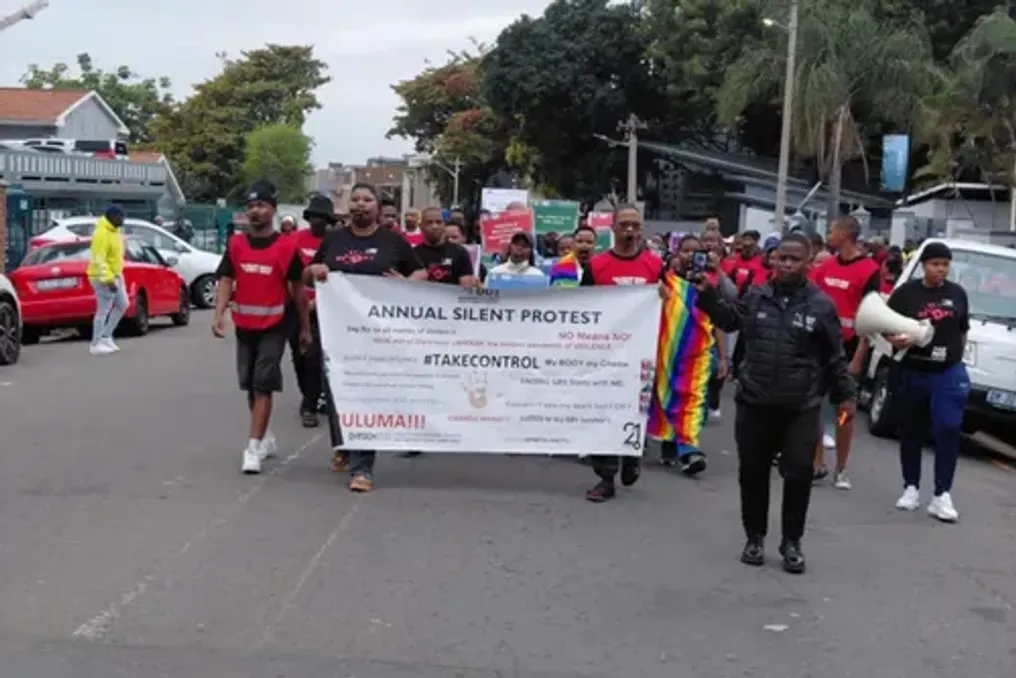
In South Africa, students and staff from DUT marched silently through Durban to honor the memory of victims of gender-based violence and femicide, and to call for an end to violence, fear, and silence.

In the eThekwini area, the body of a sixth woman was found in approximately two months. Police are investigating possible links between these cases but warn that it is too early to speak of a serial killer's guilt.

Nevertheless, this should not distract from the broader crisis. South Africa does not lack reports of GBVF; it lacks consequences, protection, and urgency.

The case of 38-year-old Elizabeth 'Ntontso' Moselakgomo intensified public anger. Moselakgomo, a mother, went missing after going for a run. Her family later identified her body at the Germiston morgue. The police deployed specialized resources to investigate her death alongside other murders.

The circumstances of the deaths are still being determined, and it would be irresponsible to claim that the women were killed by the same person before investigators establish that. However, six bodies in a concentrated geographical area demand an exceptional response.

Police have already involved multidisciplinary investigators and forensic specialists. One suspect is in custody in connection with the first body found in July. Investigators are now working to identify connections between these cases. Therefore, the public needs more than just assurances that investigations are underway; it needs results.

Because for the women living in eThekwini, the question is not whether the authorities will eventually explain what happened, but whether the state can prevent the next woman from becoming another case.

Murders in eThekwini occur against the backdrop of a national crisis. SAPS registered the murder of 569 women between April and June 2026, as well as 9201 rape cases. Over 60% of the rape cases sampled occurred in residential premises, challenging the notion that violence against women is a danger lurking somewhere outside the home.

The scale of this is precisely what led the government to classify GBVF as a national catastrophe in November 2025. This classification was intended to allow the government to coordinate its response, direct resources to the crisis, and strengthen accountability. The government also established a National GBVF Council to coordinate the national response.

However, almost a year after the declaration of the catastrophe, frontline organizations continue to report serious resource issues. The South African National Shelter Movement states that about 90% of shelters supported by them are struggling with funding and other forms of support. These facilities may be necessary for women trying to escape abusive homes, receive counseling, legal aid, or protect their children.

This reveals a fundamental contradiction. If GBVF is a national catastrophe, the infrastructure protecting its victims cannot be treated as a secondary issue.

South Africa is not alone in the fight against femicide. In Cameroon, reports indicate that over 120 women have been killed by intimate partners since the beginning of the year. In response, the government launched a three-month national campaign targeting femicide, domestic violence, gender inequality, and male dominance, focusing on prevention, reporting crimes, and prosecution.

Cameroon's campaign itself does not solve the problem. Campaigns only make sense when backed by functioning institutions. But the comparison raises an important question for South Africa: what does emergency action look like when a crisis has already been officially recognized?

It should mean swift police investigations. It should mean adequately funded shelters. It should mean prosecutors effectively handling cases. It should mean the enforcement of protection orders. It should mean early intervention when patterns of abuse emerge. And it should mean confronting the attitudes among men who normalize control, the right to dominate, and violence against women.

The most dangerous response right now will be another cycle of outrage followed by another declaration. The state has already acknowledged the problem. President Cyril Ramaphosa declared GBVF a national catastrophe, and the government established a status National Council and promised increased policing, survivor support, and prevention programs.

The question is no longer whether the government understands the crisis. The question is whether the system delivers results. This means publishing measurable targets for investigations, prosecutions, convictions, protection orders, shelter capacity, and police responsiveness. It means identifying where resources are lacking and addressing those gaps instead of creating another layer of bureaucracy. And it means that men must become part of the solution, not just receive instructions to condemn violence after another woman dies.

The women found in eThekwini cannot be reduced to statistics. Nor can the 569 murdered women in three months be reduced to statistics. South Africa has already named GBVF a national catastrophe. Now the state must act as if it believes its own declaration.

Popular