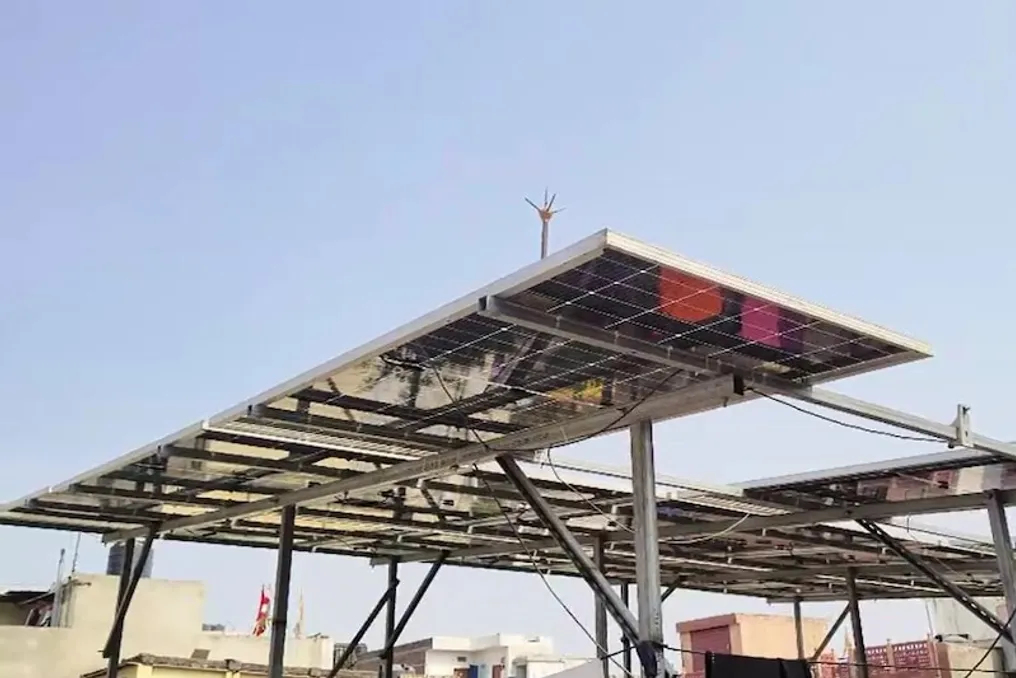
The possibility of installing solar panels on a home roof allows for reducing electricity bills to zero, and with excess generation, earning additional income. This refers to the 'RoofTop Solar Scheme' program implemented by the Government of Delhi. The most significant aspect of this initiative is that qualified consumers can install a system without any initial costs on their part.
Under this government program, solar energy systems up to 3 kilowatts will be installed completely free of charge. To begin the process, a roof must be available, and subsequent steps depend on an inspection and assessment of compliance with requirements. The Delhi portal opened the opportunity to apply for this program starting September 21, 2026. The government's goal is to connect about 230,000 homes to rooftop solar installations by March 2027, achieving a total capacity of 500 megawatts.
The assistance is intended for households that are electricity consumers. The possibility of installing a solar system on the roof depends on the technical condition of the building, the availability of free space, and the load-bearing capacity of the structure. One of the key conditions of the Delhi program is the necessity of ensuring sufficient roof load capacity to accommodate rooftop solar panels.
Another important requirement is that monthly electricity consumption must not exceed 400 units. According to the Delhi portal, a system of 1–2 kW is suitable for homes with average consumption up to 150 units, while for homes consuming between 150 and 300 units, a 2–3 kW system is appropriate. For homes consuming over 300 units, a system exceeding 3 kW may be suitable.
Delhi's policy provides a model that allows consumers to implement rooftop solar installations without investing startup capital. This mechanism is realized through RESCO/Hybrid RESCO models. In this case, the solar energy developer covers the installation cost, and the consumer benefits from the metering system (net metering). This model is particularly useful for families who have a roof but do not have the funds for the initial financing of solar panel installation.
Some of the electricity consumed in the house is generated directly on the consumer's roof. This reduces the consumption of energy from the main grid, leading to a lower bill. According to the Delhi portal, rooftop solar installations can reduce household electricity consumption to less than 200 units, allowing the consumer to benefit from a zero electricity bill discount.
However, this will not happen automatically in all homes. Actual savings will depend on actual electricity usage, the power of the solar system, and its real performance. It should be noted that in Delhi, electricity up to 200 units is provided free of charge. For consumption between 200 and 400 units, half the tariff is charged, and for anything exceeding this limit, the full tariff is paid according to current rates.
If the solar system generates more electricity than the house requires, there is a mechanism to feed this surplus energy back into the main grid. Delhi's policy includes providing generation-based incentives combined with a net metering system. According to the Delhi portal, a subsidy of 3 rupees per unit of generation is available for systems up to 3 kW. For systems ranging from 3 kW to 10 kW, this incentive is 2 rupees per unit. Thus, the benefit of solar energy is not limited only to reducing electricity bills; depending on the system's capacity and program conditions, it is possible to earn income from surplus electricity.
If planning to install a system larger than 3 kW, one can utilize subsidies under the central 'PM Surya Ghar Yojana' program. According to the official Delhi portal, central support is provided: 30,000 rupees per kW for the first 2 kW and 18,000 rupees per kW for each additional kW. The maximum central assistance for systems of 3 kW is capped at 78,000 rupees. Additionally, a regional subsidy from the Delhi government is available based on selection criteria. Consequently, the overall gain from systems over 3 kW is determined not only by one subsidy but by the combination of aid from the central and state governments.
Applications for rooftop solar panels in Delhi are submitted through the official Delhi Solar Portal. The application window was activated on September 21, 2026. After submission, a technical team will conduct a check to determine if the roof is suitable for solar system installation. The portal also considers the presence of unshaded roof area when determining the system capacity. A system of about 1 kW may require an area of about 10 square meters, although the actual requirement depends on the roof structure and system design. The Government of Delhi aims to significantly expand the use of rooftop solar installations, setting a goal to connect about 230,000 homes and create a total rooftop solar capacity of 500 megawatts by March 2027. This means that in the coming months, roofs in Delhi will function not just as part of a residential home, but as small electricity generators.