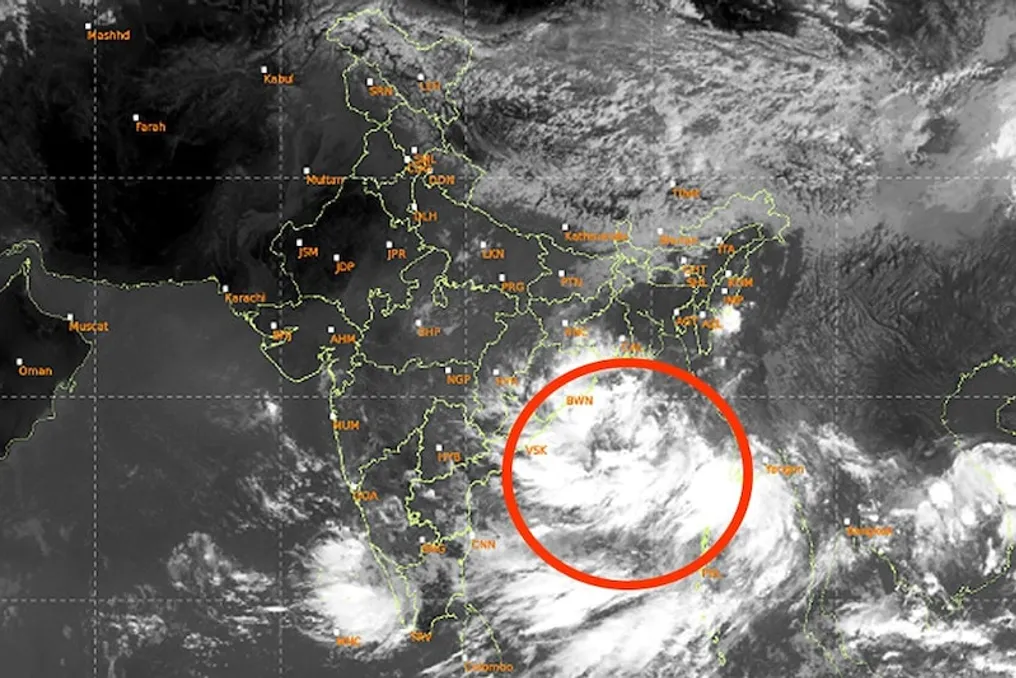
India is currently facing two major weather threats: the strengthening of El Niño in the Pacific Ocean and the possibility of a cyclonic storm in the Bay of Bengal. According to the Meteorological Department, if the low-pressure system in the Bay of Bengal strengthens further and transforms into a deep depression or cyclone, it will be named Arnab. This system may become active between September 20 and 25.
This situation has increased the risk of heavy rainfall and strong winds in several coastal states, including Odisha and North Andhra Pradesh. Simultaneously, there is an existing apprehension of drought and low rainfall in many parts of the country due to the effects of El Niño. The simultaneous occurrence of these two threats could have serious consequences for India's weather.
According to the forecast of the India Meteorological Department (IMD), the low-pressure area formed in the Andaman Sea will strengthen further in the next two days. This depression may turn into a deep depression on September 21 and September 22. It is estimated that by September 23, it could reach the west-central Bay of Bengal near the coast of Andhra Pradesh-South Odisha and its adjacent northwest.
The Meteorological Department has issued a special warning for South Odisha and North Coastal Andhra Pradesh. Heavy to very heavy rainfall is expected in some places in these regions on September 23 and 24. Additionally, heavy rain is anticipated in various places in South Chhattisgarh on September 24. In Chhattisgarh and Telangana from September 23 to 25, while Vidarbha may experience heavy to very heavy rainfall on September 24 and 25.
In Odisha, winds of 50-60 km/h with gusts up to 70 km/h are estimated during September 23-24. On the coasts of South Odisha and North Andhra Pradesh on September 23, winds of 55-65 kilometers per hour may blow. Strong winds are also likely on the coasts of South Andhra Pradesh and West Bengal during September 23-24.
The impact of rainfall will also be visible in Eastern India. Heavy rainfall may occur in the Andaman-Nicobar Islands and Ganga West Bengal between September 20 and 26. Rainfall is expected to increase in Jharkhand, Odisha, and Sub-Himalayan West Bengal-Sikkim between September 22 and 26. Heavy rainfall is predicted in Bihar between September 24-26, while very heavy rainfall is possible in Sub-Himalayan West Bengal and Sikkim on September 25. These areas face an increased risk of floods, waterlogging, and crop damage.
The strengthening of El Niño in the Pacific Ocean raises the possibility of drought and famine-like conditions in many parts of the country, as El Niño generally weakens the monsoon and increases heat. Meanwhile, the cyclonic system in the Bay of Bengal can bring heavy rainfall to coastal states.
The simultaneous activation of both situations has made the weather pattern more complex. On one hand, water scarcity may increase in some areas, while on the other hand, flood-like situations can arise in coastal areas. This dual problem can pose a major challenge for agriculture, fisheries, and coastal populations.
The Meteorological Department is continuously monitoring this system, and rainfall is expected to continue in many parts for the next 5-6 days. Administrations of coastal states are being advised to make advance preparations, and fishermen may be warned not to go into the sea. Residents of areas prone to heavy rainfall should be prepared to move to safe places, and measures must be taken to maintain drainage systems and protect crops.
If Cyclone Arnab develops, its impact will not be limited to rainfall; strong winds can fell trees, break electricity poles, and disrupt transportation. Sea waves can also rise high in coastal areas.
Therefore, local administrations should keep relief materials, medical teams, and rescue teams ready. General citizens should pay attention to the updates provided by the Meteorological Department and avoid non-essential travel. Considering the long-term effects of El Niño, focus must also be placed on water conservation and relief work in drought-affected areas.
In summary, this is a time of a dual weather challenge. Both the Bay of Bengal system and the Pacific Ocean's El Niño can create abnormal weather conditions in many parts of India. Timely vigilance and preparation can significantly reduce the damage, and adhering to the alerts of the Meteorological Department and instructions of local administration is extremely important.