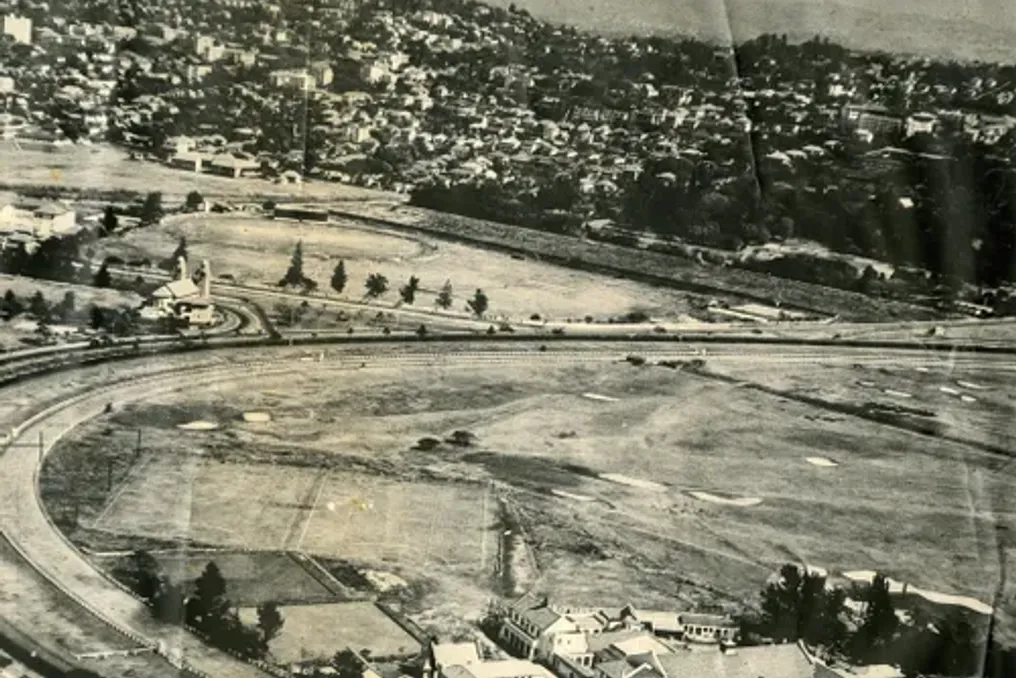
Curries Fountain Stadium, widely known as 'Curries,' got its name in the 1870s when a water purification station was located in this area, which was the first reliable source of water in Durban. Although the water purification station and the Currie's Fountain tower themselves have long since disappeared, the name remained (without an apostrophe) after the area was converted into a sports ground.
Originally situated in the marshy West Valley, or 'flats,' this ground officially became a sports facility for the Indian community in 1925. It was equipped with areas for golfers, cyclists, athletes, tennis players, as well as a constantly growing number of football and cricket players. Over the next six decades, it became the main football ground in Durban not only for Indians but for 'non-Europeans' in general. When the initial lease expired in 1950, the site featured six football pitches, four cricket pitches, three tennis courts, a nine-hole golf course, a quarter-mile running track, a changing room, and a clock tower.
Boxing
In the late 1940s, boxing promoter Nate Mudli organized an open boxing tournament at Curries, where local favorite Manny Dixon fought Alex Makela. This tournament was positioned as the first electrically lit boxing tournament for non-Europeans in the country.
Two legendary fighters from Curries—Elijah 'Tap Tap' Makhathini and Maxwell Malinga—became famous here. In 1971, Malinga lost to Makhathini, but won against him in a rematch at Curries in 1972. In 1974, Malinga drew over 10 rounds with American Alvin Anderson, then ranked No. 6 in the world by the Boxing Council.
During its heyday in the early 1970s, Makhathini was considered one of the best fighters in the country. He won 11 consecutive matches at Curries before facing Joseph Sishi for the Natal (non-white) light-heavyweight championship in 1971. In September 1972, he defeated his first international opponent, Curtis Cox, a former world light-heavyweight champion, at Curries. Natal light-heavyweight champion Joseph Sishi competed in 43 bouts at Curries. The venue also provided opportunities for several Zimbabwean residents (then Rhodesians), the most famous being Mohammed 'Tar Baby' Afonso. Tar Baby fought against boxers such as Fraser Mamela, Phineas Mthembu, Joe Ngidi, and Joseph Sishi at Curries.
Golf
The Durban Golf Club (DGC), formerly known as the Durban Indian Golf Club, was founded in 1928. With the assistance of the Durban Indian Sports Grounds Association (DISGA), nine tees and greens were developed on the boundary of Curries Fountain. The standard par for the course was 68, and membership fees were two shillings and sixpence, with a monthly subscription set at one shilling. This was intended to be the first golf course for non-Europeans in the country and a home for Indian golfers, especially in Natal, for over 25 years. The club was only allowed to use the golf course on Saturday and Sunday mornings, and during times when football or cricket matches were not taking place.
Football
One of the significant events of the 1930s was the tour by an Indian football team that played a series of matches across the country, including Curries, in 1934. In 1949, the 19th round match of the Sam Kine Cup took place at Currie, when South Natal defeated North Natal 3-0 in front of 15,000 spectators. The name Sam Kine entered the memory of many generations of Indians in South Africa as the name of the premier football competition in which Indians participated nationally for almost seven decades.
The last tournament at Curries was in 1969, when a match between South Natal and Western Province drew 25,000 spectators, with South Natal winning 3-1. Despite stated non-racial policies, in the late 1940s, a pattern of inter-racial football tournaments for the Singh Trophy began between African, Indian, and Coloured teams, which continued until 1960. From the 1950s onwards, football played separately by Africans, Indians, and Coloureds was increasingly held on the same ground, albeit with racially segregated teams.
On September 30, 1951, the South African Soccer Federation (SASF) was founded and launched at Curries, followed by a friendly match between national African, Coloured, and Indian teams to commemorate this historic event. The first match of the South African Soccer League (SASL) at Curries took place on April 9, 1961, between Aces United and Blackpool United.
Teams such as Orlando Pirates, Moroka Swallows, Real Fighters, Avalon Athletics, Lincoln City, Hearts, Maritzburg City, and Aces United participated in professional divisions that quickly became successful. Large crowds came to watch star players at Curries. After a four-year hiatus, professional football gained momentum with the creation of the Professional Football League (FPL). Sponsorship was a serious issue for non-racial organizations, and the FPL faced difficulties in this regard. Undeterred, the FPL carried out its activities with the help of volunteers from the undertaker's shop on Grey Street.
The FPL was launched with seven teams: Avalon Athletics, Aces United, Verulam Suburbs, Manning Rangers, Maritzburg City, Chatsworth Rovers, and Transvaal United, with sponsorship of 4000 Rand secured from employers RK Naidoo and Stellenbosch Farmers’ Winery (SFW). By 1971, the FPL had taken on a national character, and teams from Cape Town began joining it. Later, Berea, Cape Town Spurs, Glenville, Bluebells, Dynamos, Swaraj, and Sundowns joined the League. Although sponsorship was always a concern for the FPL, the efforts of several people secured sponsorship, and within 10 years, 15 clubs competed for a total prize fund of 100,000 Rand. FPL Cup finals were the biggest football events of the year. Since its founding in 1969, SFW had been the main sponsor of the Mainstay League Cup, and later Coca-Cola bottles began sponsoring at 5000 Rand in 1974, when the Mainstay Cup was replaced by the Coca-Cola Shield.
The FPL faced a severe decline when all sponsorships were withdrawn, leading to a fundraising campaign titled 'Save the Federation.' In 1979, the FPL presidency passed from RK Naidoo to Ashwin Tricamjee, marking a new era in the League's history. The United Tobacco Company Cup in the 1960s, the Mainstay Cup in the late 1960s and early 1970s, and the Coca-Cola Cup finals in the 1970s drew full stands at Curries, filled with young and old fans, vendors, police and their dogs, businessmen, politicians, dignitaries, beauty queens, sponsors, and gangsters.
The FPL ceased to exist in 1990 to join the NPSL, forming the National Soccer League (NSL), thereby closing a 65-year chapter of football history at Curries.
Politics
Political gatherings at Curries date back to 1913, when a large number of Indians gathered at Curries to protest the tax legislation of the period. NIC elections were held at Curries in 1945, where a radical faction of NIC was elected, steering the organization onto a different political path.
In 1946, the Women's Action Committee of the Passive Resistance Council held a five-day 'Freedom Fair' to raise funds for the passive resistance campaign. Bans, house arrests, and trials for treason led to a brief decline in political activity in the early 1960s, which was revived by the Black Consciousness Movement (BCM) in the late 1960s, leading to the formation of the South African Students' Organisation (SASO).
The 1970s were characterized by another phase of political activity and resistance, preceding the Pro-Frelimo rally planned for Curries in 1974. A violent clash with the police at the banned rally was followed by the arrest and detention of several BCM leaders in the mid-1970s, some of whom were imprisoned on Robben Island.
The formation of the United Democratic Front (UDF) and the COSATU trade union in the 1980s shifted the leadership of the anti-apartheid struggle. Curries became a primary venue for these struggles from the mid-1940s. These include the 1946 passive resistance rally and the rallies against the Group Areas Act in the 1950s, the Defiance Campaign rally in 1952, the Pro-Frelimo rally in 1974, and subsequently in the 1980s, rallies of affiliated COSATU, Sayco, MAWU, SACOS, UDF, and IFP.
In the 1990s, it was a preferred venue for rallies of the ANC Women's League following its relaunch, as well as the first SACP rally in KZN thirty years after the lifting of bans. It was also the site of the Mkhonto WeSizwe rally in 1993, when the liberation army was in the process of disbanding into the People's Army.
} , 3. {