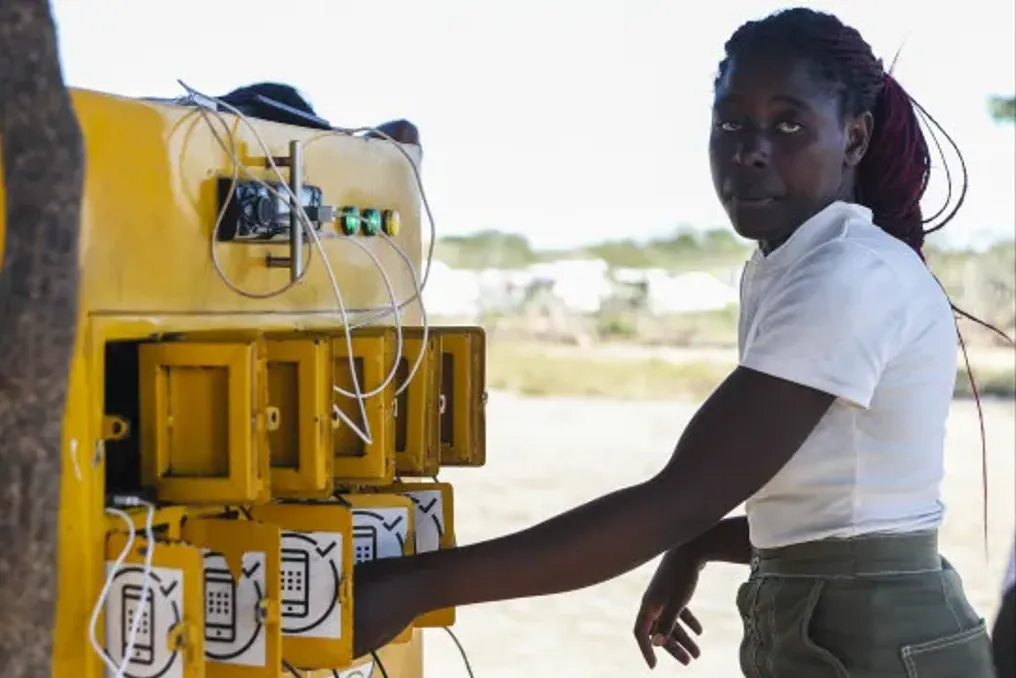
The Girafa Solar initiative has provided access to electricity for approximately 45 thousand inhabitants in Mozambique. Justino Cuna, a resident of Katembe Nsime in the district of Matutuíne, Maputo province, reported that before the installation of Girafa Solar, he had to travel about ten kilometers to charge his phone.
This structure, named 'Girafa Solar' and developed by the Carlos Morgado Foundation, uses solar panels mounted on an elevated wooden frame. It allows for the simultaneous charging of up to ten mobile phones, in addition to providing lighting and operating a fixed radio for residents' entertainment.
In communities lacking an electrical grid, Girafa Solar has also become a social meeting point. For Justino, this location served as a link to other residents. The structure was implemented in November 2025 with the community of 'Matutuíne heroes,' composed of over 500 people from about 100 families affected by floods since 2023.
Among the makeshift tents and dwellings built by the residents themselves, 'Girafa Solar' has transformed into a convergence point to discuss challenges such as water and energy scarcity. Justino emphasized that Girafa Solar changed their lives, allowing him to maintain regular contact with friends and family.
Since 2020, the project has installed 22 'Solar Giraffe' units in areas of northern, central, and southern Mozambique, benefiting about 44 thousand people in locations without access to electricity. These infrastructures recharge the battery of 11 thousand mobile phones monthly, assisting those still awaiting the arrival of the conventional power grid.
Nora Matsinhe, 39 years old, who has lived in the village for almost two years, also testified to the ease of communication provided by the infrastructure, comparing it to the great difficulty previously faced in charging her phone. However, she points out that the demand for the service already exceeds current capacity and requests the installation of another unit.
The arrival of energy generated by the solar panels has changed the village routine. Activities that used to cease at night now extend for several hours, thanks to the lighting and social gatherings around the structure. Previously, it was difficult to stay out after 6 PM; now, residents can charge devices, chat, listen to the radio, and dance.
At dusk, after charging the batteries, 'Girafa Solar' functions as a small community center, gathering children on swings and adults watching football games on a solar-powered television. The concept originated in 2015, starting as a simple porch with solar panels. The typology evolved based on suggestions from the first users, culminating in the elevated shape resembling a giraffe, supported by eucalyptus poles.
Ruben Morgado, executive director of the project, 48 years old, recalls that when redesigning the project with larger eucalyptus poles, they realized the structure had transitioned from a porch to resembling a giraffe. Each unit supports small businesses, facilitates access to mobile financial services, and increases local security through nighttime lighting.
Currently, the Carlos Morgado Foundation aims to expand the project to other regions of the country. Ruben stated that one of the objectives is to incorporate the verb 'girafar' into the Portuguese vocabulary, with the goal of 'girafar Mozambique.' Each unit costs approximately 600 thousand meticals (7,976 euros), has an estimated lifespan of five years, and can be installed in just two days. The manager is seeking new partnerships to expand the initiative.
Bernardo Pedro, 66 years old, another resident, thanked them for recovering time previously spent on long journeys to charge his phone seven kilometers away. He also requested a new unit due to the increase in the local population. Bernardo suggested that solar energy could be used to illuminate the entire village and power a water well, whose operation is hindered by the lack of energy.
The foundation was created in 2010 in honor of Carlos Alberto Sampaio Morgado, patron and former Minister of Industry and Commerce of Mozambique (2000-2005). It collaborates with various partners to develop and execute projects of innovation, inspiration, and investment, aiming to foster the sustainable development of the country.