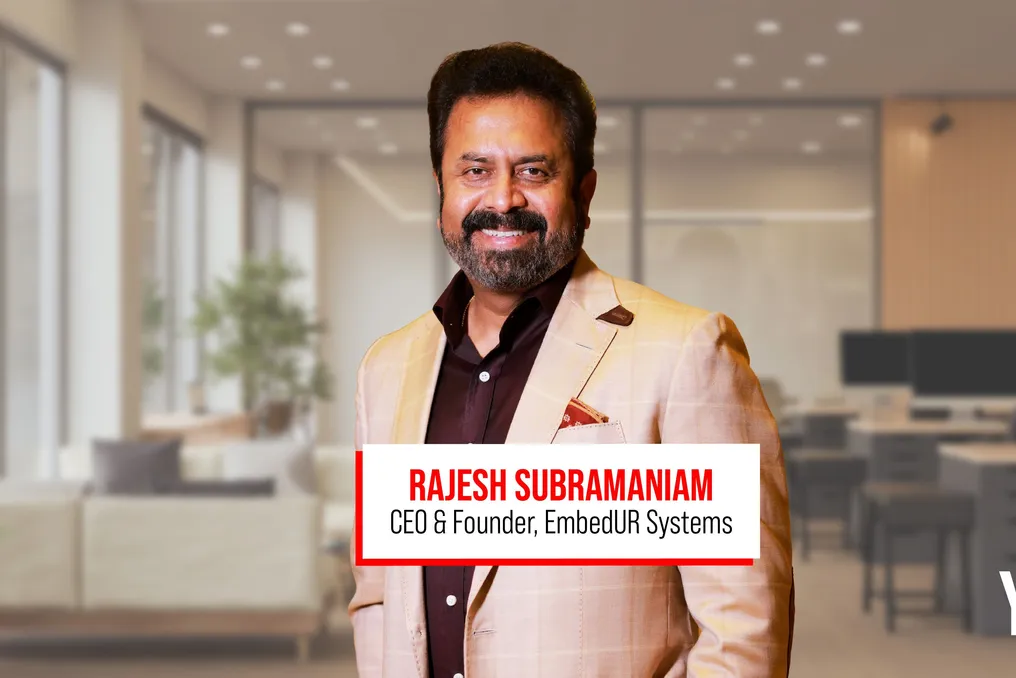
Rajesh Subramaniam initially aimed to solve lighting problems to ensure good visibility before discussing his company's plans. When he was told the story would be written, not filmed, he talked about Wi-Fi for hours.
He explained that Wi-Fi technologies and associated short-range signals provided him with income for 22 years. The core work involves software integrated into routers, speakers, and wristwatches, allowing devices to communicate wirelessly.
Subramaniam founded embedUR Systems in 2004 and continues to lead it. The company is little known outside the semiconductor industry, yet many major chip companies could not do without its developments. embedUR writes software for devices and gadgets that deliver internet to users without external funding. Its operations in India, based in Chennai, began in 2008.
He arrived in the United States in 1992, earned a master's degree from the University of Arkansas, and by 1994, was in Silicon Valley. His first job was at Schlumberger, where he worked for about four years. He then moved to Bay Networks, which was merging with Nortel at the time, where he developed software for early switching equipment. After that, he worked at a startup creating fiber optic networks during a time when the transition from 10 megabits per second to gigabit seemed like a miracle. After acquiring this company, he accumulated a diverse set of skills: knowledge of small devices, networks, and infrastructure supporting high-load network operation.
In 2004, he decided to focus on Wi-Fi, considering the free spectrum used by home routers rather than the licensed spectrum of mobile operators. He already possessed embedded software knowledge; radio frequency reception was a new element, and sorting packets received after signal reception was what he had worked on for ten years in wired networks.
Wi-Fi split into three separate business directions, and Subramaniam participated in all three. The first is ceiling-mounted devices. These flat white squares collect wireless connections from a room, whether it's a large office, hospital, or airport, and transmit them via cable. As he explained, this is a system where one side operates entirely wirelessly, and the other entirely wired.
This is enterprise Wi-Fi, requiring complex work because the corporate network must verify the user's identity before granting access to resources. According to him, such networks require more software, enhanced security, thorough verification, and greater discipline from developers.
The home router business began to take shape around 2006–2007 when American carriers like AT&T and Comcast started offering home wireless access as a service. The software here functions more simply because the operator controls all processes on their end, and the small device in the hallway does not need to worry about user trust.
Around 2011, the focus shifted to software inside personal phones. The phone connects to the home router in the evening and to an airport access point in the morning, and some system must manage all of this. Chip companies sold components, but someone had to make these components work cohesively. Soon, Bluetooth and Zigbee appeared, which was logical given that a house full of speakers, doorbells, and fitness trackers represents many tiny receivers.
The company also developed components for collecting data from all these devices and storing it in the cloud, as well as software allowing the client to manage the entire fleet of such devices.
Four or five years ago, he created the ModelNova division within embedUR. He spun it off in July. Most people perceived artificial intelligence (AI) as something grand happening far away: the user asks a question in a field, it goes to a data center with expensive equipment, and a model with billions of settings returns the answer. However, the version for edge devices turns this concept upside down. Small processors are now equipped with circuitry to run models, allowing a low-cost device to make decisions independently without contacting a central server.
When asked about the complexity of transitioning from software to the physical side, he replied that 'hardware is hardware.' The hardest part for him was implementing real intelligence into a device with very limited memory and power, often battery-operated, and subsequently trusting this device to make decisions autonomously.
He became animated, providing examples, although most of them are capabilities of his models, not finished products. One example is a medical equipment manufacturer that implemented facial recognition in its device so a nurse could avoid entering a password while wearing gloves. Other examples he cited include a coffee machine capable of recognizing hundreds of faces and pouring cappuccino upon request, locks with cameras, and factory gates activating alarms upon detecting an unfamiliar face.
He stated that the company has clients in commercial, residential, industrial, and medical sectors but did not name any of them. The underlying model is the same in all cases and performs the same function, being sold in completely different industries.
The situation is similar with audio systems. The company has developed several noise cancellation models that run on a standard processor instead of a specialized one, and their application remains open. He points to construction hard hats, cheap enough for two workers to hear each other through noise, and motorcycle helmets that allow the driver to hear a phone call through the wind. A third type of model is less numerous and more unusual: he described a model that understands the shape of a building and could direct a person to the correct store aisle or a specific hospital wing.
The reason for spinning off ModelNova was not the technology itself, but the revenue models. embedUR creates custom products, and the client owns the final product, with revenue coming from subsequent support. As he described it, 'we build once, sell once.' ModelNova works differently: a library of models is provided for free, overlaid with the Fusion Studio desktop toolkit, which is still in beta, and ready-made models are licensed. The company creates the product once and then sells it repeatedly. Since he did not want one culture to absorb the other, he separated them.
When asked what prevents chip companies like Qualcomm and Nvidia from creating their own model libraries and excluding him, he first dismissed the high-end market, noting that Nvidia, AMD, Broadcom, Intel, Qualcomm, and Marvell are not his domain. He focuses on the less flashy segment used in factory, agricultural equipment, and automobiles, where the model must fit into a few megabytes and run on battery power. Over two hundred models he keeps ready were created specifically for this purpose. Approximately 75 percent of them are related to video processing, and the rest to audio.
Chip companies are paid for hardware, not software. Their clients expect tools to be provided for free with the components, so the model library becomes an expense without corresponding revenue. embedUR took on creating these libraries for them. About 30 of his models are on the Infineon website, and he created an entire collection for the chip developer Ceva. He noted that 'the next biggest model farm is ST Micro, and ST Micro is our client.'
He considers himself one of the key players in this market. Two of his clients will announce their innovations at CES in January, and he eagerly awaits that moment. For 22 years, he has not attracted external capital. When asked what that cost him, he answered briefly: 'Cost me? Growth.'
By his estimates, the company staff ranges from 475 to 500 people. With investors, he believes the company could have 5,000 or even 10,000 employees. He prefers to talk about production volume, stating that what embedUR produces corresponds to the production volume of a 1200-person company. The advantage of not having funding, in his opinion, is customer trust. This allowed him to maintain independence in decision-making, unlike the situation with investors who start controlling the roadmap and demanding changes to plans.
The service segment brings in about 90 percent of revenue, and ModelNova accounts for 7–10 percent. He predicts that the younger company will overtake its parent company within two years of its founding and exceed embedUR's revenues by 2026, naming the amount 'many tens of millions of dollars'. At an investor meeting in Chennai in 2024, he committed to allocating 500 crore rupees over five years, 100 crore rupees annually. The current payment is the third tranche, part of which is directed to ModelNova.
When asked about the quality he seeks in new employees, he did not mention engineering. Communication came first, followed by clarity of thought, and fundamental knowledge came after those two, with the caveat that no one is obliged to be an expert in everything. His argument is that most rework in the industry happens due to a lack of questions at the initial stage. Teams are constantly busy working but never too busy reworking. He emphasized: 'If you don't know what questions to ask, you do everything wrong.'
The solution came from his own coach and became the office motto: 'Who, not how.' If a problem is new to you but known to the company, it is wiser to find someone who has already solved it instead of solving it again at your own expense. He notes that in Indian offices, people often do not ask questions for fear of appearing stupid. He advises his engineers that there are four types of questions, from simple factual ones to attempts to understand another person, and that his engineers ask too few of all types.
} , {