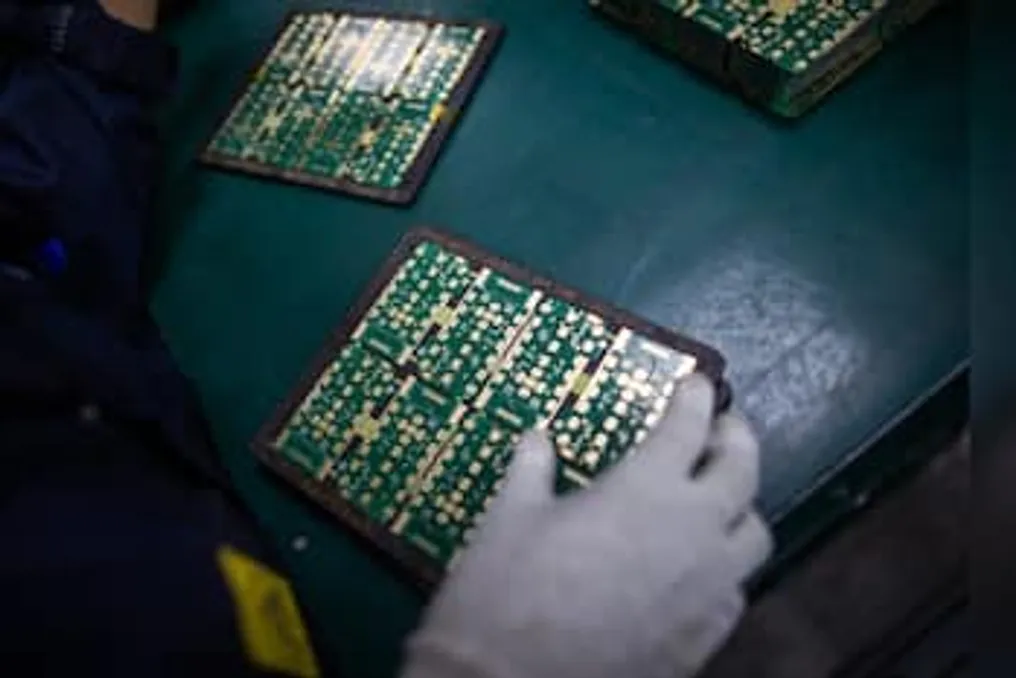
China becomes a growth market for India, but trade deficit increases
Read more
Business Standard
business-standard.com

China becomes a growth market for India, but trade deficit increases

India is increasing exports of finished goods to China, with electronics being a prime example in trade relations that remain predominantly in Beijing's favor. Analysis of government data shows that Indian exports to China grew by almost 40% in the five months leading up to August, with goods in electronics and machinery being the main drivers of this growth.

Export revenue to China tripled to $3.18 billion in the fiscal year ending in March. This growth is driven by products such as printed circuit board assemblies, smartphones, display modules, and telecommunication equipment. Electronics shipments continue to rise in the current fiscal year, increasing by more than 15% from April to August compared to the same period last year.

Nevertheless, this increase is based on a relatively low level and has only slightly reduced the huge trade imbalance between India and its neighbor. Radjou Goel, Secretary General of the Indian Electronics Industry Association, noted that the export surge is partly linked to pressure on suppliers who need to meet the demand for high-tech equipment for artificial intelligence-related products, as well as the growth in data centers. He added that this stimulated the export of electronics from India to China.

For New Delhi, recent successes support long-standing efforts to expand manufacturing and secure a more significant role in global supply chains. These events occur against the backdrop of India and China striving to restore relations after years of stagnation, as well as due to Washington's tariff policies motivating both governments to deepen economic interaction.

Pankaj Mohindru, Chairman of the Indian Telecommunications and Electronics Association, stated that this demonstrates the beginning of Indian manufacturing gaining trust in one of the most competitive global value chains. Arun Kumar Garodia, Managing Director of Corona Steel Industry Pvt., suggested that the increase in exports, although small, may indicate that Beijing is becoming more receptive to Indian goods in the current geopolitical climate.

However, there is an important nuance in the statistics. Chinese customs data does not record a comparable increase in the import of printed circuit boards from India; most of the growth is reflected in the smartphone and other telecommunication product segments. Industry experts believe that differences in goods classification between the two countries may complicate the precise determination of the reasons for this growth.

Furthermore, China remains a relatively small destination for Indian goods, accounting for 4.4% of exports in March last year, compared to just over 3% the year before. The US, India's largest market, accounts for nearly a fifth.

The recent export growth has barely affected the imbalance between the two largest economies in Asia. In March, India imported Chinese goods worth $131.6 billion, which accounted for almost 17% of its imports and significantly exceeded the value of goods it sold to China.

Nevertheless, exporters are confident that Indian supplies to China will continue to grow. According to the latest data, the growth has extended beyond electronics: exports of machinery to China increased by approximately 21% from April to August compared to last year, including auto components, hand tools, and machinery. Mohindru added that the task now is to sustain this export and expand it to components, sub-assemblies, and finished products, while deepening India's capabilities in design and components.

Similar stories

India's trade deficit with BRICS countries increases due to imports from China
Read more
www.aajtak.in

India's trade deficit with BRICS countries increases due to imports from China

India views the expansion of BRICS as a significant platform for global trade and economic cooperation. However, recent statistics paint a different picture: although trade turnover between India and BRICS countries has reached record levels, the trade deficit is rapidly growing. The main reason for this growth is the increase in imports from China, which leads to a constant increase in India's deficit.

India's trade deficit with BRICS countries reached $226.1 billion. In 2025–26, India imported about $321.8 billion worth of goods from 10 BRICS partner countries, while exports to these countries amounted to approximately $95.7 billion. Thus, the total trade deficit grew to $226.1 billion, equivalent to approximately 19 lakh crore rupees. China contributed the most to this deficit, with India's trade deficit with it amounting to $112.2 billion, against a total trade volume of $155 billion between the two countries.

India remains significantly dependent on China in crucial sectors such as electronics, machinery, solar installations, and batteries.

Against the backdrop of the growing trade imbalance, BRICS countries are intensifying efforts to conduct settlements in national currencies. The goal of these measures is to reduce dependence on the dollar in international transactions and increase the flexibility of the payment system. Although no decision has been made yet to introduce a new common currency or system, discussions continue regarding simplifying trade and cross-border payments in local currencies among member states.

Work is also underway to facilitate digital payments between BRICS countries. Possibilities for compatibility between platforms such as India's UPI and Brazil's Pix are being discussed. Furthermore, options for accelerating and reducing the cost of cross-border payments through central bank digital currencies (CBDCs) are being studied. A common BRICS Pay system has not yet been launched, and current efforts are focused on improving interaction between various national digital payment systems.

BRICS countries are also taking steps to simplify access to financing for small and medium-sized enterprises (SMEs). Members of the bloc are working on new credit rating frameworks and invoice discounting options for export-oriented SMEs. The objective is to reduce the gap in trade finance for small entrepreneurs, allowing them to receive funding not only based on large collateral but also on their turnover and cash flow. Nevertheless, these initiatives are in the initial stages and require time for implementation.

India is also insisting on strengthening supply chain cooperation within BRICS. Efforts are increasing to enhance interaction between member countries in sectors such as pharmaceuticals, agriculture, and food security to reduce the risk of excessive dependence on one country or region. Simultaneously, work is being done to simplify cross-border digital services. This could create new business opportunities for Indian IT companies and digital service providers in other BRICS countries. Thus, BRICS is evolving beyond being solely a platform for goods trade; member countries aim to steer economic relations in a new direction by expanding cooperation in trade, payments, supply chains, and digital services. The main challenge for India will be how to balance the trade deficit amid growing trade volume.

Popular