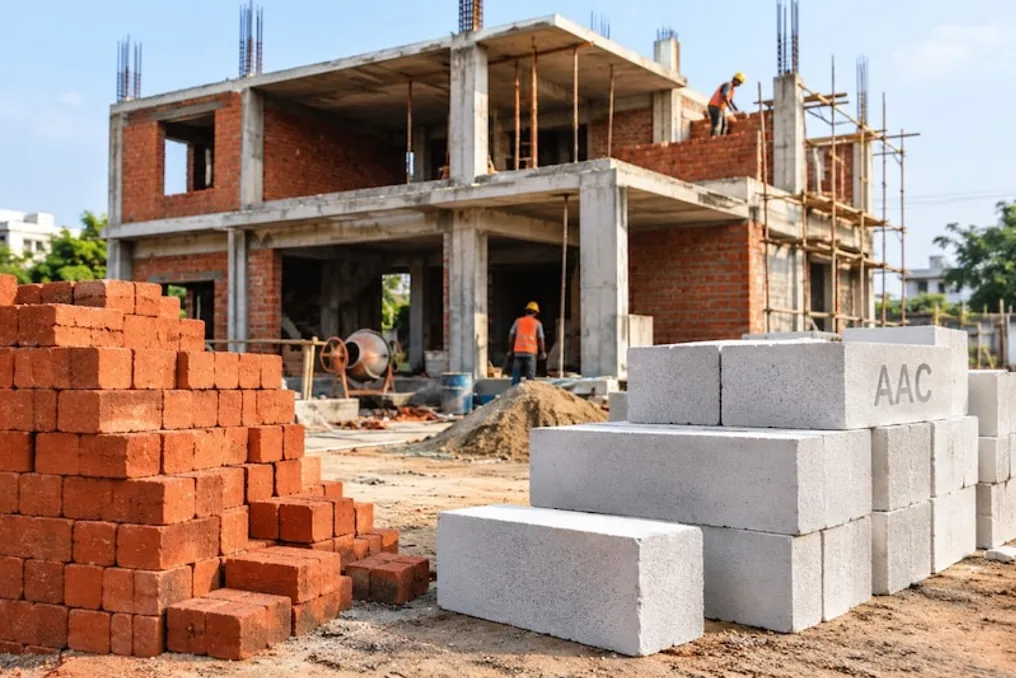
Traditionally, red brick, which is fired in a kiln, has been used for building houses. Many people trust this red brick. However, many alternatives have emerged for fast and economical construction. One such option is AAC blocks. Although both red brick and AAC blocks are suitable for building strong walls, there are significant differences between them.
An AAC block is a lightweight, ready-to-use concrete building material. It is made from a mixture of sand, cement, lime, fly ash, or aluminum powder. The production process involves exposure to high pressure and steam in an autoclave, which is why it is called an autoclaved porous concrete block, or AAC block.
Although the compressive strength of red brick is higher, the load-bearing capacity and structural strength of the AAC block are completely sufficient and excellent for modern frame construction, such as reinforced concrete structures (RCC).
The weight of an AAC block is approximately three times less than that of red brick. This leads to a reduction in the building's 'dead load'. As a result, the building experiences less pressure during an earthquake, ensuring the safety of columns and beams.
While red brick remains a reliable choice for housing construction, AAC blocks have become the preferred material due to modern construction trends. Using AAC blocks reduces long-term construction costs, speeds up the erection process, and is environmentally friendly.
The light weight of the AAC block reduces the load on the foundation and the structure of the building. This can lead to savings on steel and concrete, and also allows construction work to be completed faster. Furthermore, AAC blocks have a larger size and greater uniformity, which significantly speeds up wall construction. Thanks to the smooth surface, less plastering is required, saving both time and materials.
AAC blocks are 7–8 times larger than red brick. This reduces wall laying time and decreases mortar consumption by more than half. Due to their low weight, significant savings are achieved on foundations, steel, and concrete—from 10% to 25%.
Although the unit price may seem slightly higher than that of red brick upon purchase, when considering labor costs, time, and savings on cement, sand, and structure, the AAC block proves to be significantly more cost-effective and cheaper in overall construction.
