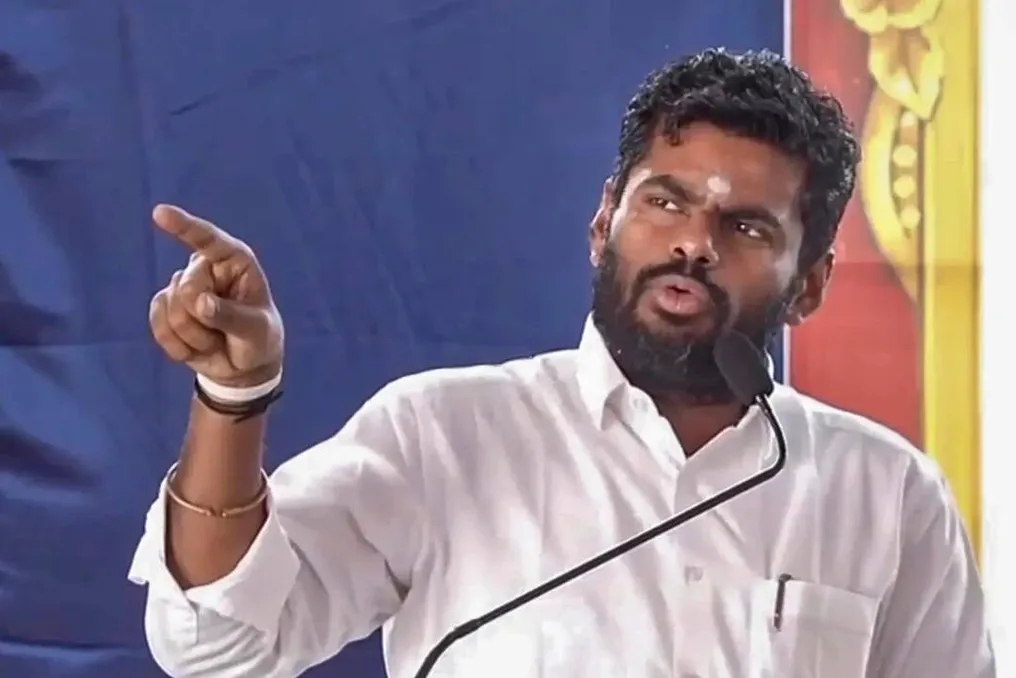
Annamalai criticizes Vijay's trip to the UK, calls for focus on local investments
Read more
The times of India
timesofindia.indiatimes.com

Annamalai criticizes Vijay's trip to the UK, calls for focus on local investments

Annamalai, former president of the Bharatiya Janata Party Tamil Nadu, criticized the recent trip of the Chief Minister and TVK leader, T. Joseph Vijay, to London. He argued that the state government should focus more on stimulating growth and investment in local industries.

Annamalai noted that after returning from London, where investments were attracted, growth in the United Kingdom is only 1%, and these investments are being made by Indian companies, including Mahindra. Therefore, instead of the chief minister traveling abroad, incentives should be provided to industrial enterprises in cities like Coimbatore and Madurai, encouraging them to invest.

These remarks came amid criticism from DMK president MK Stalin, who also questioned what specific investments the chief minister secured for Tamil Nadu during his visit to London. Speaking at the annual Muppuram Vizha at the DMK headquarters, Stalin asked: 'Mr. Chief Minister, why did you go to London? What investments did you bring to Tamil Nadu? Why do you need to go to London and sign agreements with an Indian company?'

Expressing clear criticism towards Vijay, Stalin added that he had previously stated he would cease acting but continues to perform in front of the public, noting a shift from local to foreign filming.

Vijay concluded his six-day official trip to the United Kingdom last week, securing investment commitments worth 15,300 crore rupees, which are expected to create over 10,000 direct and indirect jobs in Tamil Nadu. This visit is part of the state's strategic plan to transform Tamil Nadu into a $1.5 trillion economy by 2036 through transparent and efficient governance.

During his visit, CM Vijay met with the Indian High Commissioner in Britain, Kumaran Periasamy, on September 12th to discuss trade opportunities arising from the Comprehensive Economic and Trade Agreement between India and the UK (CETA). On September 14th, memorandums of understanding and letters of intent were signed in the fields of auto components, research and development, renewable energy, power grid equipment, and global centers of competence (GCC).

Similar stories

Film 'Ghamasan': Arshad Warsi as a bandit, Pratik Gandhi's strong performance, but a weak ending
Read more
www.aajtak.in

Film 'Ghamasan': Arshad Warsi as a bandit, Pratik Gandhi's strong performance, but a weak ending

If you enjoy stories about wild terrain, bandits, police, and politics where intellect plays a greater role than firepower, then 'Ghamasan' is an interesting project. Tigmanshu Dulia has once again returned to the world he previously explored in films such as 'Pan Singh Tomar'. This time, the setting is not Chambal, but Bundelkhand, where Arshad Warsi and Pratik Gandhi are the main figures.

The main feature of the film is that the confrontation between the hero and the villain goes beyond a simple armed fight; it is a battle of minds, influence networks, police, and power. This is why 'Ghamasan' keeps the viewer engaged throughout the screening.

Arshad Warsi portrays a character that viewers accustomed to seeing him in comedic and light roles have likely never seen before. He plays Maharaj, a ruthless bandit whose influence extends far beyond the forests. Maharaj relies not only on the strength of his weapons; his connections encompass political circles and the police. Local residents fear him, the police act on his orders, and the authorities cooperate with him for electoral gain.

Arshad's massive physique, long beard, and constant dangerous expression give his character a formidable appearance. Although Maharaj sometimes seems eccentric or psychopathic, he is not a villain with 'superpowers' to solve any situation, which makes his character more realistic.

Opposite Maharaj appears Aditya, played by Pratik Gandhi, representing the police side. Aditya is not a typical cinematic supercop; he is an ordinary person who carries out his mission, hiding minor details from his wife, and can even put a criminal in the trunk on their wedding anniversary. This fact emphasizes his 'ordinariness.'

However, this seemingly simple policeman gradually undertakes the task of dismantling Maharaj's entire network. He forms a special investigation team, organizes phone taps, and tries to uncover every thread of the bandit network. The most intriguing aspect is that Pratik Gandhi and Arshad Warsi rarely meet face-to-face, yet the tension between them is constantly felt through their phone calls and mutual challenges, sustaining the narrative drama.

'Ghamasan' tells not just the story of a bandit and the police, but also brings life to the atmosphere with numerous small details. The film contains scenes inspired by real events. For example, at the beginning, the newlyweds arrive home, and the groom accidentally drops a rice pot at the threshold while the wife gathers things. Then the groom kicks it again. This short scene eloquently depicts the picture of patriarchal society in Bundelkhand, where men move forward, and women remain gathering the remaining items.

Another remarkable detail emerges when the special investigation team tracks a person simply because he bought over thirty tubes of insect repellent. It is these nuances that prevent the film from turning into a banal 'bandit versus police' story.

Visually, the film looks very impressive. The dry, open, and vast landscapes of Bundelkhand give the film a Western feel. Unlike many modern streaming platform projects that claim realism using pliable sets and artificial locations, 'Ghamasan' looks much better. You can see the earth, you can see the dust, and the wild lands truly look wild.

Many aspects, from costumes to language and production design, immerse the viewer in the world of the story. Rajapal Yadav also contributes to the film, playing an important and vibrant role that adds extra color to the plot. Pratik Gandhi, meanwhile, manages to find a good balance between charm and seriousness in his character, avoiding excessive heroic pathos or overburdening the image.

However, the film falters somewhat in the climax. Most of the movie maintains tension, but when the finale arrives, the story feels too rushed. The last part does not make as strong an impression as the tension and patience with which the film brought the viewer to that moment. The track related to child abuse also does not evoke as deep a response as it could. The film is technically strong, the plot is interesting, the actors are good, but this point is its main weakness.

Popular