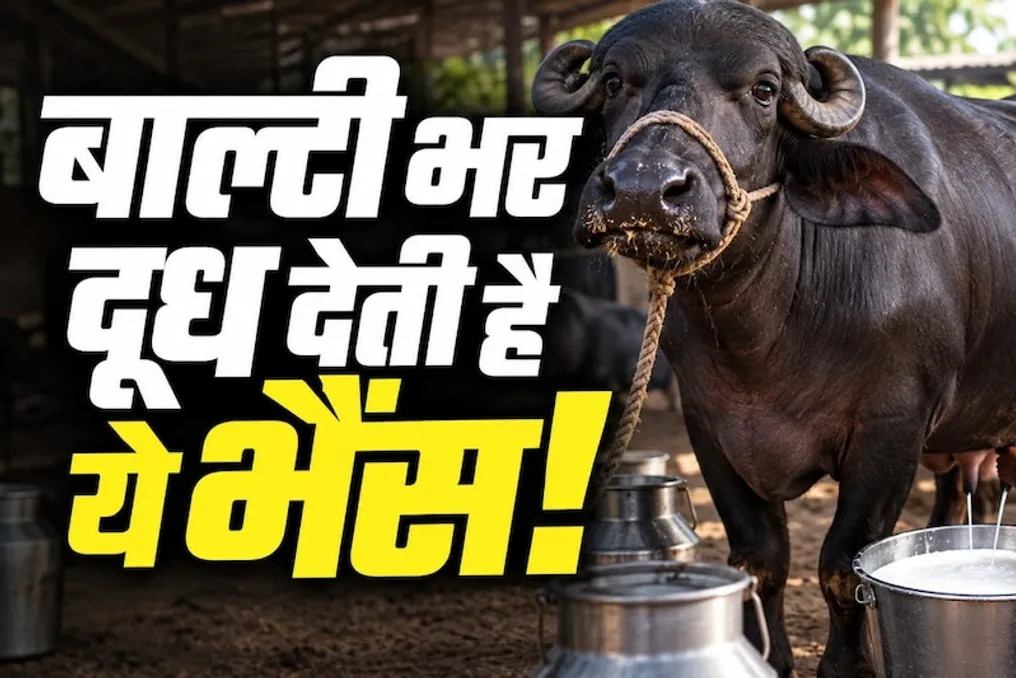
Farmers engaged in dairy farming in India are constantly seeking buffaloes that produce quality milk while also ensuring a good price. Among the many local buffalo breeds in the country, the Zafarabadi holds a special place. This breed is known for its massive physique, strong structure, and high milk productivity.
Zafarabadi is considered one of the leading buffalo breeds of Gujarat. Its historical area of origin includes the districts of Amreli, Bhavnagar, Jamnagar, Junagadh, Porbandar, and Rajkot in Gujarat. According to data from the National Dairy Development Board (NDDB), the average milk yield of a Zafarabadi buffalo is about 2239 kg per lactation, with the overall range estimated at 2150–2340 kg.
From its appearance, it is immediately clear that the Zafarabadi buffalo possesses a powerful constitution. ICAR has also classified Zafarabadi as the heaviest buffalo breed. Its body is large and sturdy, and its horns are a distinguishing feature. Due to its large size, it differs from many other buffaloes, attracting attention from people who see it in villages.
Zafarabadi is valued not only for its large size but also as a high-yielding dairy breed. According to NDDB statistics, the average milk yield per lactation is 2239 kg. However, it should be noted that the volume of milk obtained from each individual is not uniform; it is influenced by age, breed purity, nutrition, care, weather, and health condition. Therefore, it cannot be stated that every Zafarabadi buffalo will yield a fixed amount of milk daily.
In addition to volume, a characteristic of this buffalo's milk is its high fat content. A study conducted by ICAR showed that the average fat percentage in Zafarabadi milk is about 8.61%. This figure can vary depending on the animal and conditions. The high fat content is beneficial for the production of ghee, butter, and other dairy products, which ensures high demand for such milk in the dairy industry.
The main habitat of Zafarabadi is Gujarat, especially in several Saurashtra districts. NDDB data for Gujarat also records a large number of this breed. This breed is part of the local livestock system and has adapted to the region's conditions. A characteristic of local breeds is that they have evolved over a long time in accordance with the conditions of their local environment. ICAR notes that indigenous cattle species have the ability to adapt to local climate and conditions.
It is important to understand that the potential benefit of purchasing a buffalo cannot be determined solely based on the breed name. Many factors must be considered: milk volume and fat content, the animal's age and health, feed costs, and the local milk price. If a buffalo belongs to a good breed, is healthy, and has high milk productivity, it can become a good source of income for the farmer. Nevertheless, livestock farming always involves expenses for feeding, treatment, and care.
Zafarabadi is recognized as special due to its massive body, strong structure, good milk yield, and high fat content in milk. These qualities include it among the well-known local buffalo breeds of the country. Therefore, the next time you see a large black buffalo and ask about its breed, remember Zafarabadi. However, accurately determining the breed just by appearance is difficult; for reliable identification, records of the animal's breed and consultation with a specialist are more useful.