On a weekday at EuroSchool Kharadi in Pune, there was the usual hustle and bustle related to lessons, teachers, and school assignments. When the author spoke with Director Afrin Qazi Sheikh, she paused, recalling an exhibition on sustainable development that visited the school two years ago.
The director noted that the true impact of this experience began not during the exhibition itself, but after the exhibits were packed up and the visitors dispersed. She remembered children returning to their classrooms with questions, discussing what they had seen, and months later coming to teachers with their own ideas. Some wanted to start composting, others wanted to reduce plastic use or find ways to save water. What concerned her more was not what the children learned at the exhibition, but how they continued to think about it afterward.
For a school that already taught children about waste management, water conservation, climate change, and environmental responsibility, the problem was never a lack of information. The difficulty lay in helping children see how these large-scale concepts related to their own lives.
When Learning Goes Beyond the Classroom
EuroSchool Kharadi was founded in 2021 during quarantine, starting with about 200 students and being fully online in the first year. By the time the discussion about the sustainable development program took place, the school had grown to over 2800 students, covering groups from preschool to senior grades. Environmental awareness has always been part of school life: tree planting, waste sorting events, environmental clubs, awareness campaigns, and project-based learning have taken place.
However, the director felt that children needed more than just classroom discussions. She stated to The Better India: "You cannot engage children with minimal conversations. You must give them opportunities for interaction. When you do something practically, when you feel it, you will never forget it."
This opportunity arose in mid-2024 when the school adopted 'Shashwat Bharat Setu'—a mobile sustainable development training initiative created by 'The Eco Factory Foundation'. This initiative was officially launched in February of the same year and is designed to deliver sustainable development exhibitions and demonstrations directly to schools, communities, and other locations, rather than being limited to a fixed center.
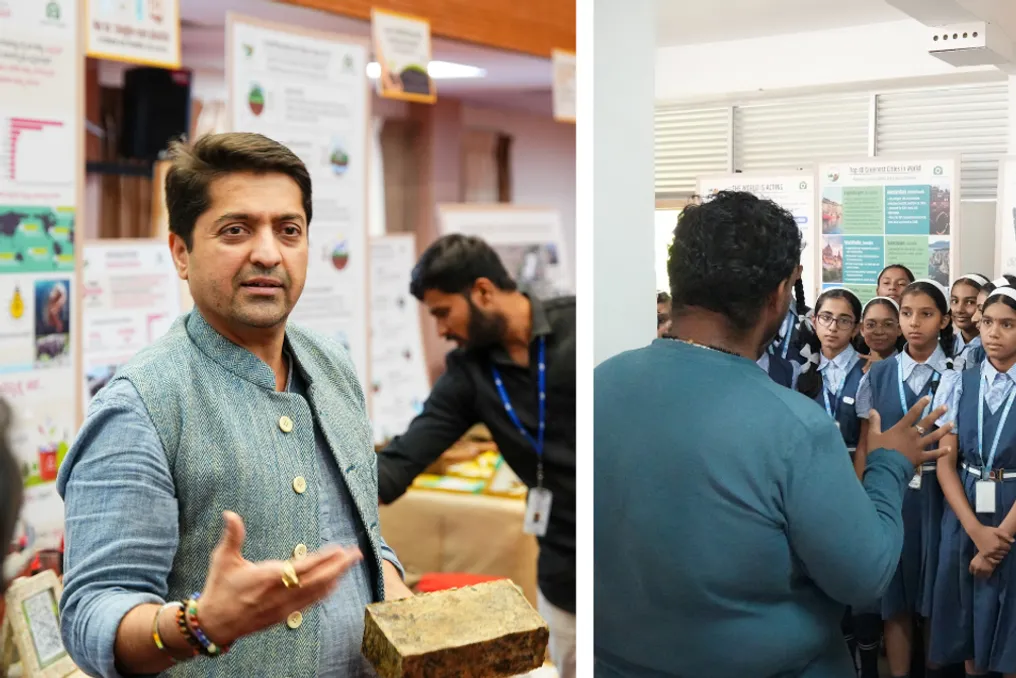
A large unused dining hall was converted to host the exhibition. Furniture was moved, exhibits were set up, and the space was organized so that students and parents could walk through different sections and interact with them. Over 2000 students and parents attended the exhibition that Saturday.
The previous week, the school prepared the children through discussions and debates about climate change and environmental issues. But once the exhibition opened, something changed. Instead of simply listening to a teacher explain a concept, children could see how it worked. There were demonstrations and displays dedicated to renewable energy, water conservation, waste management, biodiversity, composting, rainwater harvesting, urban gardening, sustainable agriculture, and the circular economy. They could ask questions directly to people working with the exhibits and hear explanations that went beyond textbooks.
For the director, this was the key difference. She recalls: "The program was different because the children met new people and experts and saw things we couldn't always recreate inside the school."