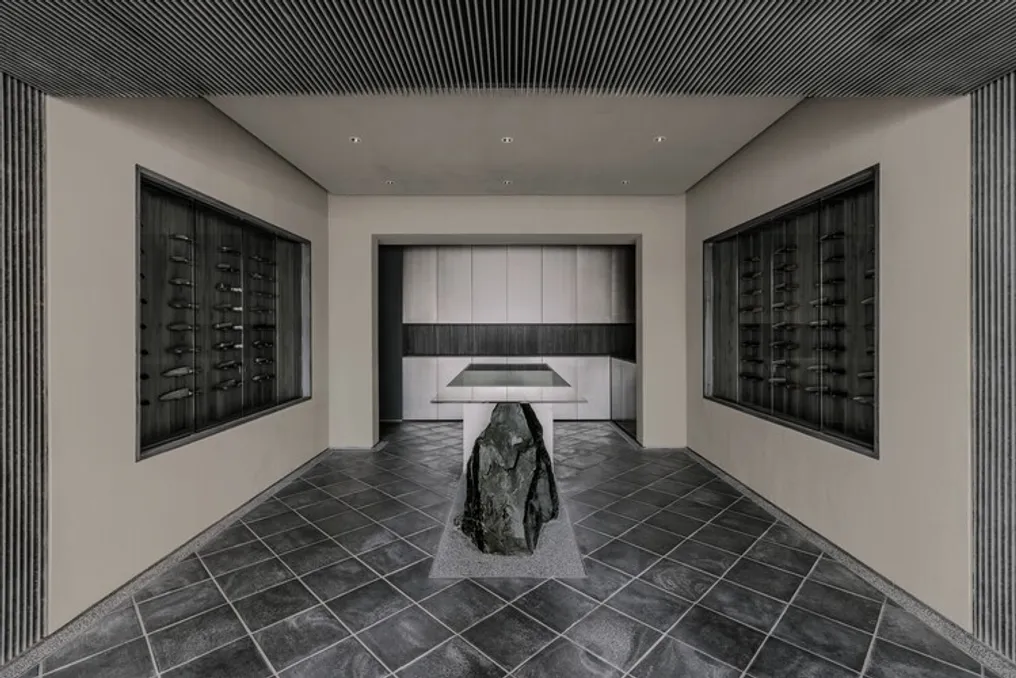
The Tojiro Knife Gallery in Tokyo, named 'Hanare' / L/O (KATATA YOSHISHITO DESIGN), was created as a place for customers to find the ideal knife, understanding that a Tojiro knife transcends a mere product; it is a tool that accompanies its owner for decades, undergoing maintenance and sharpening.
Tojiro's concept store serves to present the brand's complete range and introduce the culture of preserving a knife throughout its life, in addition to exhibiting the history of Japanese blade manufacturing. However, for more specific orders, such as unique, semi-customized, or fully bespoke pieces, a distinct environment called Hanare was conceived.
In traditional Japanese architecture, a hanare is an attached structure with a specific function, whether to receive guests or house private activities. This project does not literally replicate this form but translates its role into a modern brand experience. Near the concept store, the atmosphere changes drastically: the focus shifts from observing many knives to concentrating on the single necessary one, transforming the question 'Which should I choose?' into 'Which knife is right for me?'
This architecture aims to provoke a psychological transition, where the dialogue about cooking style, profession, hand size, weight, balance, and blade finish takes place at the table, defining not a product, but the owner's long-term companion.
The space does not imitate a factory nor is it modeled after a knife. Instead, it focuses on the landscape where the work is done. Each architectural component reflects not the manufacturing process itself, but rather the atmosphere, order, and temporal flow present in the artisanal craft.
Although not all materials originate from Niigata, the architecture carries the memory of the industries and resources cultivated in the region. Yasuda kawara, a tradition of ceramic tiles over two centuries old in Niigata, had its clay used in the floor tiles, reinterpreting a roofing material for the ground. The plaster incorporates Niigata earth, and a central stone evokes a piece of whetstone, linking regional material culture to the contemporary environment.
The cedar used in the display walls and furniture received charred (yakisugi) and brushed (uzukuri) finishes. These processes of burning, brushing, and finishing the wood mirror the stages of forging, roughing, and polishing a blade. Thus, the materials undergo treatments that mimic knife making, transporting the philosophy of craftsmanship into the space.
The projection of this architecture extends beyond physical limits; it projects the relationship between the user and the maker. A knife is only complete after purchase because it will be used, sharpened, and repaired countless times. This Hanare was designed as the starting point for this lasting relationship with craftsmanship, whose essence lies in going beyond simple sales.
The concept of 'Modern Industrial Japanese' is not just a style referencing traditional Japanese architecture, but a design philosophy that builds spaces from the active industries and crafts in contemporary Japan, with this Hanare being a clear manifestation of that vision.
An authentic knife is not defined by price or rarity, but by its ability to suit the individual's work and life, being desired for continuous use. Finding such a knife requires both the maker and the user to dedicate time to joint conversations. The project uses the historical role of the Japanese hanare to create a welcoming environment near the concept store, facilitating this shared search for the true knife.
In summary, this architecture does not have the sole objective of selling knives; it is a hanare intended to promote an understanding of the manufacturing process, assist in discovering the necessary knife, and foster a lasting bond with its producer, connecting the selection experience in Tokyo to the industry, the land, and the craftsmanship of Niigata.