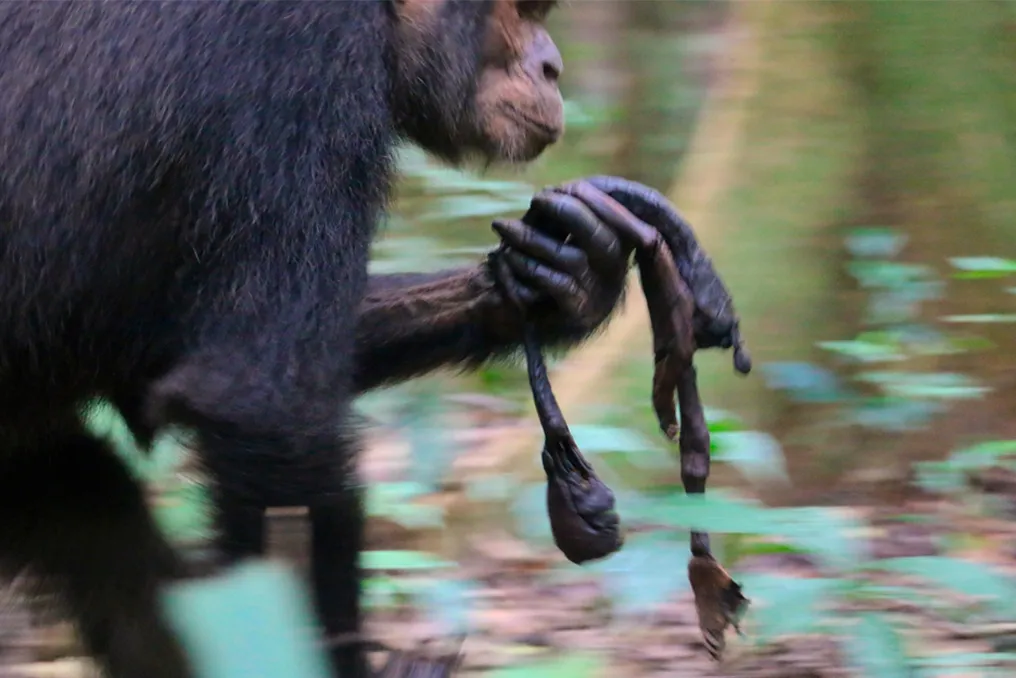
Mothers of chimpanzees and bonobos exhibit an unusual trait by continuing to carry their infants even after their death. This behavior, scientifically termed 'infant corpse carrying,' has generated great interest among scientists for years, who seek explanations for it. There are theories suggesting that maternal experience or the baby's sex is determining, while others point to the transmission of this behavior among females. However, none of these hypotheses has been definitively confirmed.
Given the genetic proximity to humans, understanding this animal behavior is seen as crucial for grasping the evolutionary origin of grief in our own species. A recent investigation conducted by the University of Oxford, and published in the scientific journal Biology Letters, was carried out to test these different theses.
The researchers concluded that this habit likely stems from the strong bond between mothers and their offspring, as well as the manner in which the death occurred also plays a significant role. To validate this idea, scientists examined 83 instances of infant corpse carrying recorded in 15 different locations, observing that the behavior showed considerable variation.
The mothers kept the infants' bodies for a period ranging from just 30 minutes to 126 days after death. In some cases, the babies were carried until their bodies had already mummified.
Several elements influenced the time the mother kept the body. Generally, infants who died at older ages were carried for a longer period than newborns. This suggests that the establishment of deep emotional bonds with the mother is a relevant aspect of this behavior.
Additionally, it was noted that infants who died from illnesses were carried for longer periods compared to those victims of infanticide (death caused by other monkeys). This was one of the most consistent findings identified by the specialists. For them, this implies that infanticide, being a traumatic cause of death, can be interpreted as an absolute end. Illness, however, may generate a more ambiguous situation for the mother, who would have difficulty processing the event and might consider the scenario as reversible.
This leads to a possible conclusion that chimpanzees may be capable of recognizing and interpreting the concept of death. However, this possibility has not yet been proven. Thomas A. Püschel, one of the study's authors, clarified in a statement: 'Our results show that we do not need to presuppose that chimpanzee and bonobo mothers understand death as irreversible to explain how long they carry their dead infants. The patterns can be explained by the persistence of maternal behavior and by social, life history, and environmental factors, but it is important to note that this does not mean these animals are incapable of recognizing death.'
External factors also exert influence. Colder periods and locations characterized by greater spacing between births showed longer periods of carrying the infants.