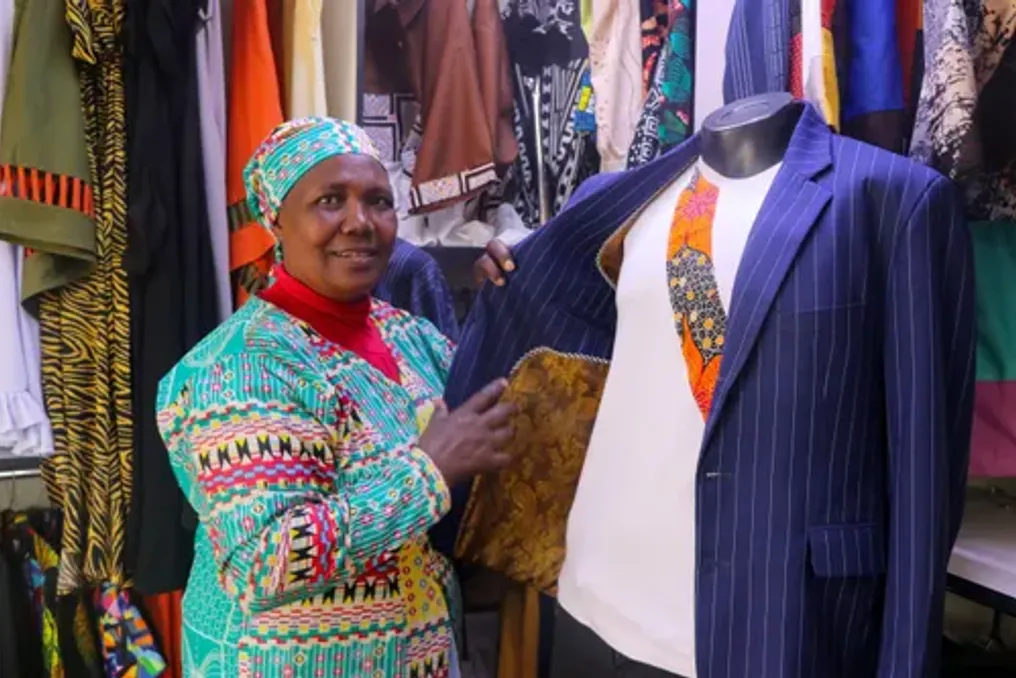
In a workshop on the outskirts of Kitengele in Kenya, garment workers are lined up, sitting in front of specialized sewing machines. While one checks the fabric quality, another is busy hemming a garment. In a neighboring cutting room, fashion students discuss the placement of cuts on a table covered with fabric. In another room, finished items hang, including pieces made from fabric scraps that would otherwise go to waste.
This workshop belongs to Tuwe Bora, a social enterprise founded by Linda Sigilai. The name Tuwe Bora translates from Swahili as 'to become better,' and it focuses on training and employing women, refugees, and youth from marginalized groups, using clothing production as a path to employment.
Sigilai, who has a background in nutrition, previously worked in public health for six years before transitioning to the fashion industry. Her transition began in 2019 when she started working with women being released from correctional facilities.
She explained that her entry into the fashion sector was prompted by the support of incarcerated women. Since most prisons have programs like sewing, and many inmates' primary skill is garment making, they saw this as a simpler way to create a foothold for them during reintegration into society.
Tuwe Bora was initially established in 2019 as an informal support group where five young mothers exchanged skills to earn income. The group later grew to 100 people, after which it was transformed into Tuwe Bora Ltd in June 2021.
However, while working with women leaving prison, Sigilai realized that employment alone was insufficient. She understood that the issue was social integration, as they were trying to solve a problem that had already occurred but could have been prevented.
Subsequently, the organization expanded its activities to include uneducated youth and refugee communities. Youth were trained in operating machinery and directed to work in Kenya's export processing zones, while refugees received support in acquiring skills and finding employment.
The organization also works with refugee communities because they are marginalized both financially and socially, due to language barriers or difficulties with documentation. Legal residency here makes it difficult for them to find work, so a system is created for training and employment to prevent them from entering the prison system.
Teresa Nyoroge, founder and CEO of Clean Start Africa, noted that poverty is the main cause of women's incarceration. She cited data showing that 70 percent of incarcerated women are in custody for minor survival-related offenses as they try to provide for themselves and their children.
Nyoroge personally knew this problem, as she spent time in prison after being falsely accused in connection with a fraudulent bank transaction she processed as a bank employee.
For women leaving prison, difficulties often continue after release. Without stable housing, employment, or support networks, some return to the same circumstances that led to their incarceration.
Nyoroge emphasized that this vicious cycle of poverty and imprisonment persists because the root cause of arrests—the lack of decent and sustainable livelihoods—is not addressed.
A study conducted in May 2025, examining the impact of imprisonment on recidivism in Kisumu County, Kenya, surveyed 700 former inmates, 85 prison staff, and 15 probation officers. It was found that 82 percent of former inmates participated in some rehabilitation or treatment program during their incarceration, while 14 percent reported no access to such services.
At Tuwe Bora, some women already knew how to sew. The task was to adapt these skills to the equipment and quality standards required by the market. Sigilai explained that they create opportunities for upskilling by teaching women what high quality means, what a finished quality product looks like, how to wind thread onto a machine, and how to ensure the thread color matches the clothing.
Joyce Wangia was one such woman. At age 60, she spent 13 years in Langata women's prison from 2008 to 2021 after being convicted of armed robbery. Her initial sentence was death, which was later commuted to serving time after the mandatory death penalty was declared unconstitutional.
When she arrived at Tuwe Bora after her release, Wangia already knew how to sew, having learned in prison using single-needle hand machines. Sigilai noted that the market demands higher quality, so they needed to show her how to operate modern machines, balance speed, and ensure a clean finish according to international standards.
Wangia spent about two years training at Tuwe Bora before opening her own business in Kitengele. She now makes school bags, laptops, and custom clothing. She also worked in prison service, returning to institutions similar to the one she once left. She shared that she underwent training with Ms. Sigilai for about two years, rebuilding her standing, and then opened her own business. Now she lives and heals with her children and can see her grandchildren.
For Sigilai, Wangia's transition embodies her goal: providing people with the skills and support to independently create a livelihood. She notes that her satisfaction comes from creating space for others to exist and do what they are capable of.
Sigilai collaborates directly with Kadjodio Women's Prison, where she established a textile center, providing machines and training. The goal is for women to leave prison with skills that allow them to start a business or find a job without having to move to the Tuwe Bora workshop.
The enterprise generates revenue through a line of recycled clothing, custom production for corporate clients, and paid short courses that prepare people for employment within four weeks. Additionally, they recycle textile waste, turning fabric scraps into new products.
Nevertheless, combining social impact with commercial sustainability remained a complex challenge. Sigilai acknowledged that they must care for the community, but at the same time, it is a business that must generate profit.
Tuwe Bora imports most of its raw materials, making it vulnerable to delivery delays and rising transportation costs. High electricity and labor costs also make it difficult to compete with Kenyan manufacturers selling imported clothing. Despite these difficulties, Sigilai stated that the business model has allowed Tuwe Bora to continue creating opportunities for people struggling to find work. The enterprise's ambitions extend beyond the Kitengele workshop; Sigilai plans to expand its textile waste recovery efforts, continuing to train women released from prison, refugees, and vulnerable youth. However, for the women who passed through the enterprise's doors, the measure of success was something simpler: whether the acquired skills helped them earn a living and build a life after prison.
_