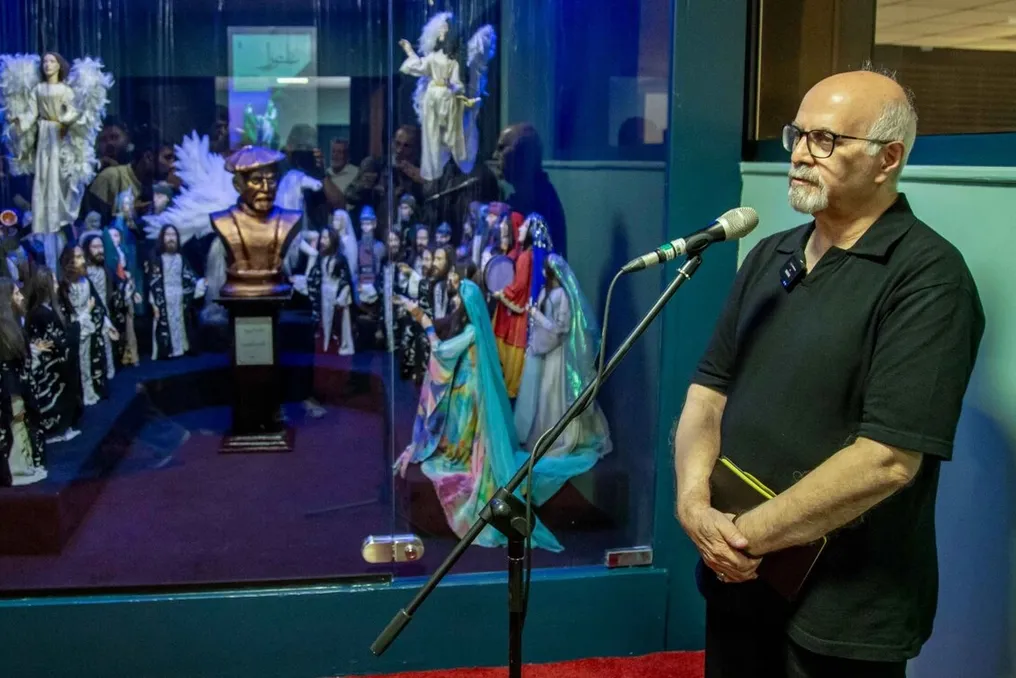
On Saturday, the Puppet Museum was grandly opened in Tehran, located in the Ferdowsi Foundation Rudaki hall. The opening ceremony coincided with the 76th birthday of Iranian theater director Behrouz Garibpour, a pioneer of Persian puppet operas and founder of the Aran Puppet Group.
The museum features about 800 puppets that illustrate the 23-year connection between puppet theater art and the literary and cultural treasures of Iran, including works by famous Persian poets such as Ferdowsi, Hafez, Rumi, Saadi, and Attar.
Behrouz Garibpour's Statements on the Museum's Significance
Speaking at the ceremony, Garibpour emphasized the extensive educational potential of the museum. He noted that the museum provides students and schoolchildren who are choosing their future professions an opportunity to familiarize themselves with artistic and cultural specialties.
Garibpour added that, unlike many other museums that highlight Iran's past and historical background, this museum introduces visitors not only to part of the country's cultural heritage but also to the process of creating puppets, the art of puppetry, and experiences that had no parallel before the Islamic Revolution of 1979.
He recalled that over 23 years of the Aran Puppet Group's activity, dozens of trained artists have performed on stage, striving to pass on the treasury of Persian literature and poetry to subsequent generations through the art of puppetry.
Regarding the 800 exhibits, Garibpour mentioned that due to space limitations, there are many works that cannot yet be displayed, and expressed hope for the expansion of the venue to showcase the achievements of figures in this field.
Furthermore, he announced an upcoming puppet opera production titled 'Love,' based on Attar's work 'Conference of Birds,' scheduled to premiere on September 28. This story tells of Sheikh San'an and a Christian maiden, being part of a mystical Persian poem and the longest story from 'Conference of Birds.'
Comments from Ministry Representatives
Leila Hosravi, Director General of Museums at the Ministry of Cultural Heritage, Tourism, and Handicrafts, also spoke at the ceremony. She characterized the opening of the Puppet Museum as an 'event of another kind' in museology. Hosravi stressed that the museum is connected to various disciplines such as literature, music, performing arts, and storytelling, making it a valuable example of a museum dedicated to intangible heritage.
She added that the importance of creating such a museum lies in the fact that children and adolescents can learn about both the art of puppetry and the historical narratives and components of the nation's intangible heritage through their presence.
Mehdi Shafiei, Deputy for Artistic Affairs at the Ministry of Culture and Islamic Guidance, also participated in the event. He called the creation of this museum one of the significant events in the field of culture and art in recent years, and its importance increases when compared to similar museums in other countries around the world.
Shafiei stated that the museum is not just a repository of objects, but the memory of the nation, a place where the past does not end but is passed on to the future. He noted that the puppets, coming alive on stage and telling romantic, historical, and literary stories, represent a piece of Iran's history and literature to the public.
He also emphasized that every figurine, costume, set design, and object in this collection is part of the history of Iranian art, allowing one to observe the evolutionary path of Iranian puppetry.
Referring to Garibpour's creative journey, Shafiei noted that during a period when puppetry was often considered a secondary art form, Garibpour believed in the potential of this medium and brought the puppet into the sphere of Iranian culture and literary narration.
Stressing the need to register and preserve the country's contemporary artistic heritage, Shafiei stated that cultural heritage remains alive only when it is not only preserved but can also be recreated and connected with the modern generation. From this perspective, the museum should serve not as an endpoint, but as a living center for research, education, documentation, intergenerational dialogue, and training young artists.
Shafiei also highlighted the museum's potential in cultural diplomacy and presenting Iranian art and culture to non-Iranian audiences, expressing hope that the museum will become a center for educating the younger generation, researching puppetry, developing international cooperation, and promoting Iranian art.
After the ceremony, guests toured various sections of the Puppet Museum and witnessed excerpts from the opera 'Love.' They were also able to meet the actors and crew, as well as see the backstage preparations for the opera.
A marionette, or string puppet, is a puppet controlled from above using wires or strings, depending on regional characteristics. A puppeteer is the operator of the marionette. Marionettes can be controlled by a hidden or visible puppeteer using a vertical or horizontal control bar in various forms of theaters or entertainment venues. They have also been used in cinema and television.
Behrouz Garibpour studied theater at Tehran University and at the Academy of Dramatic Arts in Rome (Silvio D'Amico). He founded puppet theater centers in Tehran and Isfahan and transformed the Tehran slaughterhouse into Iran's greatest cultural center. He has experience in writing scripts and directing in areas such as theater, puppetry, film, documentaries, and television.
Garibpour is best known for his deep research on Iranian puppetry practiced during the Qajar era. Before founding the Aran Puppet Group, he formed the 'Iran Heymeh Shab Bazi' Group to revive Heymeh Shab Bazi, traditional Iranian puppetry, involving both traditionally and modernly trained puppeteers. This group performed in Iran and abroad, including Czechia, Portugal, and Venezuela. In 2003, Garibpour founded the Aran Puppet Group with members of his former group.
Garibpour combined elements of epic Persian poetry, religious Tazieh opera, and traditional interest in puppetry when creating the Aran Group to help revive national opera, drawing on global experience. As a researcher, playwright, and director in film, television, theater, and puppetry, he developed works with string puppets (marionettes) for adult audiences.
Members of his group have been trained in various university programs and possess a high level of knowledge in their work. The group has performed in Tehran, Mashhad, Gorgan, and Shiraz in Iran. Internationally, they have performed in Rome (twice), Turin, Prague, Dubai (three times), Tbilisi, Krakow, and Charlottesville-Morgantown.
Earlier puppet operas by the Aran Puppet Group include 'Rostam and Sohrab' (2004), 'Macbeth' (2007), 'Ashura' (2008), 'Rumi' (2010), and 'Hafez' (2012), among others.