Nestled deep in the valley, a small village appears protected by the surrounding mountains, isolated from external hustle. The environment has a dense and fresh air, which the sun keeps hidden behind the peaks. In this landscape, there is an invitation both for observation and for listening. During winter, the silence of the snow is comforting, while in summer, the slopes gain a constant and cautious hum. There is a feeling of proximity and distance, until at dawn, the sound of wood echoes in the distance, awakened by the first breeze.
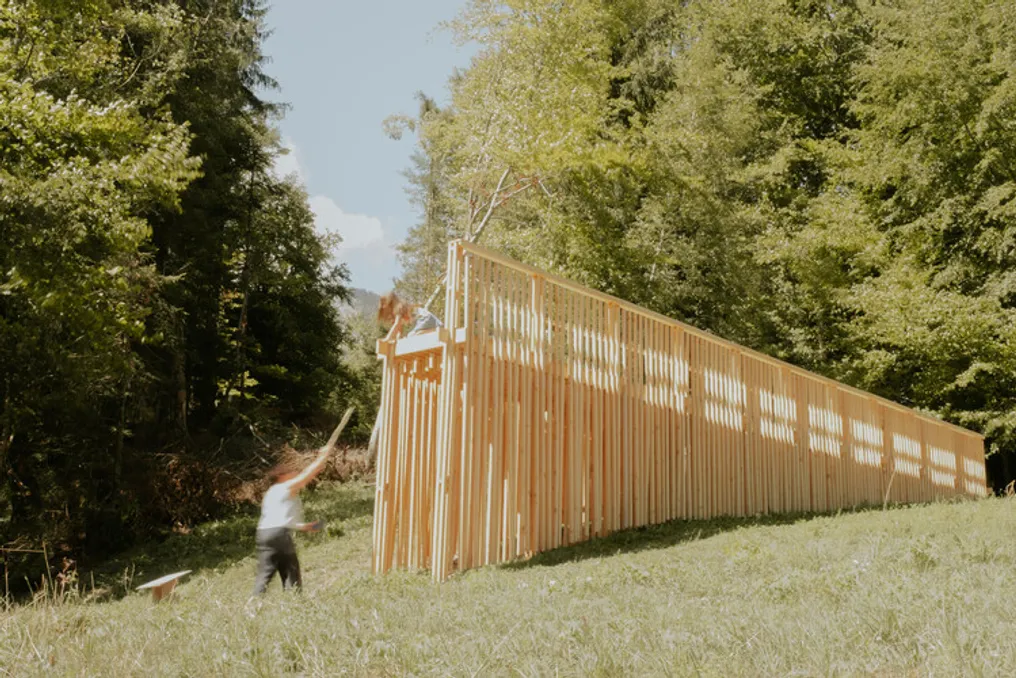
In this setting, the so-called 'ridges' appear, which have been covered with a new horizontal layer of bells. When the first rays of sunlight hit these elements, they illuminate an interface, transforming the valley into a musical instrument. Humans find in this place a space dedicated to play. By using a mallet, it is possible to start the music.
In this unexpected dialogue, posture and gaze change. Participants, with their arms extended forward, cross the wall as it musically unfolds around the movement. The sound wave spreads, and the notes change as the cut wooden slat decreases in size. Although the thin section of wood does not reveal the undulating sail of the structure, the bells of the wooden construction are maintained by a simple logic: a horizontal gesture that transcends topography.
A singular section, composed of a 4 cm wooden slat in the center of the cabin, functions to regulate, dimension, support, brace, and fundamentally, instrumentalize the wind through its movement. The slight curvature caused by this elongated and slender profile generates a slight sway at its highest point. This sensation of vertigo arises in the middle of this seemingly calm and serene landscape, quickly alleviated by the railing accompanying the elevated walkway.
The asymmetry of the structure, which projects beyond ground level to reach the visitor's hand on the north side, defines a hierarchy among the various facades. These interfaces involve the body from the moment the visitor approaches, confronting them with the immensity of the landscape. Inside the cabin, among the oscillating sails, a bell-filled cavern provides an atmosphere of intimacy, serving as a reward for the boldest visitors who decide to cross the project's walls.
The geometry of the worked wood encompasses the territory in its horizontal dimension, the forest in its verticality, and the body in its depth. The uniform rhythm of the structure, which interacts playfully with the irregularity of the terrain, offers a variety of experiences, sensations, and framed views. This rhythm directs itself to a specific point, facing the landscape, projecting the body into this bucolic escape towards the horizon. The «Sound of Wood» project makes the valley vibrate with sound.