
Ceuta residents protest again demanding solutions for the migration crisis
Read more
Noticias ao Minuto
noticiasaominuto.com

Ceuta residents protest again demanding solutions for the migration crisis

The residents of Ceuta have once again demonstrated their demands for solutions regarding the migration crisis. One of the slogans shouted during a march, which featured banners displaying the Spanish flag and the slogan 'SOS Invaded Ceuta,' was 'A resident of Ceuta never gives up.' This demonstration was followed by another act carried out by motorcyclists in the city.

Among Spanish, Ceuta, and European flags, the protesters covered about two kilometers along the coast of Ceuta, culminating at the Tarajal border crossing. There, they gathered under police surveillance and chanted slogans directed at both the central government and the Kingdom of Morocco.

David, one of the Ceuta residents who participated in the march on Sunday to the border, expressed feelings of abandonment, sadness, helplessness, desolation, and fear due to the uncertainty about the arrival of another 80,000 migrants.

In contrast to this description, Noelia Alcázar, spokesperson for the Citizen Forum, assured Efe that citizens also feel 'very supported by other compatriots' and that 'everything is contributing to a great unity among people.' She warned that the government and its institutional power are temporary and that 'they do not have much time left' to defeat the movement.

Additionally, Colonel in reserve Carlos Pavón appealed to army commanders to conduct military mobilizations 'with the dignity and honor they deserve,' mentioning that 'these poor boys are tired of being in this situation, working without resources, without being able to defend themselves.'

The subsequent and noisy motorcycle march, which started on Alcalde Sánchez Prados central avenue and ended at the border, included a tribute to the Legion, a military force closely associated with the autonomous city.

These demonstrations continue a previous event organized by the Ceuta Citizen Forum on Saturday in front of the Government Delegation headquarters in Plaza de Los Reyes, where a protest camp is also maintained to draw attention to the situation in beaches such as Trampolín.

On the beaches of Trampolín and Benítez, further from the center, thousands of migrants remain housed in various improvised shelters and tents along the waterfront. According to the latest data provided by the Government Delegation, 1,700 spots have been made available in shelters at the Port of Ceuta, which hosts the newest and largest facility. This capacity was added to existing facilities in Loma Margarita (1,300 spots), Loma Colmenar (1,200 spots), 500 extra spots at CETI (Temporary Immigrant Detention Center), and 320 spots in La Hípica.
Similar stories

Relocation of refugees from Che Guevara Street in Durban met with approval from residents, but concerns remain
Read more
iol.co.za

Relocation of refugees from Che Guevara Street in Durban met with approval from residents, but concerns remain

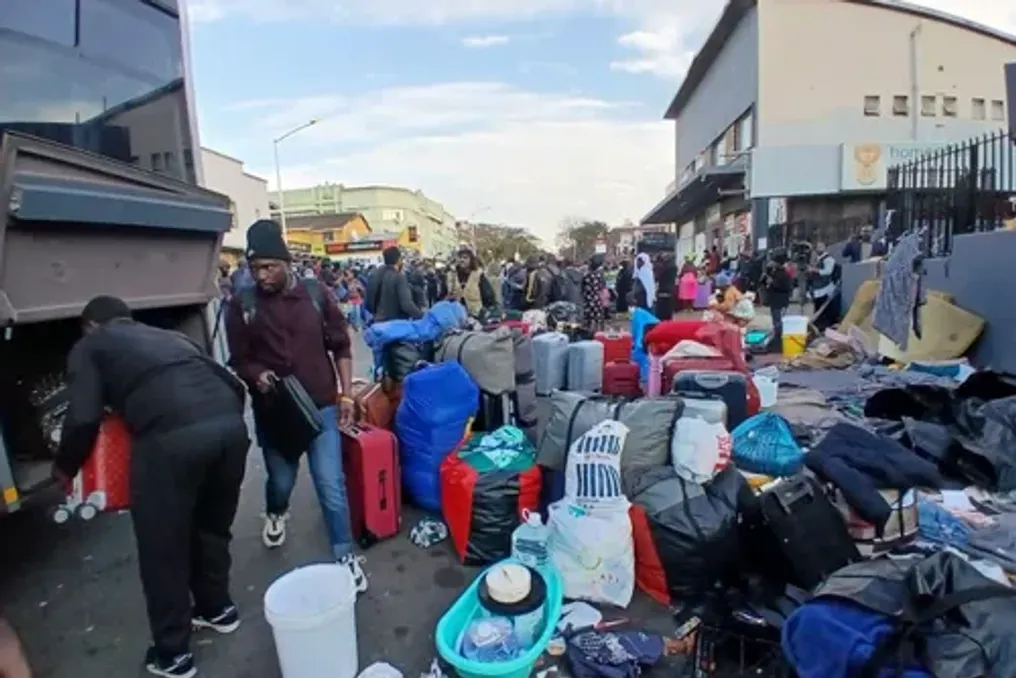
Early on Tuesday morning, Che Guevara Street in Durban experienced rush hour as foreign nationals boarded buses to leave the area towards Linden. Some refugees who were living near the refugee reception office on Che Guevara Street in Durban were transported to Linden, while others moved to Bulwer Park, which raised concerns among activists regarding their living conditions and safety.

Buses took the refugees to the Linden Repatriation Centre in Gauteng on Tuesday, but a significant number of people remained in place. Some of those remaining relocated to Bulwer Park, once again raising questions about their safety and accommodation.

Lubna Nadvi, an activist from the Siyafana Sonke Action Campaign, expressed concern for the well-being of those who remained. She stated that it is necessary to demand answers from SAPS and members of the JCPS cluster regarding plans to protect refugees from any immediate threat.

Nadvi confirmed that arrangements had been made for the transportation of refugees to Linden, with assistance provided by the organization Gift of the Givers for the buses. She noted that there are still many refugees who are not being directed to the Linden detention facility, and rumors circulate about imminent police operations aimed at evicting the remaining refugees from the area near the Refugee Reception Office on Che Guevara Street.

According to Nadvi, the state has repeatedly ignored appeals. She emphasized that the current priority is finding shelter for around 200 remaining refugees who were forced to leave the pavement on Che Guevara Street.

While human rights defenders working on refugee rights voiced concerns about the welfare of those left without stable housing, local residents stated that the situation on Che Guevara Street had become extremely difficult for the surrounding community.

Heather Russ, Deputy Chairperson of the Glenwood Ratepayers and Residents Association and Chair of the Bulwer Safety and Urban Regeneration Forum, reported that the presence of refugees negatively affected residents, noting an increase in crime. Furthermore, residents experienced difficulties moving around the area, and sanitation, garbage, and lack of basic amenities became serious problems.

Russ pointed out that sanitary conditions were critical because these people lacked special facilities and had to use the street as a toilet and bathing area. She added that neighboring businesses also suffered because customers were reluctant to visit the area, leading to a significant drop in business revenue.

A representative of the residents' association stated that they had long interacted with the authorities and believed that the refugees needed a safer and more suitable living environment. Nevertheless, Russ stressed that the authorities should cooperate more closely with organizations assisting refugees instead of waiting for the situation to escalate. She specified that the situation moved to Bulwer Park after the refugees left Che Guevara Street. Russ mentioned participating in a meeting with the Metro Police and is currently on the street with the refugees, trying to find a solution.

For residents like 69-year-old Louise Stehuwer, the relocation brought some relief after months of unrest. Stehuwer recounted that businesses were severely affected because refugees slept near their shops, and tents leaning against walls deterred visitors due to fear. She noted that the community had faced this problem since May.

Stehuwer expressed hope that the refugees would receive the necessary help to reintegrate into communities, even though Bulwer Park is not better. She also noted that the presence of refugees, combined with protests, noise, and frequent police operations, complicated navigation in the area. Despite welcoming the removal of refugees from Che Guevara Street, Stehuwer remained concerned about their well-being, regretting that they suffered living on the street, and hoping that they are now in better conditions and not on the streets, especially in bad weather.

A Metro Police representative, Colonel Boyce Zungu, stated that joint police operations were controlling the situation. He confirmed that the police received complaints about the gathering of refugees in Bulwer Park.

About 13 thousand migrants remain in Ceuta, says head of autonomous government
Read more
noticiasaominuto.com

About 13 thousand migrants remain in Ceuta, says head of autonomous government

The number of migrants in the city has reached approximately 13,000 people, as announced by the head of the autonomous government, Juan Jesús Vivás. This figure is based on counts conducted by the occupying authorities in various accommodation sites, as well as estimates made in camps such as beaches and mountains.

According to Vivás, among these 13,000 people are about 2,000 minors who are unaccompanied by adults and are under registration control and housed.

Juan Jesús Vivás questioned which Spanish city has 15 percent of its population as migrants, calling calls for 'measures to assist Ceuta' 'barbarism.' He noted that Ceuta has a population of about 83,000 people, and the city's territory covers less than 30 square kilometers.

The city head again demanded the 'immediate return' of all individuals who illegally entered Ceuta at the end of July. Previously, local executive authorities estimated the number of migrants remaining in Ceuta to be between 8,000 and 9,000.

According to the Spanish government, no less than 72,000 people entered Ceuta in just a few hours at the end of July, while local authorities estimated this number at 80,000. Most people left Ceuta in the subsequent hours and days; the Spanish government believes that at least 5,000 people remain in the city.

At a press conference on Tuesday, the Minister of Territorial Policy, Ángel Víctor Torres, coordinating the Spanish government's response to the crisis in Ceuta, stated that it is currently impossible to know exactly how many people remain in the city after the mass influx on July 30th. The Minister specified that the counting of people voluntarily returning to Morocco continues, as does the registration of those on the streets as temporary accommodation spaces become available.

According to the government, only with available accommodation can all people be registered and individual procedures for repatriation or asylum be initiated, if applicable. Currently, 3,400 temporary accommodation places have been created, and the government plans to reach 6,000 in the coming days.

Ángel Víctor Torres also reported that about 2,000 unaccompanied minors are among the registered individuals in Ceuta. After more than 90 percent of the at least 72,000 people who entered Ceuta on July 30th and 31st returned to Morocco within a few hours and days, another 4,500 people voluntarily left the Spanish city starting August 10th. Additionally, over 200 people were deported for committing offenses.

Paulo Rangel criticizes Spanish immigrant regularization measures for having a 'pull effect'
Read more
noticiasaominuto.com

Paulo Rangel criticizes Spanish immigrant regularization measures for having a 'pull effect'

The Minister of State and Foreign Affairs, Paulo Rangel, addressed the extraordinary regularization policy implemented by the Spanish government for hundreds of thousands of immigrants during a parliamentary hearing in the European Affairs committee.

Rangel mentioned that on July 31st and August 1st, he and the Prime Minister had stated that there was no threat to the Schengen Area at that time, although he reserved the possibility of this changing later.

When questioned by several deputies about events in the Spanish autonomous city of Ceuta, where over 70,000 people crossed the border with Morocco at the end of July, Rangel stated that he had received 'reliable and abundant' information from Spanish authorities and maintained frequent contact with Rabat.

The minister emphasized the 'condemnation' of certain actions by the Spanish government that generate a 'pull effect.' He declared that Portugal considered this extraordinary regularization imprudent, given that it imposes an 'enormous impact on other Member States.'

The topic of immigration sparked a heated debate with socialist deputy João Torres, who accused Rangel of lacking humanism. This occurred after Rangel highlighted the effect of approximately 800,000 immigrants arriving in Portugal between 2021 and early 2025, a result of a demonstration of interest during António Costa's administration.

Rangel criticized the former socialist executive, stating that it allowed people to enter without assessing whether there was capacity in health, education, or housing systems, denouncing situations of 'people living in sub-human conditions.' He reasoned that while labor is needed, it is essential that these people are in decent conditions.

For his part, Ricardo Reis, from Chega, thanked Paulo Rangel for endorsing what his party has defended for years, reinforcing that migration has a significant impact on health, education, and housing. The deputy questioned the minister whether he would defend against European partners the repatriation of these individuals, who, according to him, overload services.

In response, Paulo Rangel advised Ricardo Reis to present such allegations in a suitable format for the European Affairs committee, instead of using daily 'TikTok' on the streets. He concluded by saying that, using his experience as a teacher, he had never heard such an empty statement.

Popular