Kazakhstan FinTech Market Map: Analysis of Segments, Pilot Projects, and Venture Investments for 2026
Read more
UzDaily
uzdaily.uz

Kazakhstan FinTech Market Map: Analysis of Segments, Pilot Projects, and Venture Investments for 2026

The analytical company RISE Research, commissioned by BCC Hub, Fintech Center, and Tarlan, has prepared an overview of the non-banking fintech market in Kazakhstan. According to RISE Research's analysis as of July 2026, the map covers over one hundred companies across various segments.

Based on data from the Agency for Regulation and Development of the Financial Market (AFSA) and the National Bank of the Republic of Kazakhstan, licensed crypto exchanges remain the most saturated segment. These include KASE, Binance, ATAIX Eurasia, Intebix, BigOne, Cronex, and more than a dozen other platforms.

A significant number of market participants also operate in the digital assets sector (including stablecoins and custody services), WealthTech, digital lending, and financial marketplaces. Special attention is paid to areas such as Earned Wage Access (EWA), electronic identification (eKYC), crowdfunding and crowdlending, online cash registers and POS solutions, credit scoring, and Islamic finance.

In the digital lending sector, the map shows that 214 microfinance organizations are registered in the country, with over 120 currently operating.

Parallel to market expansion, various pilot projects related to tokenization and cryptocurrency payments have been launched within the regulatory sandboxes of the National Bank and AFSA.

In September 2025, the world's first spot ETF on Solana with staking—Fonte Solana Exchange Traded Fund—began trading on the AIX (Astana International Exchange). In the same month, a pilot program for a tenge-backed stablecoin (KZTE) started in the National Bank's regulatory sandbox, involving Intebix, Solana, Mastercard, and Eurasian Bank.

In October 2025, AFSA for the first time accepted a regulatory fee in the USDT stablecoin from SkyBridge Digital Finance through Bybit's infrastructure. In December 2025, a pilot for the tokenization of refined gold was approved in the National Bank's sandbox, involving the National Bank of Kazakhstan and Bank CenterCredit. In February 2026, a pilot for the tokenization of commercial real estate was launched, involving Apartchain, Nu Impact Foundation, Astana Business Campus, and First Validator.

In April 2026, Alatau City Bank and Binance conducted the first test cryptocurrency payment via QR code as part of a pilot announced by Bybit back in 2025.

However, according to RISE Research's analysis, venture activity in Kazakhstan's fintech sector remains low against the backdrop of dominant banking ecosystems, with most deals being at early stages.

Confirmed venture investments in fintech grew from $3 million in 2021 to a peak of $32 million in 2023. After this, they began a steady decline, reaching $19 million in 2024 and $8 million in 2025.

Among the funding rounds recorded between 2023 and 2025, there were investments in Prosper Pay (several rounds at pre-seed, seed, and pre-A stages totaling over $2 million), Investbanq ($3 million at the seed stage in 2023 and again at the pre-A stage in 2025), cardB ($15 million at the seed stage in 2024), and MOST Finance ($1.5 million at the pre-seed stage in 2024).

Similar stories

Video from Bahawalpur market in Pakistan showing vegetable prices goes viral
Read more
www.aajtak.in

Video from Bahawalpur market in Pakistan showing vegetable prices goes viral

A video recording from the vegetable market in Bahawalpur, Pakistan, has become popular on social media. The video shows one person asking vendors about the prices of various types of vegetables.

During the survey, the following prices were mentioned: eggplants cost 350 rupees, and zucchini and carrots cost 600 rupees. The highest price among the listed vegetables is 2000 rupees for peas. The prices for lemons are 150 rupees, and for eggplants, they are 600 rupees.

The appearance of this video provoked reactions from users in India. Some users expressed doubt about the ability of Pakistanis to afford such expensive vegetables, given the existing economic difficulties in the country. Other users questioned the cost of gold and silver in Pakistan if vegetable prices are so high.

However, there is a nuance in this video that requires attention: it is not specified whether the prices refer to a kilogram or to a 'dari'. Social media users commented that the prices presented in the video may not be listed per kilogram. Commentators assert that in some regions of Pakistan, vegetable prices are also indicated in 'dari' units.

The term 'dari' represents a local unit of weight, which is estimated to be approximately 5 kilograms in different places. Consequently, one cannot automatically assume that the '350 rupees' mentioned in the video mean 350 rupees per kilogram. To correctly interpret the prices stated in the viral video, it is necessary to find out what specific unit of weight the seller uses when stating the cost.

Uzbekistan Startup Spaceborne Joins Constructor Start Cohort
Read more
uzdaily.uz

Uzbekistan Startup Spaceborne Joins Constructor Start Cohort

The space technology company Spaceborne from Uzbekistan has been included among the 16 finalists of the fourth Demo Day of the international program Constructor Start. These finalists were selected from over 2100 applications submitted by representatives of 94 nationalities.

According to a press release from Constructor Start, the final event will take place on September 21st in Bremen, Germany, where investment decisions will be announced live on stage.

Spaceborne is developing microwave thermal propulsion technology for use in satellite engines. This startup is the first representative from Uzbekistan accepted into the fourth cohort of the program, alongside the first startup from Georgia—Hi Holo from Tbilisi.

Constructor Start notes that the participation of Spaceborne and Hi Holo in the final aligns with the program's global strategy to find technological companies in markets where the potential of DeepTech is not yet sufficiently represented among investors.

In total, the fourth Demo Day brings together 16 companies operating in industrial technology, space, biotechnology, advanced computing, quantum technologies, and applied artificial intelligence.

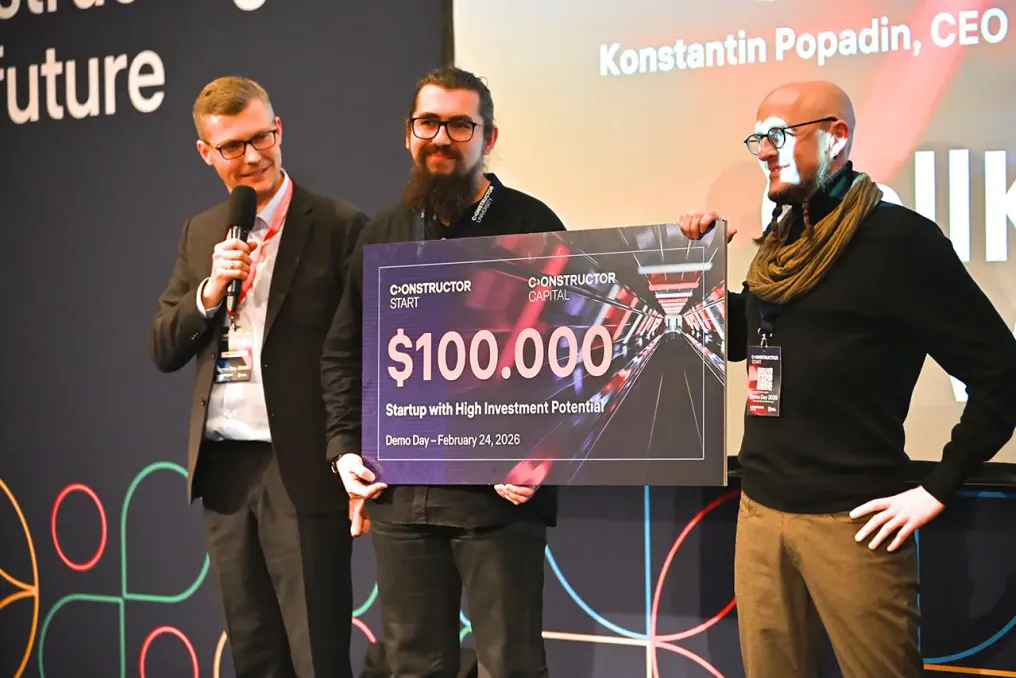
Constructor Capital directly invests $100,000 USD in each winning team in exchange for equity in the company. Within the current selection, an investment totaling $300,000 USD has been confirmed. In addition to direct funding, finalists gain access to potential additional capital through the Constructor Start network of venture funds and business angels, which can reach a total of $1 million USD.

When making investment decisions, several criteria are taken into account, including the company's mission and vision, product, pricing model, and scalability. The program reports that graduates from the previous Demo Day attracted over $10 million USD in additional funding after last year's selection.

The current cohort also includes two startups—CAUSENEX and Cytokyn M—which were created based on Constructor University. CAUSENEX develops a predictive maintenance system for industrial assets using plug-in sensors and causal artificial intelligence technology. Cytokyn M is working on a next-generation candidate—an IL-1 receptor antagonist for treating long COVID and chronic inflammation associated with aging.

The Demo Day event will take place on September 21st in Bremen and will include discussions featuring researchers, company founders, and investors about advanced technologies, their commercialization, and the creation of technology enterprises.

Popular