As healthcare increasingly moves from paper records and hospital reception desks to online portals and mobile applications, access to medical care becomes closely tied to technological access. While digital healthcare means faster consultations and easier access to medical data for many patients, this shift can create additional difficulties for other groups, including the elderly, rural residents, low-income families, and individuals with limited digital literacy.
The issue goes beyond simply owning a smartphone. Patients may face problems with internet connectivity, app loading and navigation, remembering passwords and one-time passwords (OTPs), as well as understanding the information presented online. In many families, one smartphone is used by several members, and caregivers often act as intermediaries between patients and digital healthcare services.
Since public and private medical services are increasingly encouraging, and sometimes requiring, the use of digital platforms, a broader question arises: is technology making healthcare more accessible or creating a new barrier to receiving it?
Digital healthcare has opened up numerous ways for remote treatment management for patients. People can consult doctors online, monitor blood sugar levels through connected devices, receive medication and appointment reminders, and access dietary and educational materials without frequent hospital visits. Telemedicine gained particular importance during the Covid-19 pandemic when quarantine hindered in-person consultations, but this experience also highlighted uneven access to digital healthcare.
The DIG-EQUITY study, published in The Times of India, which examined the experiences of people with diabetes, caregivers, healthcare workers, politicians, and civil society organizations in urban and rural areas of Tamil Nadu, revealed significant disparities in the use of digital health services. Younger patients generally felt more confident using smartphones, health apps, and teleconsultations, whereas many elderly people required family assistance to book appointments, participate in consultations, or access medical reports.
Physical limitations also exacerbated the problem: poor vision or hearing, as well as difficulty operating smartphones, could hinder navigation through digital platforms. Even among the youth, digital access did not always lead to a preference for online care; some Type 1 diabetics continued to prefer in-person consultations due to the need for physical examinations.
The digital divide is closely linked to place of residence and financial means. Urban patients generally have reliable internet connections, smartphones, and access to digital services. A study published in Nature on the barriers to digital transformation in India showed that the issues go beyond merely having a smartphone or internet access. Key problems noted included dense network coverage, inadequate IT infrastructure, high cost of devices and digital systems, lack of technical expertise, and language and communication barriers.
For patients, these obstacles can have very practical consequences. The study noted that some had to rely on family members' smartphones to participate in teleconsultations, and the cost of smart devices could limit access to mobile health applications. The findings indicate that digital access cannot be measured solely by whether a person owns a phone; reliable connectivity, affordability, digital skills, linguistic accessibility, and the presence of human support influence whether a patient can actually utilize digital healthcare. This difference becomes particularly important as medical services increasingly move online.
The digital healthcare infrastructure in India is rapidly expanding. The Ayushman Bharat Digital Mission (ABDM) through platforms like ABHA aims to create a unified digital healthcare ecosystem, while eSanjeevani has expanded access to telemedicine. With the creation of hundreds of millions of ABHA IDs and the conduct of hundreds of millions of telemedicine consultations, the scale of this transition is significant.
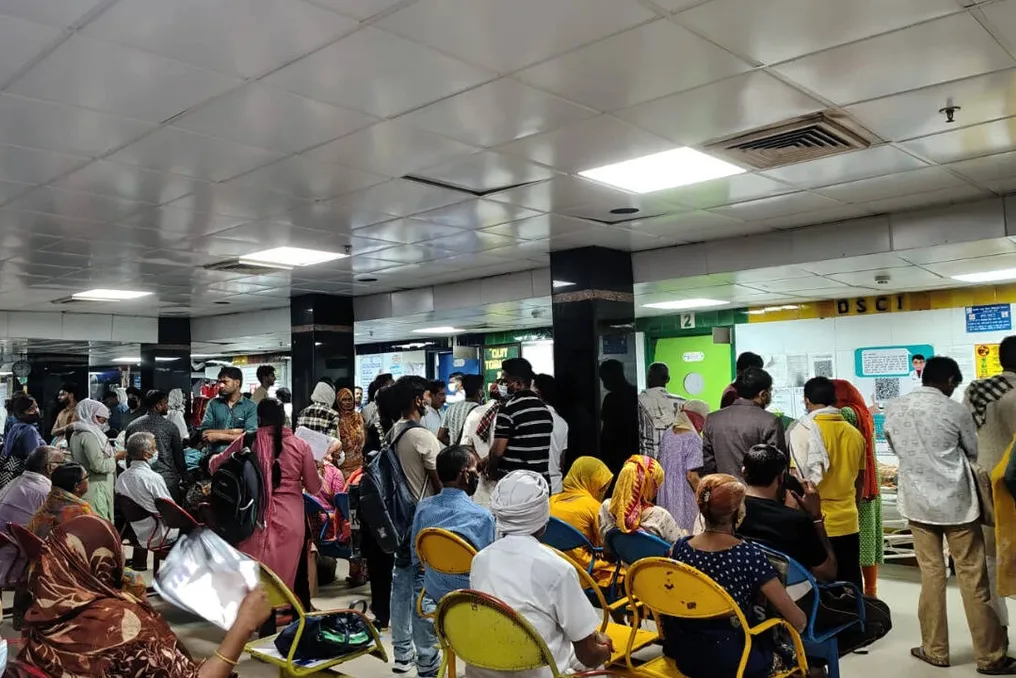
However, the benefits of digital healthcare are distributed unevenly. The gap becomes particularly noticeable when digital systems are implemented at the hospital level. For some patients, this transition has not eliminated queues but created additional ones. Rekha, a patient at the National Institute of Oncology Delhi, recounted that previously patients waited in one outpatient department (OPD) queue, and doctors arrived around 8 am. Now, the process requires generating a token via the ABHA app before arriving at the hospital, followed by another number at the registration desk. She noted: 'Before, there was only one OPD queue, and doctors came at 8 am. Now they made it mandatory to download the ABHA app and apply for a token number. Then we get another number at the registration desk, and doctors come at 10 am. Some patients require urgent help, but this extra queue made life a little harder.'
For those without a smartphone or reliable internet connection, the process can begin hours before the doctor's visit. Some patients, she said, arrive around midnight or 1 am and spend the night waiting because they cannot access the network or generate a digital token. Those who have smartphones can apply via the ABHA app around 5 am and arrive at the hospital by 7 am, only to wait again at the registration desk until the doctor sees them later in the morning.
Dr. Manisha Arora, Director of Internal Medicine at CK Birla Hospital in Delhi, believes that ABHA should remain a tool for facilitation, not a gateway to care. She emphasized: 'A patient should never feel that access to technology determines access to healthcare,' adding that patients without an ABHA ID, smartphone, or internet access must continue to have the option to register physically and receive the same clinical care. She insists that hospitals adopt a 'digital-first, not just digital' approach, which implies maintaining manual registration points, providing assisted kiosks, and having specially trained staff to support users, especially the elderly and first-time service users.'
Digital insurance processes are another area where patients may struggle. Families in the hospital may simultaneously have to deal with e-KYC, pre-authorization, co-payments, deductibles, and non-covered items. Manivannan Selvaraj, founder and managing director of Kauvery Group of Hospitals, stated that translating a clinical treatment plan into a pre-authorization request, and then managing subsequent queries and actions, is a long chain of steps that the patient is neither equipped nor trained to handle, and should not have to do while they or a family member is ill.
Arora noted: 'Sometimes delays or claim issues arise due to incomplete documentation, not medical problems,' stressing that hospital insurance desks should act as consultants to patients, explaining the process rather than just uploading documents. 'True digital accessibility is achieved when technology works in the background, and the patient still interacts with a human on the front line.'
At 65 years old, Amarnath has an insurance policy but says managing it digitally has become complicated. He often doesn't know when he can file a claim, when premiums are due, or how to complete the process online, so he delegates these details to his son. He remarked: 'I have an insurance policy, but I often don't know when I can file a claim, when the premium payment is due, or how to complete these processes online. My son manages it for me. At my age, it is not always easy to visit the center every time I need to check my policy or file a claim. If healthcare becomes digital, these services must also be accessible to the elderly so we can manage them ourselves, without depending on others.'
He also pointed out how the growing use of digital payments in hospitals could create another problem for elderly patients unfamiliar with technology. Having a phone with UPI support does not necessarily mean comfortable usage, especially during a medical emergency when payments might be needed quickly. He added: 'I have UPI on my phone, but for our generation, it is difficult to fully master the process and make an immediate payment, especially during an emergency medical situation. This also needs to be addressed.'
The Covid era demonstrated that systems still face challenges. The pandemic served as an early and stark example of how intertwined technology and healthcare are. While telemedicine and digital systems helped patients receive services during lockdowns, other parts of the healthcare chain showed that digitalization alone cannot solve issues of throughput and access.
As previously reported in The Times of India, delays in Covid testing became a serious issue during the second wave. Udhham Singh, 22, developed a high fever, severe cough, body aches, and shortness of breath after taking an RT-PCR test sample. His report confirming Covid infection arrived several days after the sample was taken. Singh stated: 'If I had waited a little longer, I would have been in intensive care. The element of uncertainty due to the delay also caused severe psychological trauma.'
For patients waiting at home, the delay was not just an inconvenience; it affected treatment and isolation decisions. Some families also faced difficulties adhering to quarantine while awaiting test results. Priya Jaiswal, a resident of Old Delhi, recalled how the network outage during the pandemic made her dependent on officials for necessary medicines. Without internet access, she could not use UPI to pay or order medicines online, forcing her to wait for officials to come to her home. She said: 'We had to wait for hours for officials to come and hand over the medicines while we were in quarantine. Even online consultations became difficult due to constant power outages when we needed medical help the most.'
The surge in demand for Covid testing also put pressure on government laboratories to release digital reports promptly, highlighting another digital healthcare issue: the effectiveness of the digital interface depends on the supporting system.
Covid-19 vaccination certificates also impacted people's travel and employment plans. Varghase Thomas, a young man from the city, told TOI that five people in his group received their first dose of the vaccine around the same time, but only one received the certificate almost 40 days later. He recounted: 'When we applied for jobs, potential employers asked us about vaccination. They wanted us to provide the certificate.'
Registration through Co-WIN also proved difficult for rural residents. As previously reported in The Times of India, 68-year-old Adhi Kesavan from Gudiyattam in Vellore district, Tamil Nadu state, had to travel 5-7 km with his wife to a service center to register for vaccination. Kesavan did not own a smartphone and did not know how to use one. He was directed by the panchayat head, who informed him that his data could be registered at the center and that the hospital would contact him when the vaccine became available.
[