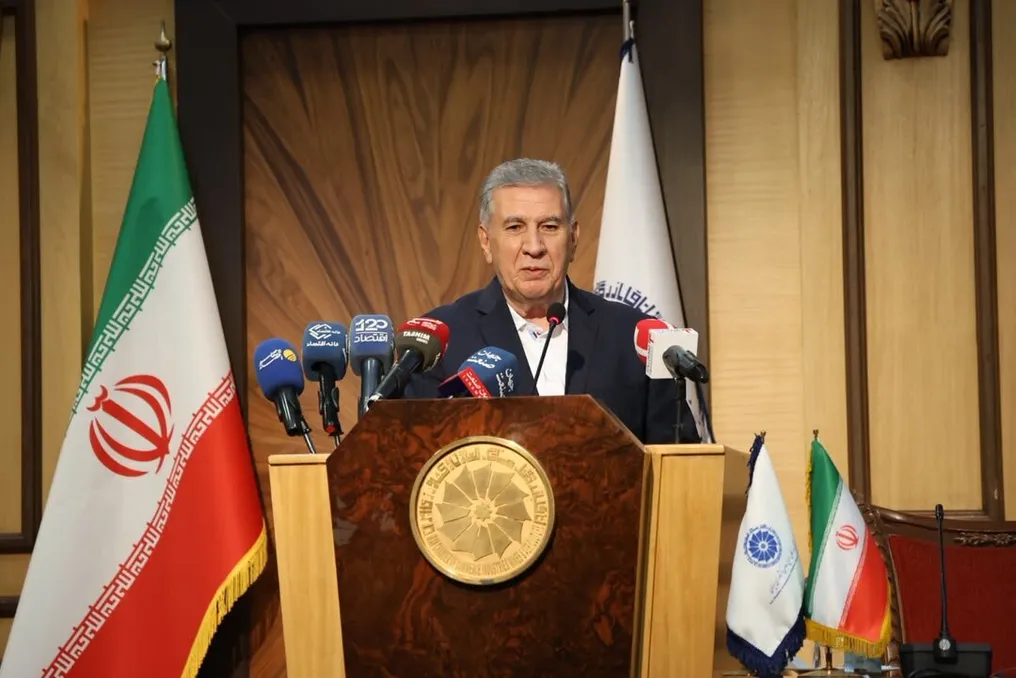
The President of the Iranian Chamber of Commerce for Trade, Industry, Mining, and Agriculture (ICCIMA) announced the signing of a five-party memorandum of understanding during the State-Private Dialogue Council meeting on Monday, September 21. The goal of this agreement is to strengthen interaction and coordination between governmental bodies related to improving the business environment and supporting the private sector, aiming to make the economic atmosphere transparent, stable, competitive, and predictable.
Samad Hassanzadeh, President of ICCIMA, noted the efforts of economic actors despite challenging economic conditions at the Chamber's representatives meeting on Sunday, September 20. He emphasized that economic players managed to maintain production centers and protect employment in the country, and that the Minister of Industry, Mining, and Trade, along with all government officials, have always been grateful to the private sector for this.
Hassanzadeh drew attention to the impact of the complex international situation on the country's worsening economic problems. He stated that about 50 years of sanctions and military actions, including wars lasting 8, 12 days and Ramadan, as well as the continuation of these conditions, have put immense pressure on the country. Significant figures have been lost who will never be forgotten, and large enterprises and factories have suffered, but Iran's economic actors and worthy people have managed to resist these aggressions and damages, creating conditions for satisfying the basic needs of society.
The Chamber President also pointed out the negative consequences of major war, both military and economic, on the lives of all citizens. He added that all private sector experts believe that the responsibility of economic actors and businesses is more important today than ever, and efforts must be made to maintain production to alleviate problems for the country and economic activity.
Samad Hassanzadeh believed that overcoming the current situation depends on strengthening the internal ties of the country's economy. He believes it is necessary to combine the power of large industries with the potential, experience, and innovation of small and medium-sized enterprises, thereby increasing the resilience of the country's economy. He also noted that SMEs, which constitute a significant part of employment, face serious challenges, and large economic players must integrate them by using their products in sales and exports.
He introduced an important step by the Iranian Chamber towards achieving 'national synergy'—the launch of the Iranian Subcontracting and Partnership Exchange System (SPX). This new Chamber initiative aligns with the principles of national synergy as it creates an operational platform to connect small businesses with large industrial enterprises. The SPX system was implemented in cooperation between the Iranian Chamber and the Iranian Small and Industrial Parks Organization.
The Chamber President added that through the aggregation of information regarding the needs of businesses and employers, this system transforms relationships between small and large enterprises from fragmented and temporary to sustainable and targeted cooperation, creating a mechanism for establishing stable, transparent, and managed relationships.
The Chamber President announced a plan to conclude a five-party memorandum of understanding as a national action aimed at improving the business environment. As a national measure targeting closer integration and development of inclusive cooperation in the country's economic policy, the Iranian Chamber initiated the formation of a five-party interaction. To implement this interaction on Monday, September 21, during the State-Private Dialogue Council meeting, a five-party memorandum will be signed between the Iranian Chamber, the Ministry of Economy, the Deputy President for Legal Affairs, the Ministry of Interior, and the Secretariat of the Council of Ministers.
Explaining the details and goals of this five-party memorandum, Hassanzadeh specified that its task is to enhance interaction and coordination between governmental institutions related to improving the business environment and the private sector. This will make the economic environment transparent, stable, competitive, and predictable. Furthermore, through a coordinated and sustainable mechanism of cooperation and coordination, the quality of economic policies and regulations will improve, and the implementation of laws and rules will be facilitated and monitored, identifying and eliminating legal and executive obstacles for economic actors to perfect the regulatory system.
In another part of his speech, he mentioned that the exchange rate increase has caused inflation in society. Due to the Central Bank's restrictive policies, there are restrictions on the distribution of foreign currency to enterprises, especially for essential goods, spare parts, and equipment. In this regard, meetings were held with Central Bank officials, and it was proposed that the Central Bank should distribute foreign currency for essential goods, such as medicines, which are part of state obligations. Meanwhile, other issues should be resolved by the private sector through import without currency control registration, without currency transfer, and without verification of the origin of foreign currency, so that economic units can meet their needs independently. He also mentioned that Dr. Hemmati gave a positive commitment on this matter, which will help overcome the conditions created by America and the West for the country.
Hassanzadeh also touched upon the country's customs issues regarding goods clearance and document processing. He reported that the Minister of Industry, Mining, and Trade announced at the Council of Chambers meeting the inclusion of a unified customs management plan on the agenda, with governors being responsible and customs directors supervising. There is hope that thanks to this measure, all goods will be available for economic enterprises to clear in the shortest possible time.