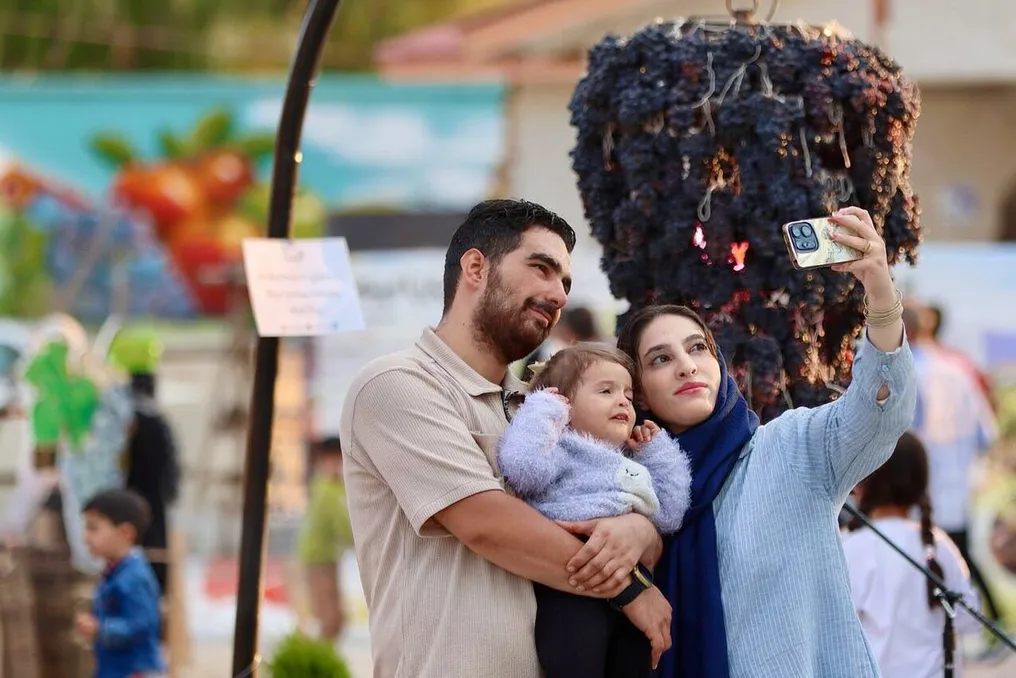
By the end of the day, the road leading out of Urmia began to become heavily congested. After the arrival of a flight around five in the evening and quick hotel check-in, the group headed to the village of Chi Chest Coastal, located near Lake Urmia, where the ninth Urmia Grape Festival was taking place.
During the trip, the author asked the guide about the significance of grapes in Urmian culture. The guide explained that harvest festivals are an ancient local tradition with roots stretching back millennia, and also mentioned the harvesting customs among various religious communities in the region. One such tradition is called Shanadar or Shanidar.
The destination represented a modern interpretation of this old connection. Upon arrival, the parking areas were already overflowing. People moved toward the entrance, stopping to take pictures next to large sculptures, statues, and colorful grape figures. The author estimated that there were between two and three thousand people present at that moment.
Various varieties grown around Urmia were displayed on numerous stalls for visitors. Among them were unusual, long, and large fruits resembling dates, as well as round and heavy berries of different shades—green, red, and black. After tasting a Japanese variety, the author was surprised because its flavor changed while eating, first reminiscent of one fruit, and then another.
At one kiosk, a middle-aged man offered visitors grapes from baskets. When the author asked which one to try, he pointed to a dark variety and advised, 'Don't judge by color. Just try it.' The man smiled after the author's reaction and suggested taking some home, claiming that such a taste is hard to find in the city. The author bought a seven-kilogram box to transport to Tehran, later realizing the practical difficulty of passing through the airport with luggage.
At another stall, a woman carefully arranged green grapes in rows. She stated that most of the harvest comes from the surrounding areas, emphasizing that Urmian grapes are known for the diversity of their varieties, each having its own purpose. The young woman nearby added that some varieties are better suited for fresh consumption, others for raisins, and a third are used to make Doshab.
This brief conversation explained more than the exhibits themselves: grapes represented an entire category of local product, labor, and knowledge. On other stands, methods of processing the fruits after harvest were demonstrated. More than two tons of green and black grapes were being dried on an inclined surface to produce raisins. Huge bunches left to dry for several weeks were also presented; locals called this traditional method 'Milah'. They explained that this drying method retains more moisture, making the raisins softer and juicier.
Additionally, bottles and jars of grape products, including thick Doshab syrup, were available. After purchasing some products, the author saw that grapes are not just a fresh product, but a raw material that can be dried, cooked, preserved, and turned into food for winter storage. One vendor offered a piece of dried fruit to taste, explaining that the preparation time depends on the variety and drying method, but it was a traditional way of preserving the harvest.
Beyond Grapes
The most interesting part of the evening was the moments happening outside the trading aisles. Around the main festival area, families set up temporary camps, bringing food with them. They ate dinner together while children ran around the festival grounds. Nearby, Ashiki musicians in traditional costumes sang and played, accompanied by drumming, and a group of people performed a traditional dance, holding hands.
Speaking with a woman sitting with her relatives, the author learned that they try to come every year. When asked what attracts them—the grapes or the festival itself—she laughed and replied, 'Both. But mainly family.' Her son added that he likes the games, to which his mother agreed. This small dialogue gave the event a family character, showing that for many, grapes were only part of the reason to come, and the main thing was the opportunity to spend time together.
Nevertheless, behind the music lay a significant agricultural economy based on food and vibrant exhibitions. The author also met Aidine Rahmani-Rezaei, the Mayor of Urmia, who was attending the festival. The mayor announced that ambassadors and representatives from fifteen foreign countries were expected at the closing ceremony. He noted that the origins of the grape festival are linked to an ancient tradition of giving thanks for the harvest, which people celebrated at the end of Shahrivar month (mid-September).
The municipality has been holding the festival for almost a decade. This year, it became larger because the goal was not only to preserve the tradition but also to popularize it among the younger generation. The municipality created special sections dedicated to innovation, industry and investment, history and identity, sports, mothers and children, as well as food and agriculture. In the innovation section, agro-technologies related to grapes were demonstrated, and specialized panel discussions were held.
Another zone was dedicated to the industry and investment in agriculture. The 'history and identity' section featured photographs over three hundred years old. Furthermore, a market operated where farmers sold their produce directly to visitors. Rahmani-Rezaei emphasized the importance of this sales channel 'directly from the farmyard'. He also announced the municipality's intention to make Chi Chest a permanent venue for festivals and create a year-round calendar of events based on tourism and local attractions.
The Governor of Urmia, Kahraman Avazlu, who accompanied the mayor, reported that grapes are the second most important agricultural product in the city after apples. The annual production volume is estimated at approximately 240,000 tons, involving over 30,000 producers. He also mentioned the variety of products derived from grapes, including vinegar and grape syrup.
The Deputy Mayor of Urmia, Vahid Abbasi, described the city's connection to vineyards more personally. He called grapes the 'aroma of Urmia and the blessing of the city'. Abbasi noted that the people of Urmia have lived near vineyards for generations, and now the city seeks to transform this long-standing connection into an economic and tourist opportunity whose benefits should ultimately go to farmers and participants in the local economy. The overall goal is to strengthen Urmia as a tourist destination and make the grape festival an event that attracts guests from outside.
Beyond the Festival
Understanding this connection deepened the next day. Driving outside Urmia towards the Tamtaman cave, along the roadside, vineyards appeared in far greater numbers than anticipated at the festival. If yesterday the grapes were displayed under lights, on tables, and shown to guests, today they were simply growing in the fields.
The driver stopped near one of the vineyards and spoke about an ancient local custom according to which a passerby could pick and eat a few berries. He mentioned the local name for this custom, which the author subsequently forgot. The author picked a few berries, and there were no barriers between him and the fruit: no stall, no packaging, no sign, no scene—only the vine. The driver watched him eat and laughed, saying, 'Now you understand Urmia.'