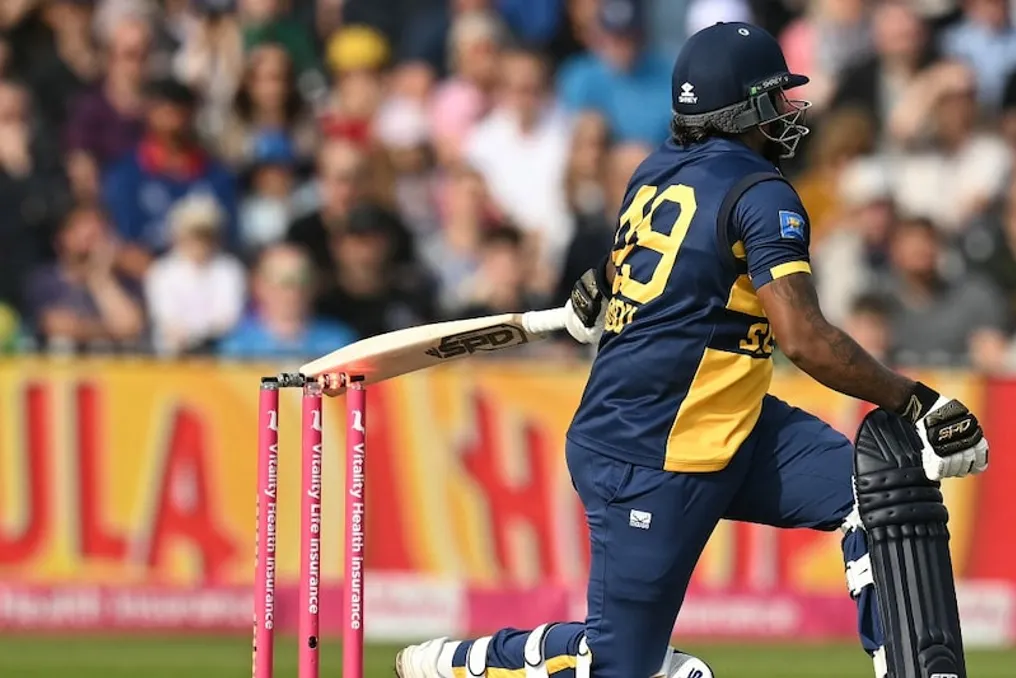
Wanindu Hasaranga was dismissed by a hit wicket in the match between Sri Lanka and England
Read more
Aaj Tak
www.aajtak.in

Wanindu Hasaranga was dismissed by a hit wicket in the match between Sri Lanka and England

An incident occurred during the third and final T20 series match between Sri Lanka and England, which sparked debate among cricket fans and experts. During the game on September 19th (Saturday) at Old Trafford stadium in Manchester, Sri Lankan player Wanindu Hasaranga was dismissed by a hit wicket.

Hasaranga attempted a powerful shot against a fast delivery from English bowler Jofra Archer but missed. In the process, the Sri Lankan all-rounder's bat turned during the swing and struck the stumps. As soon as the bails fell, Wanindu Hasaranga was declared out by hit wicket. Jofra Archer initially seemed not to notice the fall of the bails. Hasaranga left the field having scored 7 runs. The Sri Lankan team's total score was 124 runs.

Sri Lankan critic Rex Clementine commented on Hasaranga's dismissal, noting that he initially perceived it as a common occurrence in cricket, but later realized that this moment raised many questions among people.

Chasing 124 runs, England completed the match in just 9.4 overs. Jos Buttler was not dismissed, scoring 62 runs off 32 overs, and helped his team secure an 8-run victory. Captain Harry Brook also contributed, scoring 33 runs. Buttler and Brook formed a quick partnership of 85 runs in 38 overs. England scored 82 runs during the powerplay, which eased their path to the target score.

Thanks to this victory, England achieved a clean 3-0 triumph in the three-match T20 series against Sri Lanka. This marked England's fifteenth victory over Sri Lanka in T20 international matches. Furthermore, England secured the first place in the T20 international rankings.

From Sri Lanka's side, Pathum Nissanka contributed 36 runs off 24 overs, and Chamindu Mendis scored 35 runs off 28 overs. Although the Sri Lankan batsmen showed good hitting early in the match, the English bowlers consistently dismissed players, controlling the run rate.

The most successful player for England was Sonny Baker. He took 2 wickets, conceding 17 runs in 3.5 overs, and was named 'Player of the Match'. Throughout the three-match series, Baker took six wickets, maintaining an economy rate of 3.71.
Similar stories

Former player Krishnamachari Shrikant criticizes decision not to include Vaibhav Suryavanshi in the Indian squad
Read more
www.aajtak.in

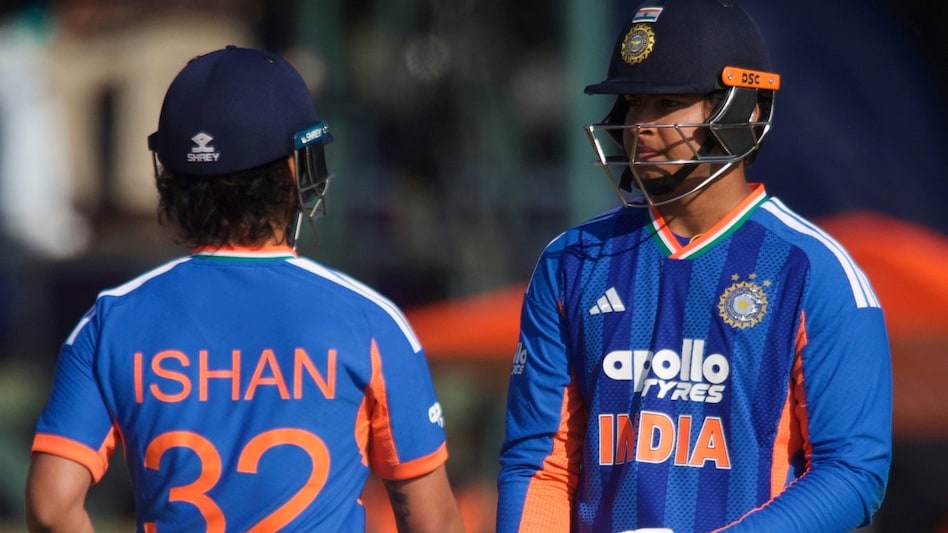
Former player Krishnamachari Shrikant criticizes decision not to include Vaibhav Suryavanshi in the Indian squad

The Indian team defeated Afghanistan in the first match of the three-match T20 series, winning by seven wickets. After a confident start, the Indian squad aims to win the second game to gain an advantage in the series.

Young 15-year-old batsman Vaibhav Suryavanshi, who impressed with his powerful batting during the visit to Zimbabwe, did not get a chance to play in the first match against Afghanistan. Before the game, there were active discussions among fans regarding Vaibhav Suryavanshi's participation.

Despite India's comfortable seven-wicket victory, the decision not to include Vaibhav in the starting lineup sparked controversy. Former Indian selector and experienced player Krishnamachari Shrikant sharply criticized this decision by the team management.

Speaking on his YouTube channel, Shrikant noted that it was completely unclear why the player, who was the best in the previous match of the series, was suddenly excluded. He joked that when Vaibhav Suryavanshi didn't play yesterday, they started watching movies instead of the match on TV. His wife also expressed dissatisfaction, questioning why the star from the previous match was absent from the team today. He added that if such an ordinary viewer asks this question, one should consider what the player himself is going through.

Shrikant believes that constantly including and excluding a young athlete undermines his confidence. He stated that the team is treating Vaibhav incorrectly. Now, when he steps onto the field for the next match, he will have the fear of being excluded again if he does not score runs.

Shrikant emphasized that this young batsman, who has proven his worth in domestic cricket, India-A, IPL, and international T20, should be given consistent opportunities. Furthermore, he expressed regret over the treatment of Sanju Samson. He noted that Samson is sometimes included in the team and sometimes suddenly excluded, which does not contribute to the stability of any player.

It turned out that Vaibhav Suryavanshi participated in the final match of the Theleef Trophy, a red-ball tournament, just two days before the series against Afghanistan. Because of this, he had fewer opportunities to train with white balls (T20). In the first match, Sanju Samson played in place of him in the opening batting alongside Abhishek Sharma. Although Samson was dismissed after scoring 10 runs, the Indian team achieved the target of 157 runs in just 13.4 overs.

The Story of Lala Amarnath, India's First Centre Batsman Who Played Alongside His Sons for India
Read more
www.aajtak.in

The Story of Lala Amarnath, India's First Centre Batsman Who Played Alongside His Sons for India

September 11 marks an important date in the history of Indian cricket: 115 years ago, in 1911, Lala Amarnath was born, the first centre batsman for the Indian team. Amarnath became not just an athlete, but a significant figure who left a deep mark on the culture and system of Indian cricket, being involved in it as a player, bowler, captain, selector, coach, and commentator.

Lala Amarnath, born into a modest family in Lahore, demonstrated his talent in 1933-34, scoring 109 runs for the South Punjab team against MCC. Shortly after, he got the opportunity to play in India's first home Test match against England at the Jimkhana ground in Bombay. Despite India's difficult situation, Amarnath managed to counter the attacks of the English bowlers, completing a century in 117 minutes and becoming the first player to score a centre in international cricket for India, although the team ultimately lost.

In 1936, during a tour of England, Lala Amarnath was one of the most influential players in the Indian squad. However, a dispute arose with the team captain, Maharaja Kumar from Vijnagaram, known as 'Viji'. Following this incident, Amarnath was sent back to India mid-tour, which seriously affected his Test career, forcing him to step away from it for about 12 years. Nevertheless, his domestic performances continued, and in 1938-39, he scored an impressive 241 runs for the Hinduja team against The Rest.

Lala Amarnath's return was not limited to batting. In 1946, during a visit to England, he made a splash in a match at Lord's, dismissing players such as Len Hutton, Cyril Washbrook, Dennis Compton, and Wally Hammond in England's first innings. A specialty of his bowling was the ability to bring the ball inside with precise length, allowing him to play a useful role both with the bat and with the ball for the Indian side.

In 1947, Lala Amarnath was appointed captain of the first Australian touring Indian team after the departure of Vijay Merchant. The Australian team under Don Bradman was very strong, and India faced serious difficulties in five Test matches. Although his personal Test performances did not meet expectations, he performed brilliantly against regional teams, notably his innings of 228 runs against Victoria was noted by the great Australian player Neil Harvey.

In the 1952-53 season, Lala Amarnath once again led India, and this time the opponent was Pakistan. This was the first official Test series between the two countries, which India won, creating a historic moment. Nevertheless, Amarnath's relationship with Indian cricket politics remained complicated; due to disagreements with the then influential council officials, he faced problems regarding leadership and team decisions.

Throughout his career, Lala Amarnath played 24 Test matches, scoring 878 runs at an average of 24.38. In Tests, he scored 1 centre and 4 half-centuries. Regarding bowling, he took 45 wickets at an average of 32.91. In total across 186 first-class matches, he scored 10426 runs and took 463 wickets.

Although Lala Amarnath's sporting career concluded, his contribution to Indian cricket remains significant. He became a selector, and his name is particularly associated with the decision to give a chance to spinner Jaswant Patel in the Kanpur match against Australia in 1959-60. Patel secured a historic victory for India through his outstanding bowling. His family also continued the cricketing tradition: his sons Surinder Amarnath and Mohinder Amarnath represented India. Surinder also scored a centre in his debut Test match, and Mohinder played 69 Test and 85 ODI matches.

Lala Amarnath was characterized by his straightforward nature and ability to openly express his opinion. His contemporary Mushtaq Ali vividly described his personality. Given his contribution to Indian cricket, former Prime Minister Atal Bihari Vajpayee called him an 'icon'.

Experts advise Vaibhav Suryawanshi not to let fame influence his cricket career
Read more
www.aajtak.in

Experts advise Vaibhav Suryawanshi not to let fame influence his cricket career

Vaibhav Suryawanshi's batting has amazed the world, as he demonstrated incredible success against bowlers in T20 cricket at a very young age, leading to inflated expectations. Now that he steps onto the field, spectators expect not just good play, but explosive moments.

However, this is where another chapter of the story begins. Players who aim to hit every ball for a four or a six eventually encounter a situation where bowlers begin to use that same haste against them. An example of such risk was Vaibhav's elimination in the Dalip Trophy final in Chennai after a delivery by Vijay Tripura, which served as a warning about this danger.

With a score of 8 runs off 16 balls, while Vaibhav tried to send the ball outside the boundary, he himself fell into a trap due to his haste. Vijay nudged the ball slightly back, and Vaibhav stepped out of his defensive zone, intending to send the ball over the boundary. But this time, the ball bypassed not the bat, but the batsman's mind.

The ball spun in the air, Vaibhav missed, and Jagdishan bowled him out. This moment should prompt Vaibhav to pause and ask himself questions. What he sent far yesterday, the same player read today.

This dismissal is particularly interesting because he was facing the same Tripura Vijay, who had previously conceded three fours and one six from Vaibhav in his debut IPL match. At that time, Vaibhav managed to read Vijay. This time, Vijay read Vaibhav. In cricket, victory is not always achieved with words; sometimes one ball is enough.

Perhaps an image of the previous confrontation remained in Vaibhav's mind. Perhaps he thought Vijay would again be an easy target, so he stepped out of his defensive zone to reach the ball. But in Red Ball Cricket format, the bowler shows you not only the ball but also illusions. Vijay did the same: he allowed Vaibhav to come closer and then stopped the ball in the air in such a way that the batsman's entire mathematics was disrupted. Last time, Vaibhav taught the bowler a lesson; this time, the bowler taught Vaibhav a lesson.

T20 helped Vaibhav gain fame due to his fearless style of play, which is his main asset. However, first-class cricket tests this fearlessness. Here, it is not necessary to hit every ball. Sometimes the best shot is simply not hitting the ball. Sometimes the right play is not scoring runs for ten balls. It is also important to show the bowler that the batsman will not fall into his trap.

Vaibhav needs to learn this. He is not lacking in shots, power, or confidence. He needs to learn when 'not to hit'. This is what distinguishes an explosive batsman from a great batsman.

Popular