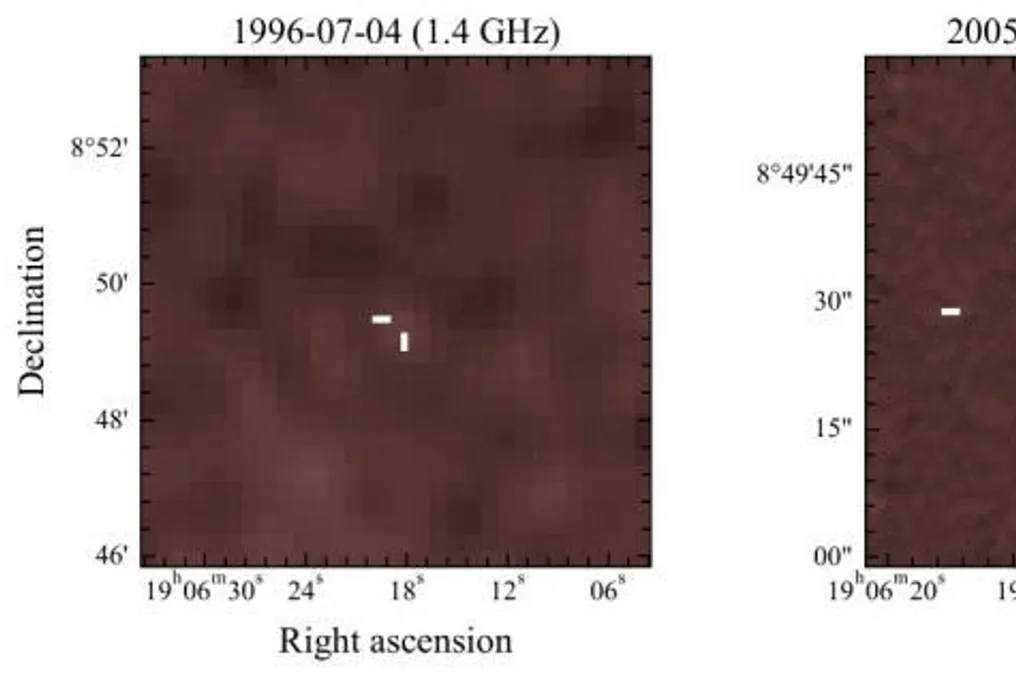
The object, which is a transient radio source in the Milky Way, has remained active for over twenty years without exhibiting X-ray emission. This discovery, presented in an article available for review on the arXiv repository, calls into question the expected behavior of known classes of galactic radio sources.
This object, designated VT J1906+0849, was discovered during the Very Large Array Sky Survey and is the brightest transient object registered by this program, according to an official statement. The research is conducted by scientists from the California Institute of Technology (Caltech) in the USA, who combined archival data with new measurements across various wavelengths.
Analysis of the source's history showed that its brightness increased by at least six times over a 21-year period. Data from 2005 recorded the source with lower intensity, reaching an emission peak around 2014, followed by a decline and a new flare-up in late 2025.
Measurements made with the Very Long Baseline Array (VLBA)—a network of radio telescopes located across the United States functioning as a single high-resolution observatory—indicate that the emitting region is extremely compact and is located at a distance estimated between 49,000 and 104,000 light-years from Earth. Observations by the Swift space telescope found no X-ray emission associated with this object during the analyzed period.
Radio transient objects are typically characterized by a rapid brightness peak followed by a gradual fading. However, VT J1906+0849 does not conform to this pattern, maintaining emission for two decades without visible spatial expansion, despite data suggesting gas movement at speeds of thousands of kilometers per second.
Processes such as supernova explosions, active binary systems, and variable stars have been ruled out because they do not possess sufficient luminosity to explain the obtained data. The source's luminosity temperature ranges from 100 million to 10 billion Kelvin, which excludes thermal origins related to star formation.
The high temperature suggests a non-thermal origin, such as synchrotron radiation. This mechanism occurs when high-speed electrons orbit strong magnetic fields. Although young pulsars generate this type of radiation, they evolve over centuries, whereas the object under consideration has changed in just a few years.
Based on these factors, the research group suggests that the most likely mechanism is sustained accretion of matter onto a compact object, such as a black hole or a neutron star. This process would provide a continuous ejection of particle jets and magnetic fields.
The absence of X-ray emission is attributed to the presence of a dense stream of gas emanating from the accretion disk. This gas covers the central region, blocking direct X-ray radiation and preventing the visible expansion of the radio source observed by telescopes.
Near-infrared data showed redshifted emission lines, indicating that part of this dense gas is moving towards Earth. This structure resembles the microquasar SS 433, where dense winds interact with the central object's jets.
Confirmation of the nature of VT J1906+0849 depends on new infrared analyses and observations in the hard X-ray range. If the hypothesis is confirmed, this object will become the first identified member of a new class of bright radio-accreting compact systems hidden from X-ray radiation.