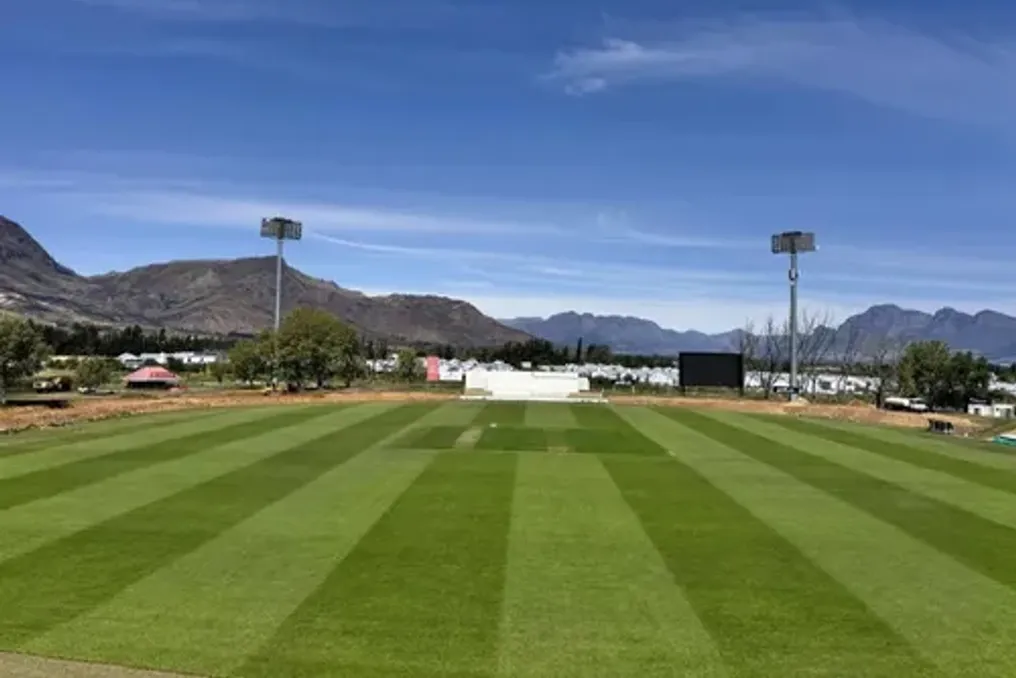
In anticipation of the ICC Men's Cricket World Cup in 2027, which will be held in South Africa, Zimbabwe, and Namibia, a significant transformation is taking place at cricket grounds across the country. South African Cricket has spent the last two years developing interchangeable surfaces for major sporting venues nationwide.
However, this innovation has sparked lively debate among lawn care specialists, coaches, and players regarding the preservation of the traditional advantages of a home ground. Nevertheless, cricket pitches across the country have long required modernization, as deteriorating surface quality caused some grounds to behave differently than before.
For instance, the Wanderers stadiums in Johannesburg and Kingsmead in Durban have gradually changed character: they have transformed from pitches known for pace and bounce into ideal conditions for spinners. The Wanderers Stadium, which is likely to host the 2027 World Cup final, has already used a strip grown in a stainless steel tray next to the playing area before installing it on the pitch.
According to player reports, the ball 'flew slightly low' from the Golf Course side, while Lions bowling coach Allan Donald stated that 'he played very well.' At Boland Park in Paarl, lead lawn care specialist Rupert Bailey is overseeing the integration of the new interchangeable surface at this venue. Although routine maintenance and field construction have been ongoing in recent years, the introduction of the interchangeable surface marks a new chapter for the field in Winelands.
Rupert Bailey noted: 'Over the past couple of years, I have probably built four new fields at the venue, but this year we have added a new interchangeable or exchangeable surface.' He added that it is planned to test it later this year, possibly in November or December, to assess its playability over one or two days, after which a decision will be made on its use in matches.
While this infrastructure development is directly linked to preparations for the World Cup, Bailey emphasizes that the long-term benefits extend far beyond this tournament. 'It is for the World Cup, but also for the time after the World Cup, to create greater potential, host more matches, and ensure that your other grounds, especially the main ones, get a little more rest. That is the main aspect,' he explained.
The technical specifications of the interchangeable trays are standardized across the country; however, the microclimate of South Africa means that the characteristics of each ground will inevitably influence the course of the game. Weather conditions can still play a role.
In Paarl, combating extreme heat and humidity remains an ongoing challenge. Last winter, there was little rainfall in Winelands, and strong winds blew since early September. Bailey noted: 'All the interchangeable surfaces in the country are absolutely identical—the same amount of local bull, the same depth.' He added that he cannot say how it will play on another ground, but temperature and humidity management plays a huge role. He also stressed that 'the heat in Paarl is very high, dry heat. It probably won't play exactly the same as the grounds in Highveld.'
Bailey expects the new tray to provide a contrast to the traditional characteristics of Boland Park, which were historically slow and low, although the North West Dragons team scored over 600 runs in their domestic four-day match against Boland. He believes the new tray will likely have a better, sharper bounce, which is better for batsmen, provided the bounce remains consistent throughout the match.
Maintaining these surfaces under a tight schedule and harsh summer weather, especially with El Niño forecasts bringing intense heat, presents a delicate balance. Bailey added: 'If you play many matches, your wickets experience much more load and stress, and recovery and maintenance periods become much shorter.' He concluded that fields require time for maintenance and recovery, which is sometimes lacking, and interchangeable surfaces can help with overuse.
Potential Loss of Identity
Although curators welcome the added flexibility, the nationwide implementation of interchangeable surfaces has met resistance within the national team structure, where concerns persist about losing unique local conditions. Shukri Conrad, head coach of the Proteas Test team, expressed serious doubts about the possible loss of traditional home conditions ahead of the World Cup.
Conrad stated: 'The only experience I have is observing from afar when this was applied at the T20 World Cup in America, and we all know how that played.' He added that 'on a personal level, and this is not an opinion of South African Cricket or anyone, I must disclaim, I would be disappointed if this was used in the World Cup because it nullifies any home advantage, if one exists.' He emphasized: 'We know our conditions in South Africa are unique at every ground. And I would like to think that this advantage will be preserved.'
Proteas spinner Tabraiz Shamsi supported Conrad's sentiments, noting that the distinctive features of South African grounds have historically served as a tactical advantage. Shamsi stated: 'In my unofficial opinion, our stadiums are specific to cricket, and in every city there are different grounds with different characteristics; they all play differently.' He continued: 'Knowing the conditions is a huge advantage, and the Proteas will lose that in the World Cup if we play on interchangeable surfaces.'
During trials scheduled for the 2026/27 summer season, lawn care specialists across the country will closely monitor the performance of the interchangeable surfaces, balancing the practical demands of the modern schedule with the tactical preservation of South Africa's renowned ground diversity. All that is known is that an interesting cricket summer lies ahead for everyone.