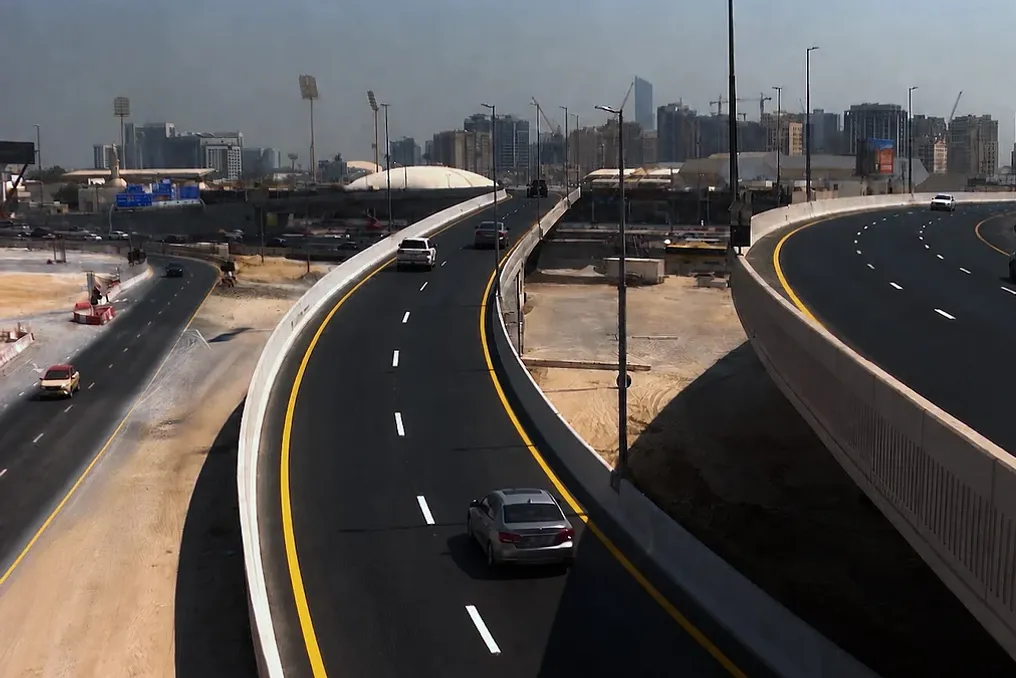
Drivers in Dubai traveling through the areas of Oud Metha, Al Jaddaf, Umm Hurair, and surrounding territories can now complete key journeys significantly faster thanks to the completion of a major road project implemented by the Roads and Transport Authority (RTA).
The development project for Oud Metha Road and Al Asail Street has increased the capacity of Oud Metha Road from 10,400 to 15,600 vehicles per hour in both directions, representing a growth of up to 50 percent. Furthermore, travel time has been reduced from twenty minutes to five minutes.
As part of this project, 14 kilometers of roads were constructed, four intersections were modernized, and bridges and tunnels totaling 4.3 kilometers were built, improving connectivity between Oud Metha Road, Al Asail Street, and neighboring routes.
This project serves residential and developing areas, including Zaabil, Al Jaddaf, Oud Metha, and Umm Hurair, as well as important destinations such as Latifa Hospital and Al Wasl Club. It is expected that the population in the served areas will exceed 420,000 people by 2030.
The CEO and Chairman of the RTA Executive Council, Mattar Al Tayer, stated that this project is part of a comprehensive plan to expand Dubai's road and transport infrastructure in line with population and traffic growth. He emphasized that the project's goal is not only to meet future demand but also to make daily commutes more comfortable for residents and visitors to the city.
Describing the project's role in connecting different parts of the road network, Al Tayer noted that it strengthens links between main corridors, residential areas, and service facilities while increasing intersection efficiency and road safety. He added that the project is vital for Dubai's road network due to its location and role in strengthening connections between multiple corridors, residential and developing areas, and service facilities, while improving intersection efficiency, facilitating access to key locations, and enhancing traffic safety.
Al Tayer also mentioned that the project was conceived with Dubai's future urban expansion in mind, and the infrastructure is designed to anticipate growing demand rather than just solving existing traffic problems. He reiterated that the project increases the capacity of Oud Metha Street from 10,400 to 15,600 vehicles per hour in both directions, which is an increase of up to 50 percent, and reduces travel time from 20 minutes to five minutes, which is a 75 percent time saving.
The authority reported that the changes improve the connection between Oud Metha Road, Al Asail Street, and the surrounding road network. At the intersection of Oud Metha Road and Sheikh Rashid Road, RTA added a left exit lane leading to Al Gharhoud Bridge, increasing its capacity to 1,800 vehicles per hour. Additionally, the service road on Sheikh Rashid Road between the existing bridge and the exit to Al Zahrawi Street was modernized to eliminate congestion and enhance safety.
The right turn capacity from Sheikh Rashid Road towards Oud Metha Road and Dubai-Al Ain Road was increased from two lanes to three, boosting the capacity to 4,000 vehicles per hour. A new tunnel connects the service road on Oud Metha Road with the Sheikh Rashid Road intersection for drivers heading to Bur Dubai.
Additional improvements were made at the intersection of Oud Metha Road, Al Asail Street, and Al Wasl Club Street. Two overpasses now connect Al Asail Street to Al Hail Road via Al Wasl Club Street. One bridge has two lanes and accommodates 2,400 vehicles per hour, while the second has three lanes with a capacity of 3,600 vehicles per hour. A separate two-lane bridge with a capacity of 2,400 vehicles per hour is designated for left-hand traffic from Al Asail Street towards Oud Metha Road.
RTA also improved access to Al Wasl Club, including its entrances and exits onto Al Wasl Club Street, to reduce conflicts with main traffic flow. Another two-lane bridge with a capacity of 3,000 vehicles per hour was built at the intersection of Al Wasl Club Street and Al Hail Road, serving traffic towards Al Hail Road and Business Bay crossing. Al Wasl Club Street was widened to create a two-lane exit onto Al Hail Road, along with service roads in both directions and additional parking spaces.
At the intersection of Zaabil Palace Street, Al Hail Road, and Oud Metha Road, RTA added a left exit lane towards Dubai-Al Ain Road, doubling its capacity from 900 to 1,800 vehicles per hour. A single-lane tunnel with a capacity of 1,200 vehicles per hour was also constructed to direct traffic from Dubai-Al Ain Road to the Oud Metha service road and alleviate current congestion. The project also expanded the bridge connecting traffic from Al Hail Road towards Oud Metha Road from two to three lanes, increasing its capacity from 2,200 to 3,300 vehicles per hour.