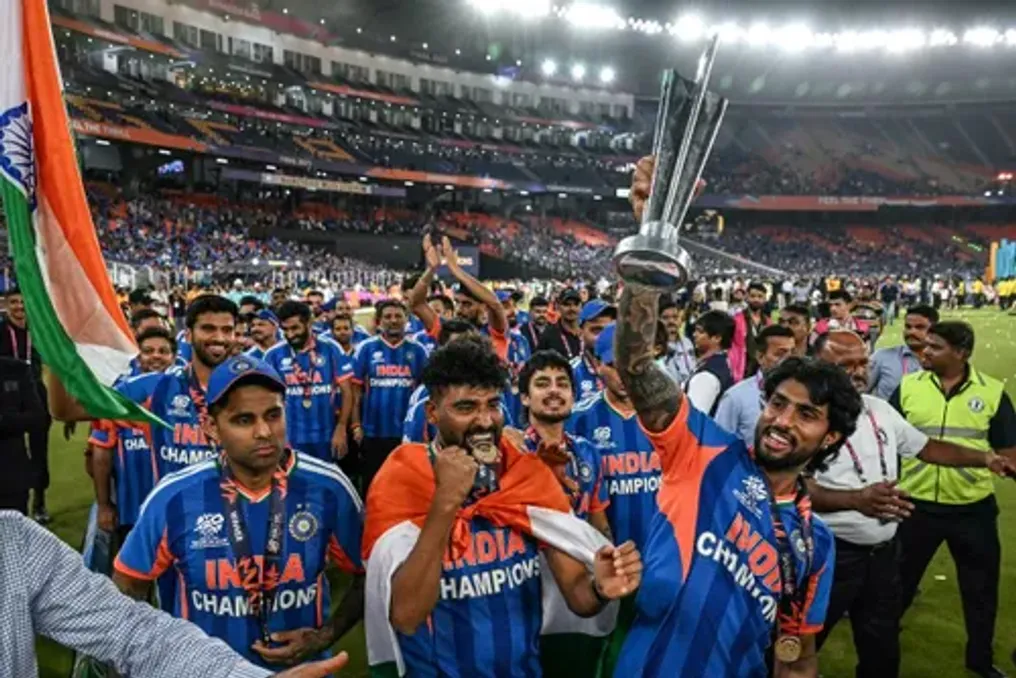
For the first time, the full six-verse version of the anthem 'Vande Mataram' was performed before an international cricket match in India, and also before the national anthem. This event brought the historical song about freedom and long-standing discussions about patriotism, religion, and national identity onto the sports field.
The song, once used to mobilize Indians against British rule, has now become the subject of new debates on patriotism, moving from political rallies to the popular sport of cricket.
Before the T20 match between India and Afghanistan in New Delhi, players and spectators stood during the performance of 'Vande Mataram' before the international match in India, which happened for the first time—it was done before the national anthem. This six-verse version lasted over three minutes, placing the 19th-century song at the center of a modern debate on nationalism and religion in constitutionally secular India, home to 1.4 billion people.
Some Indian players sang the opening lines, but most remained silent, awaiting the national anthem that followed.
What is 'Vande Mataram'?
'Vande Mataram', which translates to 'Mother, I bow to you', is a poem written by Bengali author Bankim Chandra Chattopadhyay and first published in 1875. The poem is composed in Sanskrit—the root language of Hindi, which makes it difficult for many people to understand or sing.
The government stated in a 2025 declaration that 'the evolution of the anthem from a poetic work into a national song demonstrates the collective awakening of India against colonial domination.' Although 'Vande Mataram' was officially adopted as the National Song of India in 1950, it is not the national anthem; the national anthem is 'Jana Gana Mana', or 'People of all', which was also formally adopted in 1950. British colonial rule ended with the bloody partition in 1947, which created India predominantly Hindu and Pakistan predominantly Muslim.
Why does the song cause controversy?
The conflict centers on the later verses of the song. While the first two verses praise the motherland, subsequent ones mention Hindu deities, including Durga, Lakshmi, and Saraswati. In 1937, the Congress party approved only the first two verses for public use, aiming to accommodate India's religious diversity, including its large Muslim minority. Many Muslims object to the depiction of the nation as a goddess, arguing that such veneration contradicts Islamic teachings.
Why have the debates returned?
The issue has resurfaced due to several governmental measures increasing the official status of the song. In February, the Ministry of Home Affairs ordered that 'Vande Mataram' be performed or played in its musical version at the beginning of state events, prior to the national anthem. In July, Parliament passed legislation providing for fines or imprisonment of up to three years for those who intentionally violate or obstruct its performance. This directive was applied to international cricket in India for the first time before a match on Sunday.
How has the dispute developed?
The ruling Hindu nationalist Bharatiya Janata Party (BJP) accused the opposition Congress party of weakening the symbol of the struggle for freedom. Congress insists that only the first two verses should be sung, adhering to the long-standing political compromise. This dispute has moved beyond television studios and parliament, entering public events where commentators and politicians discuss whether singing the full version constitutes a test of patriotism.
Prime Minister Narendra Modi, leader of the BJP, stated in a message on a special website created for the song last year for its 150th anniversary: 'If patriotism and love for Mother India are felt inexpressibly, then 'Vande Mataram' is the song that gives concrete expression to these feelings.'
Why is this important?
This dispute has become part of a broader discussion on nationalism and religious identity. Supporters view 'Vande Mataram' as an enduring symbol of anti-colonial struggle and national pride. Critics argue that a song containing explicit Hindu religious imagery should not be used to define patriotism in a multi-faith country.
The BJP under Modi promotes the ideology of 'Hindutva'—the belief that Hindus represent not just a religious group but the true national identity of India. Professor Apurvanand of Delhi University, using only his first name, noted that the current pressure marks a departure from the consensus reached at independence, which limited the public performance to the first two verses. He told AFP: 'With the rise of 'Hindutva', they want to break this consensus. And they want to create a new consensus... by force of numbers.'