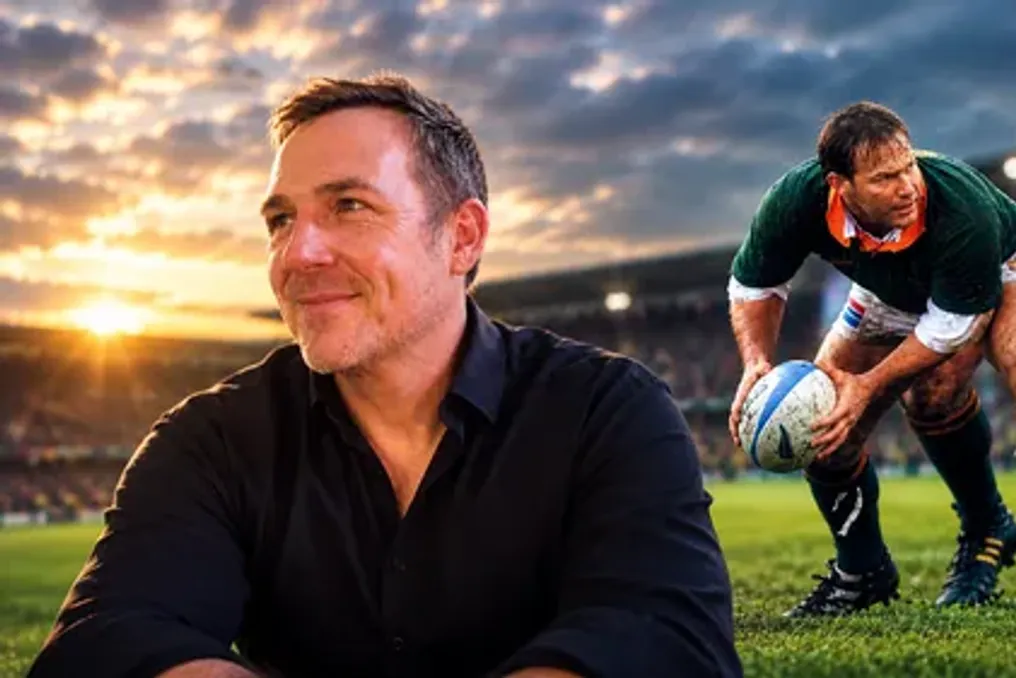
Rugby players reported that they were persuaded to invest hundreds of thousands of euros into the alleged takeover of the French club Béziers. Among those involved in this matter are agent Anthony Johnson and Johan Roux, a former South African national team player.
However, instead of acquiring Béziers, which is a second-division French rugby club, the collected funds were transferred to an Italian man's personal bank account in Poland, where a criminal case was initiated.
Rugby agent Anthony Johnson and Johan Roux, a former midfielder who played in 12 matches for South Africa between 1994 and 1996 and participated in the victorious 1995 Rugby World Cup team, told the players that their money was needed as an advance to 'unblock' a loan of 100 million euros, equivalent to approximately 1.9 billion rand, which was supposed to be used for the full purchase of the club.
Nevertheless, both men claim that although they presented this deal to the players, they themselves became victims of circumstances. Johnson described his life as a nightmare he works around the clock to 'fix,' while Roux stated that this crisis cost him his marriage.
The men reported that they invested their own funds in the deal and remain hopeful of recovering this money, although Roux refused to provide proof of his payment or disclose the amount he allegedly invested.
The former forward for the Sharks team recounted that after depositing 120,000 euros, amounting to about 2.2 million rand, based on a promise made in October 2021, the situation turned into a 'damned clown show.' He requested anonymity to avoid public scrutiny of the case.
This player stated that he was introduced to the scheme through a Zoom meeting organized by Johnson, his agent of 15 years, to which Roux later joined. He added: 'Anthony organized the Zoom meeting, and Johan joined later. Anthony asked me to pay the money, and Johan was behind it. Since I haven't received any money after five years, my lawyers helped me file a criminal complaint with the Polish police.'
The agreement signed by the player stipulated a 30-day period. After this period, he was supposed to receive his 120,000 euros along with 80,000 euros in interest, totaling a 66% return in just one month. However, the deadline passed, and he received neither the investment nor the promised interest.
Another rugby player, who also wished to remain anonymous, reported a similar investment opportunity and suggested that the method of operation was likely analogous. He noted that he did not want to make a public statement because he feared losing the chance to recover his money.
Both players speculated that it was a 'rob Peter to pay Paul' scheme, where money collected from each new player was used to cover up previous ones.
Johnson is a rugby agent accredited by the Rugby Football Union in England and also the director of the SA Rugby Agents Association. He has been living in France for the last few years.
Former Springbok midfielder Roux now manages Global Sport Capital, which, according to him, invests in sports and related enterprises. He told IOL that the players' money was never intended for the rugby club, although he confirmed that the players were told otherwise.
'To get loans, you need collateral, right?' he said. 'So this money went towards activating the collateral so we could get the loan.'
According to the plan, the players' money was used as security to convince the bank to issue a much larger loan, which was then supposed to be directed towards buying Béziers. The realization of the plan depended on Global Sport Capital obtaining the 100 million euro loan, which would then acquire the club. However, the loan was never issued, and the club acquisition did not materialize.
When IOL asked Roux what the collateral was and who held it, he refused to disclose this information.
During one of the Zoom meetings where the deal was presented, Roux told the player that he was part of a bank where the money would go—an organization called Eurokredit Merchant Bank. He stated: 'I [am part of] Eurokredit Merchant Bank, it is a merchant bank that we obtained in Italy and Poland.' He continued: 'Now we are short 120 thousand, and we need you to transfer it tomorrow. For 120 thousand, we are ready to return 200 thousand. We will probably return it to you within 15 days. You are dealing not with some small player. This is a registered merchant bank.'
Later, at a meeting, the forward expressed concerns about taxes that would have to be paid in France on the 80,000 euro profit. Roux suggested channeling the funds through Cyprus, Poland, or Latvia. He also assured him that the CEO of the Cypriot bank personally supported this scheme. 'They don't care which government knocks on their door; they will never open their books to them.'
When asked about such a proposal, Roux told IOL that he does not handle other people's money. The forward signed the agreement on October 28, 2021, and had 24 hours to pay. He made the payment the following morning in 12 installments of 10,000 euros each. Each transfer was made to the name 'EMB Antonino Pane' and marked with the French word 'pret,' meaning 'loan.'
Pane is an Italian citizen who calls himself the CEO of Eurokredit Merchant Bank and provides an address in Sorrento, southern Italy. The account to which the money was transferred was in his name at the Alior bank in Warsaw, Poland.
IOL's investigation, based on the signed agreement, bank records, five years of correspondence, corporate documents from three countries, and three audio recordings, established that the deal promised the player insurance coverage of at least 1 million euros, equivalent to about 18.7 million rand, from a company named 'Heuler Hermes' in the agreement. However, a company by that name does not exist. The corresponding trade credit insurer—Euler Hermes, now operating as Allianz Trade—was asked by IOL whether a policy was ever issued in connection with this deal.
The invoice indicating where to send the money was dated a week before the agreement was signed. A year after the payment, Roux signed another document in a strikingly similar format, this time guaranteeing the return of advance payments made by a Hong Kong company for loans that never materialized.
All eight South African companies in which Roux is registered as a director have been liquidated or are in the process of liquidation. Global Sport Capital is not registered in South Africa at all. Roux told IOL that the company that will become Global Sport Capital is an American public company of which he is chairman.
Roux himself named three people behind the deal in a recording: 'We are busy with the deal: me, Anthony, Rudi Huber (sic).' Huber is a former Bulls coach who was part of the Springbok management team at two World Cups. Roux told IOL that he received written instructions from Pane to collect funds but did not present this instruction. He claimed he does not hold a stake in the bank, invested more than the forward, but refuses to disclose the amount or confirm whether his own money went to the same account.
'I was directed,' Roux said. 'Eurokredit is essentially a bank that was supposed to finance me. I mean, I also invested money in it. But currently, I am neither a shareholder nor an employee of Eurokredit. Why isn't he suing Eurokredit if he wants his money back? It's a business deal.'
Roux himself did not sue the bank. He was confident in the safety of his money and continues to raise funds. Initially, he claimed he had never seen the player's signed agreement, but later admitted to seeing it.
Meanwhile, Johnson told IOL that he lost about 100,000 euros, equivalent to about 1.9 million rand, of his own money in this deal and found himself in the same situation as the players he recruited. He stated: 'I have nothing to do with EMB [Eurokredit bank]. I do not work for EMB. I do not work for EMB. In fact, I personally invested in this, and I am in the same situation as [the Sharks forward] and the other guys.'
He explained that Rudi Huber introduced him to Roux. 'So, Rudi approached me with the question of finding a club and everything else. I met Mr. Roux later. I worked with Rudi. We met with clubs. We had meetings with mayors and club presidents. He handled the financial matters with Johan. I know the idea was to make the rugby club 100%. But obviously, it never reached the rugby club because it was never bought.'
Johnson provided IOL with evidence, on condition that it not be published, of three payments totaling 91,500 euros, equivalent to about 1.7 million rand, sent to Pane's account in Warsaw from an Irish company owned by him. He also confirmed that another player's money passed through his company's account on its way to Pane. It is unclear whether the money invested by Johnson was his own or belonged to other players whose funds passed through the same account. Nothing in the payment documents provided distinguishes one from the other.
In the second audio recording listened to by IOL, Johnson discussed the club purchase and raising additional funds for it. Johnson is heard saying that he cannot openly have an interest in the club due to his job and cannot appear to be doing so. Agents generally do not have the right to a financial interest in the club into which they bring players, as this could put them in a position of being on both sides of the same deal.
Johnson informed IOL that the agreement yielded no results because the club was never bought. He stated that there was no conflict of interest because he is not licensed as an agent in France and did not disclose this agreement to any accreditation body.
Huber, 64, told IOL that he flew to France at his own expense, organized meetings in Béziers, and accompanied Johnson to a meeting with the city mayor. He was expected to become the club president. Huber reported spending about 500,000 rand on travel and legal expenses on behalf of Roux and received nothing in return. He also stated that he never met Pane. 'I was not involved in financial operations at all. I was not in that role. I only negotiated rugby matters,' Huber said. 'I know the players acted because they knew me and my reputation as a person of integrity. I have been a professional rugby coach all my life. I coached the Springboks. I participated in three World Cups. I am 64 years old now, and I am the head of the sports department at a middle school. I had to start over. I had to move to a small town. I sold my car.'
Between February and June 2022, the player received four letters, each accusing something new of delaying the payment. They were written and signed by Pane but forwarded by Roux.
In February, he wrote that an investment of 800,000 euros, equivalent to about 15 million rand, was about to close, and that a two-billion bond was secured for a 450 million euro offer, equivalent to about 8.4 billion rand, for a sportswear group. This letter also mentioned Roux's company.
Roux told IOL that such a purchase never happened. In March, Pane blamed US banks worried about Russia and promised payment on a date that was two years prior. Eleven days later, he apologized and pointed to a firm in New York. 'I will get back to you with exact payment dates, and it won't change anymore,' he wrote. But the date changed again. In June, he blamed the war in Ukraine, saying funding would come from China, and promised to settle everything by early July with a bonus on top. Nothing was settled, and no bonus was paid. Questions were directed to Pane and the Polish police.