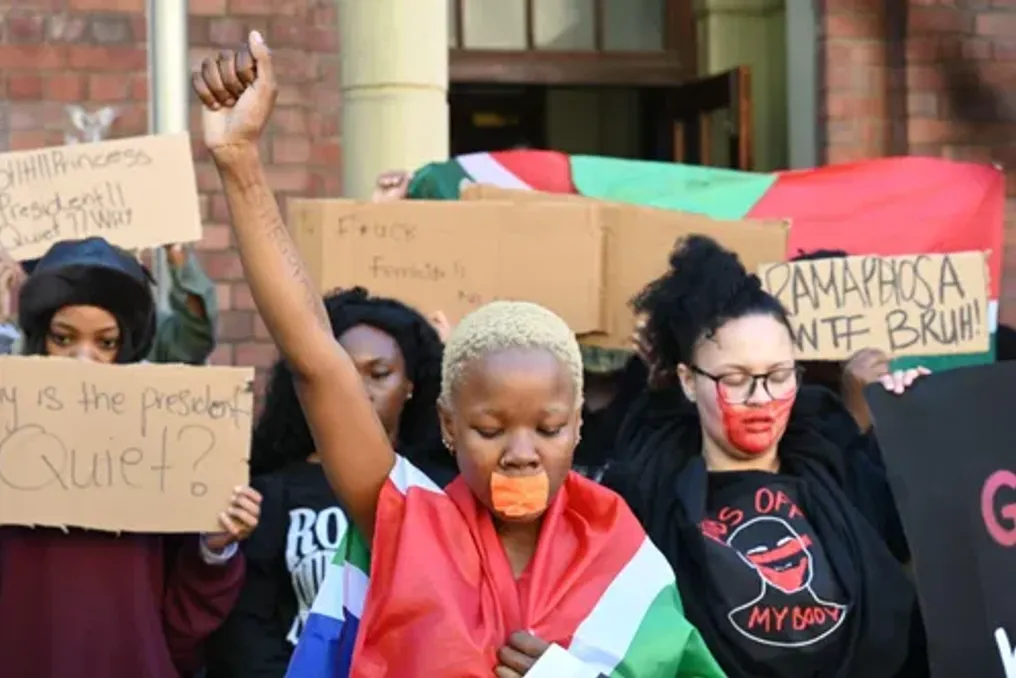
Street demonstrations took place in South Africa in memory of women killed in eKhuruleni, accompanied by growing demands to take action against gender-based violence (GBV). Dr. Iqbal Surve asserts that preventing femicide requires the involvement of men, improvement in public services, and increased government accountability.
The author of the letter, speaking not as a businessman or organizational representative but as a South African man, father, and brother, expresses deep concern over what is happening to women in the country. In recent weeks, residents of South Africa have again faced horrific discoveries of women's bodies in eKhuruleni; nine female bodies were found in approximately two months as of September 17th.
It is necessary for the police to establish the circumstances of each case and determine if these deaths are connected. However, even without further investigations, it is evident that there is a femicide crisis in South Africa.
Femicide, defined as the killing of women and girls based on gender, is the most brutal end to violence against women because there are no survivors left to consult or intervene in time. There is only a body, a grieving family, and the future of another woman that has been taken away.
Statistics should shame us
South African statistics are deeply alarming. Parliament reported earlier this year that the femicide rate in the country is around nine women per 100,000 people, which is approximately five times the global average. Studies also show that many women die at the hands of intimate partners, meaning the danger can come from an acquaintance, trusted, or loved person.
However, it is also necessary to acknowledge another reality: cases of women being killed by strangers. A woman cannot recognize warning signs from a stranger she has never met, nor can she obtain a protection order or report threats that he has not made to her. When the predator is a stranger, the responsibility for prevention falls even more heavily on the systems around her: visible patrolling, functioning public infrastructure, effective investigation, and the ability to identify crime patterns. Preventing femicide should not become an additional obligation of potential victims.
Men, we need to talk to each other. Of course, not all men commit violence or abuse women, but this should not limit our contribution to this conversation. Since men constitute the overwhelming majority of perpetrators of violence against women, they must play a much larger role in its prevention. We cannot leave women to fight femicide alone.
For decades, women have marched, protested, and demanded stronger legislation. Women share their locations and convey a familiar message: 'Let me know when you are coming home.' As men, we must ask ourselves: why did women have to change their lifestyles so drastically while violent men have changed their behavior very little?
The ability to say, 'I have never harmed a woman,' is no longer sufficient. We must be ready to challenge the man who does. Friendship, family loyalty, and silence cannot serve as shields behind which violent men operate. If your friend beats his girlfriend, it is not just a 'relationship problem.' If your brother threatens his wife, it is not just a 'family matter.' Threats, stalking, and escalation of violence must be taken seriously. Sometimes the warning signs appear long before the funeral.
Prevention must start with our boys. If we are serious about ending femicide, prevention must begin long before a man becomes an aggressor. It must start with our boys. As fathers and men, we cannot shift the responsibility for raising boys onto mothers, teachers, or society and then ask what went wrong. Raising a child requires the participation of the entire community, and this community cannot neglect its boys.
We must teach our sons that strength is not aggression, rejection is not humiliation, women are not property, but empathy, respect, and self-control are qualities of manhood. The mind possesses immense power. Children learn from what they see, hear, and constantly experience. Upbringing alone does not cause femicide, but prevention cannot begin only after violent behavior has become entrenched. Men who hold influence today must act in government, business, communities, schools, religious institutions, and homes. Fathers must act. Brothers must act. Friends must act. If we want to eradicate femicide, we must help shape the boy before society is forced to confront a violent man.
The government must answer difficult questions
We must ask ourselves an uncomfortable question: have we allowed parts of South Africa to become a playground and sanctuary for criminals and femicide perpetrators, places where predators believe they can hunt women, disappear into abandoned areas, and act without fear of being caught? The government bears an inescapable responsibility. In November 2025, Gender-Based Violence and Femicide were officially classified as a national disaster, which was an exceptional recognition of the seriousness of this crisis.
Nearly a year later, South Africans have the right to ask: what has materially changed? Prevention must mean more than reacting after a woman is murdered. Government and municipalities must create conditions where predators have fewer opportunities to act. Overgrown public spaces, broken streetlights, dark pedestrian routes, and insufficient visible patrolling make communities more vulnerable. Police stations need adequate staffing, operational vehicles, and resources for community patrolling and rapid response.
Equally worrying are the accounts of women who report attempted abductions or frightening encounters and provide potentially valuable evidence, including video recordings, vehicle descriptions, and registration details, but feel that their complaints are not being taken seriously. These reports must be properly investigated. The SAPS cannot afford to ignore credible information that could identify a potential predator. A report dismissed today might contain a warning that saves another woman's life tomorrow.
We cannot call on women to report suspicious behavior if they are not sure their reports will be taken into account. And we cannot tell them to avoid dark streets, accepting the fact that streetlights are not working. These shortcomings do not cause femicide; the responsibility always lies with the perpetrator, but the government is obliged to reduce opportunities for predatory violence and ensure the investigation of credible warnings. The government cannot only become visible after a woman's body is found. By then, prevention has already failed.
We cannot get used to burying women. Perhaps what worries me most is the danger that South Africa will become numb. We know this cycle: a woman disappears. Her photo circulates. Her family begs for help. Then comes the terrible announcement: her body is found. Outrage arises, a call for justice, and then—the funeral. After that, the country moves on until another woman disappears. We cannot allow this to become the rhythm of life for South Africans. Femicide is not a women's problem. It is a South African crisis.
Seventy years ago, brave South African women marched to the Union building and gave generations the words: 'Wathint' Abafazi, Wathint' Imbokodo' (A blow to a woman is a blow to the stone). But why must our women constantly be stones? Women must have the freedom to walk home, go to work, run alone, go on dates, break up with partners, and say 'no' without fearing that exercising these freedoms could cost them their lives. South Africa has asked for too long: how many more women must die? Perhaps that is the wrong question, because every time we ask it, another family has already paid the price.
The more complex question, especially for us men, is this: what are we going to do differently before another woman dies? Prevention must start with the boy, continue with the man, and be supported by the surrounding community and state. Women have fought this battle for too long. Men must stand beside them, challenge other men, and raise the next generation differently. As a South African man and father, I cannot accept that fear and femicide will become normal features of life for the women with whom we share this country. None of us should allow it.