Since the entry of Generation Z into the corporate job market, significant changes have been observed in their attitude towards work. Many members of this generation strive to establish a clear boundary between their professional and personal lives. The core principle is that work tasks should remain within working hours, and personal time should be completely free. This is precisely why the culture of constant work after business hours is unacceptable to them.
It might seem illogical for someone to remain available for work-related issues during personal time after a 9-10 hour shift; this can cause significant irritation. In such situations, many young people question job openings, even when they are in need of employment, if they have to sacrifice work-life balance.
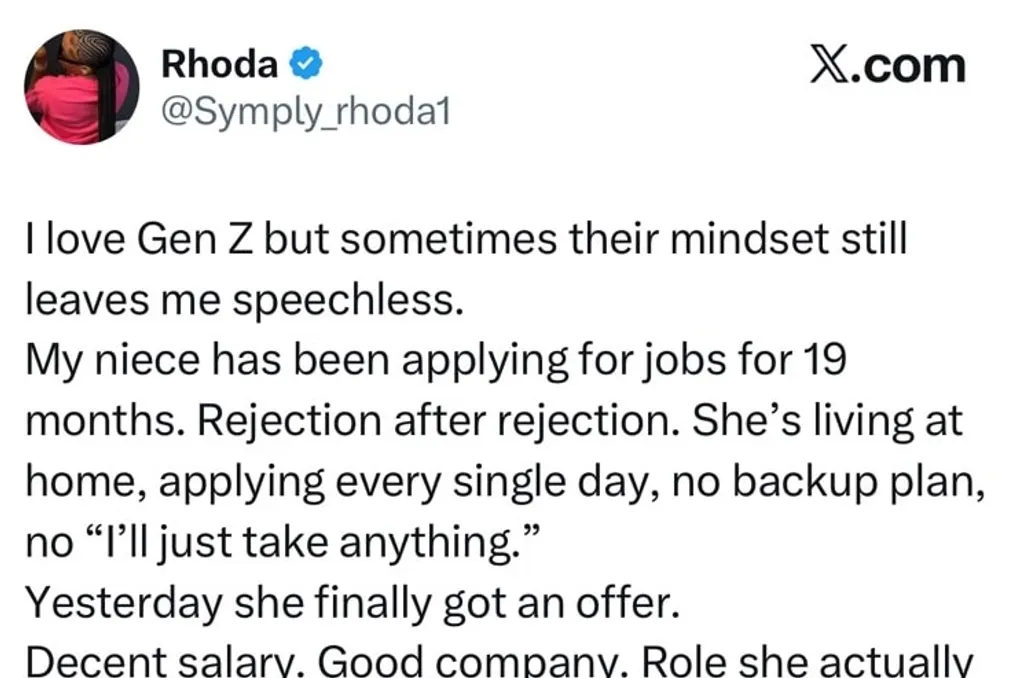
Recently, a user named Rhoda shared an experience on the social network X that quickly went viral. Rhoda noted that she likes Generation Z and communicates well with them, but sometimes she fails to understand their way of thinking.
She cited her niece, who had been looking for a job for the past 19 months. Despite numerous applications, she constantly faced rejections and had no backup plan. Eventually, she managed to secure the desired position at a good company: it offered a decent salary, a suitable role, and a reputable company—everything met her expectations.
However, the hiring manager presented a condition: employees were expected to be available on Slack several times a week after 9 PM if any task arose. She was faced with the question: is it worth sacrificing work-life balance for the desired job?
After long consideration, she asked the manager, 'Am I getting paid for this extra work?' The manager replied with a smile, 'No, it's part of our culture. We all do it.' Following this, Rhoda's niece firmly stated, 'Then I will have to decline this offer.'
An awkward silence fell during the conversation. Then the manager asked her why she was still not accepting the offer, considering she had been looking for a job for almost two years. Her answer was that, after experiencing a long period of unemployment, she no longer wanted to spend the next few years on a job that would mentally exhaust her. As a result, she rejected the job offer.
According to Rhoda, her niece never once considered taking the job. Linking this entire experience to Gen Z boundaries, Rhoda wrote that this generation is very conscious of its personal peace and comfort, even despite financial needs.
Rhoda's post went viral and received thousands of likes. Nevertheless, opinions on this decision were divided. Some users criticized the rejection of the job offer, arguing that she could have started working, improving her skills, and then seeking better opportunities. Others supported Rhoda's niece's decision, emphasizing the importance of setting personal boundaries.
This dialogue presented an interesting picture of Gen Z's worldview in the sphere of labor: for many young workers, the question of how much one must compromise personal boundaries despite the need for work has ceased to be simple.