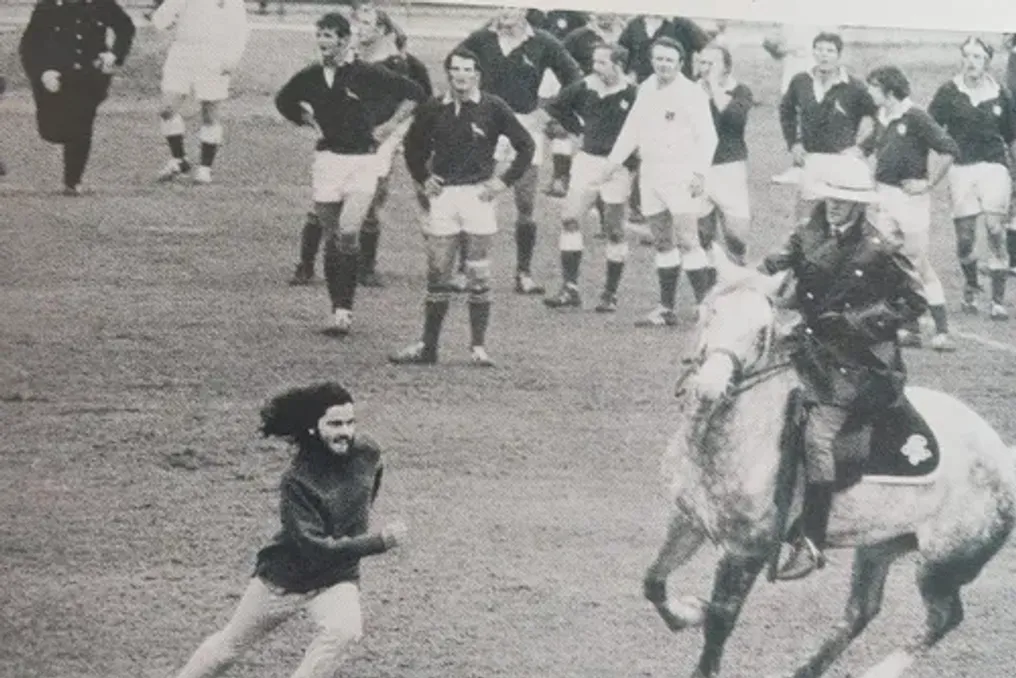
During the Springboks' tour of Australia in 1971, players faced extremely difficult conditions, including the need to avoid police pursuit and demonstrations. Imagine a match where national anthems and pre-game entertainment are absent, and the field is surrounded by barbed wire and police officers, some mounted on horses.
This grim atmosphere accompanied a series of matches in which the Springboks defeated the Wallabies 3-0. Hannes Marais' team from the '71 class became fugitives from the moment of their secret arrival in Australia after midnight. To deceive the waiting demonstrators at Perth Airport, the players hid their jackets under cloaks and removed their Springboks ties.
Thus began the 16-match tour, which earned Marais' team the title of 'Invincibles.' They won all 16 encounters, including three matches in the series against the Wallabies, becoming the only Springboks team in history to return from a full tour—series matches and friendly games—without a single loss. Although many outstanding Springboks teams have won Grand Slams in Europe, they always lost at least one game to provincial rivals.
The famous South African radio and television commentator Kim Shippy described this period as 'the sweetest hell the team knew for six weeks of sun, sweat, and tears,' alluding to the anti-apartheid demonstrations that pursued the South Africans at every turn.
To avoid crowds of demonstrators at airports, the Springboks traveled across the country on four small planes. After Perth, their next stop was Adelaide, where cunning police misled the opponents by placing officers in the main terminal while the Springboks landed on a secondary runway, from where private cars collected them.
Nevertheless, about 500 demonstrators gathered at the team's hotel in Mayfair, drumming, whistling, throwing fireworks, and chanting: 'Paint them black and send them back.' Furthermore, there were food supply issues. Australian unions banned the delivery of provisions to the Springboks' hotels, and the Mayfair hotel had never hosted a rugby team and lacked sufficient stock. As a result, the Springboks were forced to eat rations, and they were shocked to discover that breakfast consisted of only two eggs and one sausage.
After defeating Western Australia 44-18 and crushing South Australia 43-0, they headed to Melbourne. The chief organizer of the demonstrators, Bishop Edward Krauser, stated: 'They are forced to use the back door, just like they treat their Black homes. They know they are not welcome in Australian airports as ordinary tourists.'
Police warned of the high level of organization of the anti-Springboks faction in Melbourne. As an extreme measure, the Springboks were housed in the homes of rugby enthusiasts, as their luxurious hotel had become a target. The players accepted this calmly, as they were guaranteed enough food, prepared at home.
Since the South Africans were keen to see Melbourne and shop, the city mayor devised a plan. He invited the Springboks to a reception, and instead of wearing their jackets and ties, they came in casual clothes borrowed from the hosts. According to Shippy, they looked like the most diverse group ever to attend a civilian event, resembling the unruly demonstrators themselves.
Another striking moment was watching the television broadcast of the women's Wimbledon singles final. Since television only arrived in South Africa in 1976, this was the first live sport these young people had seen on screen. There was huge excitement, as it was the final between 19-year-old newcomer Evonne Goolagong and reigning champion Margaret Court. The young woman won.
The Springboks' victory over Victoria that week was overshadowed by 2000 demonstrators who threw stones wrapped in nails, lead-cased firecrackers, and tennis balls with attached nails onto the match. The evening banquet after the match was cancelled, which delighted the players as it allowed them to watch the men's Wimbledon final. Chaos reigned in Australia when local hero John Newcombe defeated American Stan Smith in a tense five-set match.
In Sydney, the Springboks could not stay in private homes and remained at the Squire Hotel, where they were surrounded by protesters. The players watched the police and picketers argue over what constituted a breach of public order, which largely took on a comical character. As they grew accustomed to the attention, including regular live reports from mobile cameras, one player remarked: 'At least the female presenters look decent.'
The team participated in a limerick contest for the newspaper. The winning entry read: 'A sea serpent saw a big tanker / Bit a hole in its side and sank it / Devoured the crew in a minute or two / Then polished its teeth with an anchor.'
Every Springboks team has its minstrel, and fullback Ian McCallum set music to this poem, playing it on the guitar. Being young men, the Springboks also visited the notorious red-light district of Sydney, Kings Cross. Their eyes were saucer-sized, but Shippy says they had fun. They joked with girls on the streets and bought magazines banned in South Africa. Veterans who had been to London claimed that the clubs in Cross surpassed Soho. 'It's not that they go further,' argued the priest's son, 'it's just that they have prettier girls and they are more enthusiastic.'
The humor vanished before the Springboks moved to Brisbane, when Queensland declared a state of emergency. The newspaper The Mirror was stunned: 'This is the worst thing that can happen. The Springboks will feel right at home in a police state.'
The justification was that police intelligence services discovered demonstrators planning to use marble rifles, similar to how the IRA operated in Northern Ireland, as well as tear gas and smoke bombs during the three Springboks matches in Queensland.
In Brisbane, the Springboks stayed at the Tower Mill motel, on a hill overlooking the city. Demonstrators initially entertained by singing 'Tower Mill is falling down, falling down...', but the situation escalated. After hours of provocation, a breaking point was reached when a stone broke the window of the police chief's office. Police used force to disperse the demonstrators, and although there were no serious injuries, blood was shed.
Against this unusual backdrop, the Springboks continued to do what they had come to Australia for. As Rasís Erasmus later said more than five decades later, they allowed 'the best to remain the best.' They won all 16 games and confidently outperformed the Wallabies in three series matches. The third match was particularly poignant, as it marked the farewell of perhaps the greatest Springbok freak, Du Prez, who announced his retirement before the tour. He was 35 years old and played 38 matches after debuting in 1961. Du Prez was naturally sociable and a charming storyteller, but after his last match, emotion paralyzed him. When team members spoke of him, it was his turn. But words failed him. The room fell silent. No one tried to cheer him up. Shippy wrote: 'In the silence they showed him their respect, and in the silence he acknowledged their adoration. It was the most eloquent non-speech I have ever heard.'